The Bala Housing Challenge: A Ready-Made Opportunity Ana Bailão and the Carney Government Can’t Afford to Miss
Serviced land, municipal approvals, and cross-party support give Build Canada Homes a rare, low-risk opportunity to turn policy into homes. Fully backed by the Royal Canadian Legion, the Bala project is a high-impact test — if this “gift” can’t get built, what hope is there for Canada’s broader housing plan?
Canada’s housing crisis did not appear overnight — it was built, decade by decade, through misaligned policy, fragmented programs, and supply that consistently lagged behind demand. Today, the country faces soaring rents, shrinking affordability, and a generation of Canadians struggling to enter the housing market. Amid this reality, the Bala Legion Heritage Manor in Bala, Ontario, presents a rare, fully serviced, and fully municipally approved opportunity to deliver homes quickly. Backed by the Royal Canadian Legion, supported across party lines, and ready for construction pending federal funding, Bala is a “gift” for Build Canada Homes. If Ana Bailão and the Carney government cannot make this project a reality, it raises a stark question: what hope is there for the broader national housing plan?
The scale of Canada’s housing shortage is staggering. The Canada Mortgage and Housing Corporation estimates that restoring affordability requires 430,000 to 480,000 housing starts per year for the remainder of the decade. Yet even in the strongest years, starts hover around 240,000 to 270,000 units. Population growth has surged to record highs, largely driven by elevated immigration targets. In some years, Canada added over a million residents — one of the fastest growth rates in the developed world. The arithmetic is unambiguous: demand has consistently outpaced supply.
Under the Trudeau government, housing was repeatedly positioned as a political priority. The 2017 National Housing Strategy promised $40 billion in transformative spending. Later programs added rental financing tools and the Housing Accelerator Fund, culminating in a 2024 pledge to enable the construction of roughly 3.9 million homes by 2031. Despite the fanfare, completions consistently fell short. Committee testimony has shown why: federal programs emphasized financing rather than direct construction, municipal zoning and permitting processes remained slow, skilled-trades shortages constrained output, infrastructure bottlenecks limited density, and population growth consistently exceeded new supply. Ottawa expanded demand while hoping supply would catch up.
Opposition Leader Pierre Poilievre and Conservative housing critic Scott Aitchison have framed the issue as a failure of execution rather than intent. In committee, Aitchison highlighted the shortcomings while offering practical solutions and constructive guidance to help Build Canada Homes succeed. He noted, for instance, that a federal lands initiative with $200 million allocated for 4,000 units produced only 309 homes. “…a federal lands initiative… was given $200 million… for 4,000 units. Only 309 units of the 4,000 have been built.” He went on to suggest ways to accelerate federal land transfers and improve municipal coordination, demonstrating a willingness to collaborate rather than simply criticize.
In 2025, the Carney government created Build Canada Homes (BCH), a federally backed agency with roughly $13 billion in initial funding and a mandate to move from policy announcements to actual construction. Ana Bailão, the agency’s president, emphasized that BCH would focus on supportive, transitional, social, and affordable housing; unlock surplus federal lands; partner with municipalities, non-profits, and private developers; and streamline approvals to accelerate project timelines. “Build Canada Homes will be focused on supportive, transitional, social, and affordable housing… mixed income and mixed communities,” she told the committee, signaling a hands-on approach distinct from the past decade’s fragmented programs.
Even with this mandate, early projections from the Parliamentary Budget Officer suggest that BCH’s incremental impact may be modest, adding roughly 26,000 units over five years — far short of the half-million annual starts needed nationally. For the agency, credibility will be measured not in projections, but in tangible results. That test begins in Bala.
The Bala Housing Gift
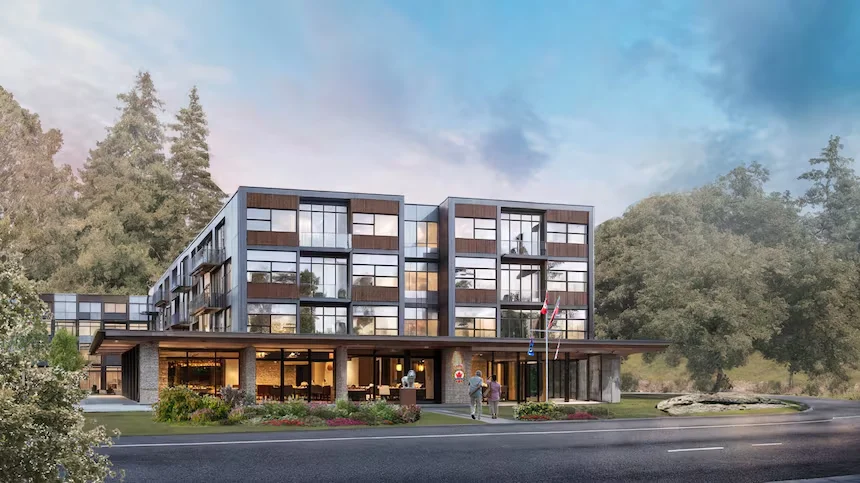
Proposed on land owned by Royal Canadian Legion Branch 424, the Bala Legion Heritage Manor site is fully municipally approved: zoning, site plans, and all infrastructure — water, sewer, and roads — are ready. The only remaining hurdle is federal funding to accelerate construction. In short, this project is ready to build.
What makes Bala exceptional is the alignment of stakeholders behind the project. The Royal Canadian Legion, which has more than 1,350 branches nationwide, fully supports the initiative. Like the Bala branch, many Legion properties are already connected to municipal water and sewer services and sit on underutilized land that could support similar mixed-use housing, creating a replicable model for affordable housing communities across Canada while revitalizing Legion branches for current and future generations. Conservative MP Scott Aitchison has been actively engaged, offering constructive support and practical solutions to help Build Canada Homes navigate potential bottlenecks and advance the project. This approach aligns directly with the mandate of Build Canada Homes under CEO Ana Bailão — accelerating affordable housing delivery through partnerships across government and community institutions, and prioritising projects that make strategic use of serviced land and existing infrastructure to build faster, smarter, and at scale.
Former Liberal MP Dennis Mills, president of the Bala branch and the driving force behind the project, has spent over a decade developing the plan, demonstrating both strategic vision and operational persistence. “I think the legion system could play a major role in reigniting affordable rental property in this country,” Mills has said, highlighting the national potential.
Bala is more than a local project; it is a litmus test. Fully serviced land, municipal approvals, cross-party political support, and community buy-in make this an opportunity few projects offer. If BCH cannot move forward here, it raises a difficult question: if a project designed for success cannot be delivered, what hope is there for federal housing policy elsewhere?
On February 2, Bailão and Aitchison discussed the Bala project at Canada’s House of Commons Standing Committee on Human Resources, Skills Development and the Status of Persons with Disabilities, exploring both challenges and solutions. The exchange underscored the collaborative approach that defines constructive criticism: identifying flaws while actively seeking to remove barriers. The discussion clip is available here:
Scaling Housing Nationally
Bala is a blueprint for replicable national impact. With more than 1,350 Legion branches, each with land that could accommodate housing, the federal government has the potential to deliver hundreds of mixed-income communities quickly and efficiently. Using existing infrastructure, municipal approvals, and trusted community institutions minimizes delays and demonstrates that rapid, scalable housing solutions are possible when strategy, government coordination, and local engagement align. Success at Bala would validate Build Canada Homes’ model, Ana Bailão’s leadership, and the Carney government’s “build big, build bold” approach.
Failure, by contrast, would highlight the systemic obstacles that have hindered housing delivery for years, even when all favorable conditions are met. Bala is not just a project; it is a test of whether Ottawa can finally turn housing promises into homes.
From Promise to Pavement
Canada’s housing crisis is the product of a decade of mismanagement, fragmented programs, and a failure to synchronize population growth with housing supply. Carney’s government, through Build Canada Homes, has sought to move beyond announcements toward measurable results. Bala embodies that shift.
If Build Canada Homes can deliver here, it demonstrates that federal housing policy can produce real outcomes when barriers are removed and programs are coordinated. If the project stalls, it exposes persistent structural and bureaucratic obstacles. Ana Bailão’s mandate is clear: units built, not press releases. Scott Aitchison exemplifies constructive oversight, identifying obstacles while offering practical solutions. Dennis Mills and the Royal Canadian Legion provide leadership and infrastructure that could be replicated nationwide, creating a scalable model for affordable housing.
Canada does not need another housing announcement. It needs homes. Bala represents the first opportunity for Ottawa to show that federal housing policy can work.