The Canadians we Choose to Remember
By Ray Pennings
City council’s decision to rename Trump Avenue provides an opportunity to think about the Canadians we choose to honour. The street belongs to a neighbourhood with New York-inspired names. Canada’s own history offers plenty of people whose contributions deserve a place in our daily surroundings.
The names we give public places help each generation understand the country it inherits. A school named for someone who served a community gives teachers and parents an opportunity to explain why that service mattered. Children can see how their own contributions might matter too.
We could give more thought to those opportunities.
Consider Canada’s airports. The names of former prime ministers adorn several of them, while just three Canadian airports—Toronto’s Billy Bishop, Inuvik’s Michael Zubko, and Sarnia’s Chris Hadfield—remind us of those who made contributions in other fields.
Schools offer a useful opportunity because their names become part of children’s everyday vocabulary.
Among Ottawa-Carleton District School Board schools, roughly three-fifths bear the names of streets or neighbourhoods. Politicians and royalty account for another substantial group. The board’s schools include people whose accomplishments lie outside politics, although recent examples are harder to find.
Steve MacLean Public School opened in 2006. Its namesake, a physicist and astronaut, became the first Canadian to operate Canadarm2 in space that same year. Students from the school even had an opportunity to ask him questions while he was aboard the International Space Station. The encounter illustrates what a name can make possible.
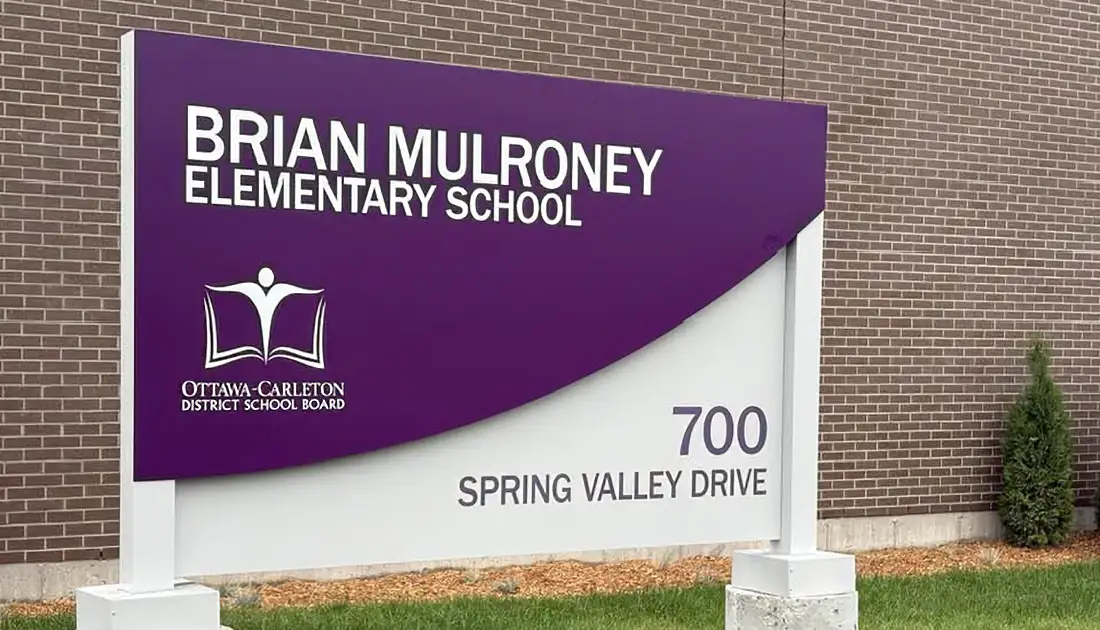
Brian Mulroney Elementary School opened this September, a name chosen by the province. Mulroney’s career offers students much to learn about public service and the difficult judgments governing requires. Future school names could give similar attention to Canadians whose service took place beyond elected office.
That requires some effort after the sign goes up. A school could display a short biography near its entrance and revisit the story during the school year. Thinking beyond schools for a moment, commemorative street signs could direct residents to an account of significant contributions by our fellow citizens. Ontario’s bridges honouring police officers killed in the line of duty would mean more to passing motorists if their stories were easier to find.
These are modest ways to cultivate gratitude. Much of what we enjoy depends on people whose work preceded our own. Learning about them helps us recognize our responsibility to those who will follow.
Choosing someone to commemorate requires judgment about both their contribution and their conduct. Communities should be able to explain that judgment publicly, including any serious failings. A policy that routinely avoids using personal names misses an opportunity to teach young people how to make those assessments.
There is also room to widen our understanding of whose work deserves recognition.
William Teron, for example, helped create Kanata and later led the Canada Mortgage and Housing Corporation. His work offers students a way to consider how decisions about housing shape the lives of families and the communities they inhabit. His support for educational and artistic institutions adds another dimension to that story.
Each community will have their own candidates — those who established charitable institutions or helped neighbours through difficult circumstances. Inviting those suggestions could itself become an exercise in discovering the history of a place.
Renewed interest in Canadian identity gives us a reason to take this work seriously. Affection for a country grows through familiarity with its people and an appreciation of what they have contributed. Schools and municipalities can help that familiarity develop.
Author V. Gilbert Beers cautioned, “We live in a throwaway society; we dispose of things we consider a burden. My concern is that we do not add our predecessors to the collection of throwaways, carelessly discarding those who have made us what we are.”
By sharing honest accounts of our predecessors’ lives, we help children understand the inheritance Beers urges us to preserve and imagine what they might contribute for those who follow.