
• By: Allen Brown

The Global Classroom: Why Learning English in a Multicultural Environment Offers More Than Fluency

Canada has long been a beacon for those seeking world-class education, with international student enrolment in public colleges growing by nearly 400% in the last decade alone. This remarkable influx underscores the country’s reputation for academic excellence and its welcoming atmosphere. But for the hundreds of thousands who arrive each year to learn English, the most profound lessons often happen outside the textbook, sparked by the very people sitting next to them in class.

The journey to master a new language is about more than memorizing words and grammar rules. The environment where one learns—and, more importantly, the people one learns with—are critical components of the educational experience. Learning English in a deeply multicultural setting like Canada offers transformative benefits that traditional, homogenous classrooms simply cannot replicate, from developing genuine cultural fluency to building a lifelong global network that can shape a career.

The Ultimate Immersion: From Classroom Theory to Real-World Practice

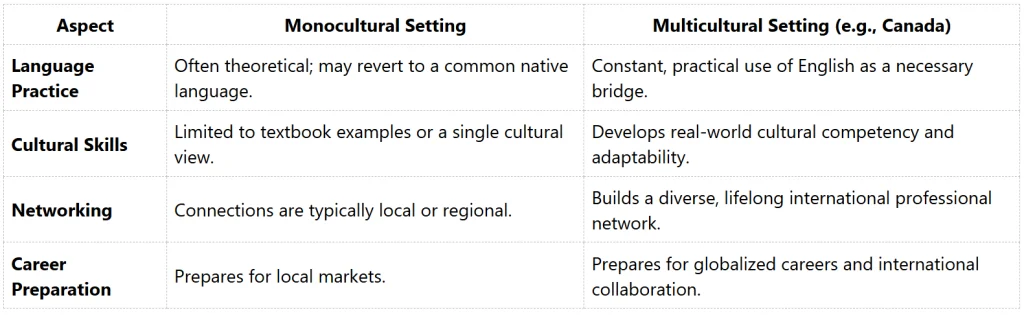
In a classroom where students hail from dozens of different countries, English instantly becomes more than an academic subject; it becomes a vital tool for connection. When no two classmates share the same mother tongue, English serves as the sole bridge for communication, both for group projects and for forging friendships over coffee. This constant necessity to express complex ideas, share personal stories, and navigate social situations in English accelerates practical fluency in a way that rote learning never could.

This immersive environment also prepares students for the reality of English as a global language. Hearing it spoken in a variety of international accents—from Brazilian to Japanese to Turkish—trains the ear to understand English as it is truly used in international business and travel. According to a 2024 analysis, English is the primary language of international business, and proficiency allows professionals to broaden their career opportunities at multinational companies where English is the standard. This real-world practice is invaluable preparation for a globalized workforce.

Key Ways a Multicultural Classroom Boosts Fluency

• Daily practice negotiating meaning with non-native speakers.
• Exposure to a wide range of accents, intonations, and cultural communication styles.
• Constant motivation to use English for building friendships and social connections.
• Reduced temptation to revert to a shared mother tongue with classmates.

Beyond Words: Developing True Cultural Competency

True communication extends far beyond vocabulary. A significant portion of interaction is non-verbal, and in a multicultural classroom, students learn firsthand to interpret different cultural norms, gestures, and social etiquette. This daily practice in cross-cultural understanding builds empathy and adaptability—skills indispensable to any international career. As one report on the topic notes, language is one of the clearest reflections of how a society thinks, and learning it in context is a way to understand how other people see the world.

This process of navigating new social and cultural situations also fosters immense personal growth. A survey by the AIM Overseas found that a remarkable 90% of students reported increased self-confidence after studying abroad. This boost comes from tangible achievements, such as building connections and thriving in an unfamiliar setting. Institutions that actively cultivate this diversity, such as the award-winning ILAC School, which welcomes students from over 90 nations, see it as a core part of their educational philosophy, creating a microcosm of the global community right in the classroom.

The Lifelong Advantage: Forging a Global Network

The relationships formed in a multicultural classroom often become one of the most lasting and valuable outcomes of the experience. The friendships made are more than just social; they evolve into a powerful professional network that spans continents and industries. Today’s classmates become tomorrow’s colleagues, business partners, and key contacts in international markets, providing a personal connection to opportunities worldwide.

This advantage is amplified by Canada’s welcoming policies for international graduates. Programs like the Post-Graduation Work Permit (PGWP) allow many students to stay in Canada and begin their careers, strengthening their local and global networks. The number of new PGWP holders surged to 243,294 in 2023, underscoring the number of students transitioning from the classroom to the Canadian workforce. This creates a diverse, highly-skilled talent pool that enriches Canada’s economy while giving graduates a solid foundation for their global careers.

Learning Environments: A Comparison

The New Standard for Modern Language Education

In an increasingly interconnected world, simply knowing the English language is no longer enough. The true advantage comes from learning it in an environment that reflects that world—one that is diverse, dynamic, and global. The skills gained are not just linguistic but social and professional, preparing students to thrive in any international context.

As a top destination for international education, Canada offers a unique model for this holistic approach. Students who choose to learn here leave with far more than a certificate of fluency. They depart with a deeper understanding of the world, a new perspective on communication, and a global community of friends and colleagues to call their own.

Image generated by Gemini