




• By: OLM Staff

The Haunting Backstory of Ottawa’s Newest Heritage Building

A clock, a creek, a grave and an old stone farmhouse — survivor of the Great Fire of 1870 and decades of suburban sprawl in modern Ottawa — recall a tragic moment in local history


By Randy Boswell

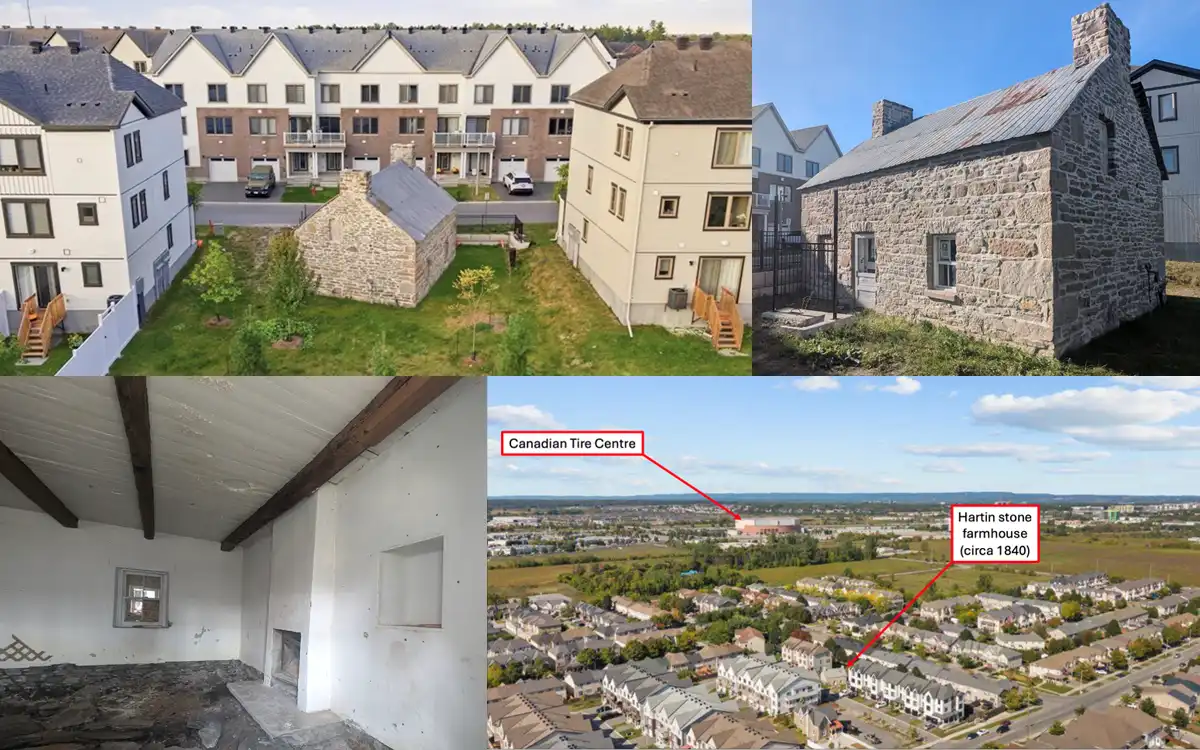
There’s a brilliant October sun pouring its light on an old stone farmhouse in Stittsville, a settler-era relic built 186 years ago and now surrounded on all sides — absurdly so — by freshly-built suburban homes, just a kilometre south of the Canadian Tire Centre.

Laura Tupper is reconnecting with the place she first visited with her father more than a half-century ago, back when this part of present-day Ottawa was still the southeast corner of historic Huntley township, and endless farm fields stretched out to the western horizon.

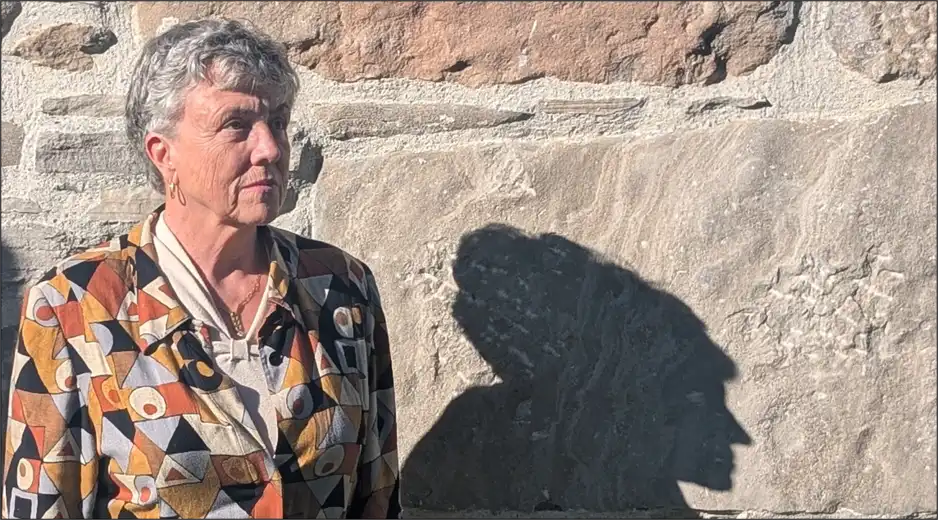
Now 70, the former Laura Hartin pokes her head in an open window of the squat, one-storey homestead, runs a hand along its rough outer wall. Then, as she turns, a sharply defined shadow is cast behind her.

Given the remarkable backstory of this building, which happens to be Ottawa’s newest designated heritage site, it’s hard not to imagine Tupper’s silhouette as the spectral presence of her great-great-great-grandmother, Margaret Hartin. Margaret lived with her husband Patrick in this house — what city heritage officials call the Hartin family “stone cottage” — for three decades in 19th-century Carleton County, from about 1840 until her tragic death by fire on Aug. 17, 1870.

Laura Tupper (née Hartin) first visited the stone cottage with her late father, Dr. Ken Hartin, when she was a young girl. Here, she learned about the tragic death — a century earlier — of her 74-year-old great-great-great-grandmother Margaret Hartin after retrieving a beloved clock from the farmhouse during the Great Fire of 1870. [Photo © Randy Boswell]


In a report to city councillors, municipal heritage planners praised the building as a “representative example of a mid-nineteenth-century vernacular stone cottage in Eastern Ontario. Typical of the typology, the building . . . features a simple rectangular form, side-gable roof, and off-centre entrance flanked by windows.”

Architecturally, it’s hardly a masterpiece. However, surviving structures of any kind from the first half of the 19th century are uncommon in Ottawa, where settlement had barely begun before the construction of the Rideau Canal between 1826 and 1832.

The rarity of stone farmhouses at the time it was built is clear from the 1861 census, which shows that nearly every other home for miles around the Hartin homestead was a log cabin. In fact, the city heritage report on the building states that just six of the 361 homes in Huntley Township in 1861 were made of stone.

The site, therefore, is an extraordinary remnant of Ottawa’s rural roots — a vestige of pioneer times that has somehow survived the urban sprawl of the late 20th and early 21st centuries. Simply put, there are precious few intact stone structures from the early days of Bytown within the present-day bounds of Ottawa.

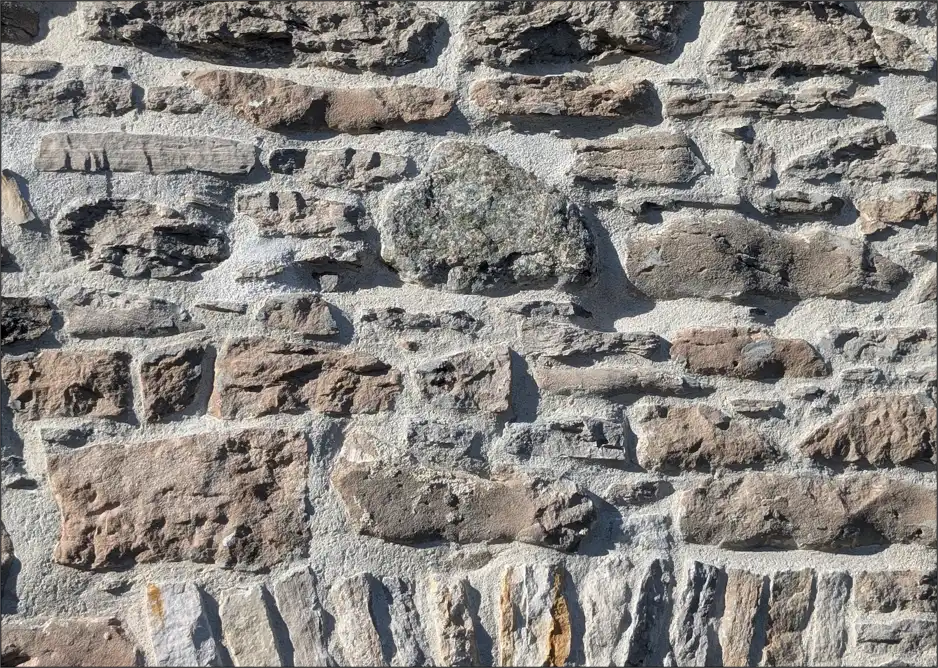
The Hartin family’s 1840s-era farmhouse was made mostly of stones from surrounding fields, mortared together in a simple style common for the era. Log cabins, however, outnumbered stone-walled dwellings by more than 50 to 1 at that time in historic Huntley township. [Photo © Randy Boswell]


But it’s the building’s historical associations that clinch its heritage value. The story of the Hartins — an important family in the Irish Protestant farming community that cleared and cropped much of Carleton County’s western countryside — is powerfully evoked by the enduring stone cottage. And Margaret’s story is the most compelling of all.

She almost certainly gave birth to the youngest of her nine children (Anna, in 1844) within its walls. She likely attended the birth of two of her grandchildren there, too (John Jr. in 1866 and James in 1868), at a time when her youngest son, John Hartin Sr., and his wife shared the house with his parents.

The same patch of land where the cottage sits — but in an earlier log house that was the Hartin home from about 1820 to 1840 — was where Margaret and Patrick’s eight other children (including John Sr., in 1832) were born. The farmstead was the setting, no doubt, for much happiness, sorrow and struggle as the immigrant Irish family pursued pioneer life in 19th-century Upper Canada, then (after 1841) in what was called Canada West, then (after Confederation in 1867) in the new Province of Ontario.

Finally, though, there was anguish. Margaret died horrifically at age 74 during the Great Fire of 1870 — a runaway bush, grass and cropland blaze that incinerated a vast swath of what is now Ottawa and Gatineau. The infamous inferno, which burned nearly every home, barn, livestock pen, tree, fence and telegraph pole between Pakenham and Nepean, left about 20 dead, hundreds of farm families ruined and thousands of people homeless.

Margaret, so the story goes, had rushed into the farmhouse to rescue a family treasure — a handsome wood-framed mantel clock — as the epic wildfire raged perilously close. According to family lore and several published historical accounts, the Hartin matriarch first ensured the safety of her children and grandchildren before making her ill-fated dash back to the stone cottage to retrieve the cherished timepiece.

She got out alive as the roof and other flammable parts of the home caught fire. But Margaret is said to have died minutes later near Poole Creek, about 500 metres away, as she was overcome by smoke and flames just steps from the refuge of the water.

The story has been recounted often over the years in local history books, museum displays and news stories. Margaret perished “clutching a prized old-world clock on the bank of Poole Creek,” according to a local historical society’s chronicling of the Great Fire.

“My understanding is that the men went to fight the fire,” says Tupper, sharing what she was told about the sad event at the heart of her family’s history. She learned that Margaret had returned to the house for the clock, but died running for her life. Her body, Tupper says, was found with her arms still wrapped around the clock, which was only “singed a little bit” on one side. “She went to the creek thinking she’d be safe, but it was the CO₂ that killed her.”

It’s the stuff of legend, you’d think. But the story, startlingly, is real. Certain details, naturally, have blurred over time. Yet even the clock has survived to this day, and remains in the possession of a family member in New York state. And the Hartin stone cottage — long overlooked, but its preservation now assured despite the onslaught of suburbia all around — has suddenly emerged as an astonishing new portal into Ottawa’s past.

There’s one more twist: the old stone house could be yours for a little under $450,000. It’s currently for sale.

Laura Tupper (née Hartin) grew up hearing tales about her pioneer ancestors, especially Margaret. As the daughter of the late Dr. Ken Hartin — a well-known Ottawa-area veterinarian, local history buff, collector of agricultural antiques and proud owner of a 19th-century stone manor in Richmond village — it was inevitable that young Laura would be raised to appreciate her family’s deep roots in the farm fields of old Carleton County.

Margaret Hartin is deservedly remembered as the hardy matriarch of a prosperous and generous farming clan in 19th-century Huntley, Goulbourn and Nepean townships. Huntley (along with March, Torbolton and Fitzroy townships) was absorbed in 1974 into the new, super-sized West Carleton and eventually merged into the present City of Ottawa with the 2001 amalgamation of the 11 former townships, villages and cities of the region.

The story of Margaret and her terrible death in the Great Fire was always particularly memorable for Tupper, her interest stirred by visits to the ancestral Hartin farmstead.

“Certainly, my dad had taken me to show me,” she said, recalling childhood trips to see the stone cottage when it was still encircled by pasture north of Old Stittsville.

Now the epitome of architectural incongruity in modern Stittsville, the building is formally known as 756 Kinstead Private. It’s owned by Mattamy Homes, the homebuilder behind the 3,000-house Fairwinds community — a portion of which occupies most of the original Hartin farm at the convergence of former Huntley, Goulbourn and March townships. The Hartins’ original 100-acre rectangle of land is located at what today is a residential area northwest of the corner of Huntmar and Maple Grove roads.

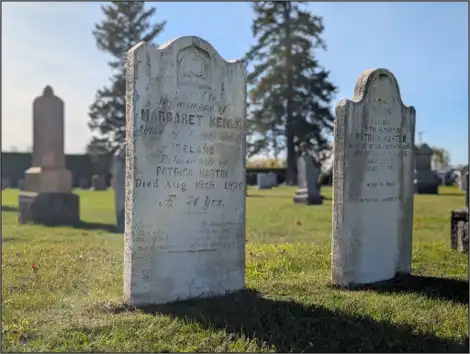
The grave marker of Margaret Hartin, née Kenly, stands alongside the burial place of her husband, Patrick, in the Huntley Presbyterian Cemetery on Carp Road between Stittsville and Carp. Margaret was one of about 20 Ottawa Valley and Outaouais residents who died in the Great Fire of 1870, a mid-August blaze that swept across hundreds of square kilometres of bushland and farm fields between Pakenham and Ottawa-Hull, a disaster that was covered by newspapers around the world. Though Margaret’s grave records her death as occurring on Aug. 19, 1870, the fire is known to have killed her on Aug. 17. [Photo © Randy Boswell]


A bigger stone house on the same farm, built in 1886 by son John Hartin Sr., has survived, as well, and is now identified as 1837 Maple Grove Road. It was also declared a City of Ottawa heritage building in early October, and is currently being renovated to become a café and cocktail lounge.

A third historic Hartin house — built in 1871 by Patrick and Margaret’s second-eldest son David, Tupper’s great-great grandfather — occupies 10 Cedarow Court, about a kilometre to the south of the original family farm on the far side of Poole Creek, in former Goulbourn township. It’s now the JASK Salon & Day Spa, and city councillors are expected to approve it as a heritage-designated building in November.

The Hartins’ eldest son, James, owned the farm immediately south across the township line from his parents’ place, also in Goulbourn. No historic buildings have survived from that property, and all of the former Hartin family farms in the area have been swallowed by the ever-expanding Stittsville.

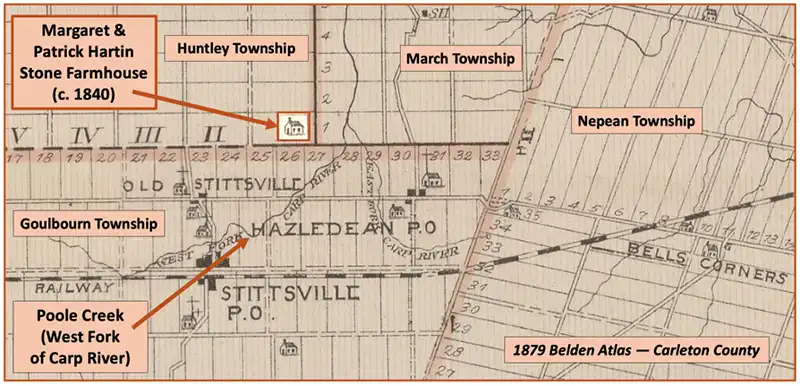
This 1879 base map shows the historical townships of Carleton County, with the location of the original Hartin farm inset in the southeast corner of Huntley Township — today the northeast end of Stittsville. Nearly every house and barn in Old Stittsville and Bells Corners was destroyed in the Great Fire of 1870, the Hartin “stone cottage” among the few buildings that survived at the time (though it was damaged) and one of the only structures in the path of the fire that is still standing today in modern Ottawa. Nevertheless, the old Hartin farmhouse — which gained a city heritage designation earlier this month — was a key scene in the tragic death of 74-year-old family matriarch Margaret Hartin, who made the ill-fated decision to race back to her home to retrieve a coveted clock as the flames approached from the west. She was killed by the fire before she could reach the safety of Poole Creek, marked as “West Fork Carp River” on the map just south of the Hartin farmhouse. [Base image: Belden Atlas, Carleton County, 1879]


The Hartins, after starting from scratch as newcomers to Canada before Bytown even existed, had become one of the most prominent and successful farm families in Carleton County by the late decades of the 1800s. Several of Margaret and Patrick’s daughters married other farmers in the area, weaving the family more fully into the tapestry of local history.

“I suspect they came with pretty much nothing from Country Antrim,” says Tupper, referring to the family’s origins in Northern Ireland, the homeland they left for Canada around 1820. “But clearly Patrick was an entrepreneur,” adds Tupper, who lives near Kars in rural south-end Ottawa. “He had three sons and he was going to make sure that they were all set up. And he did.”

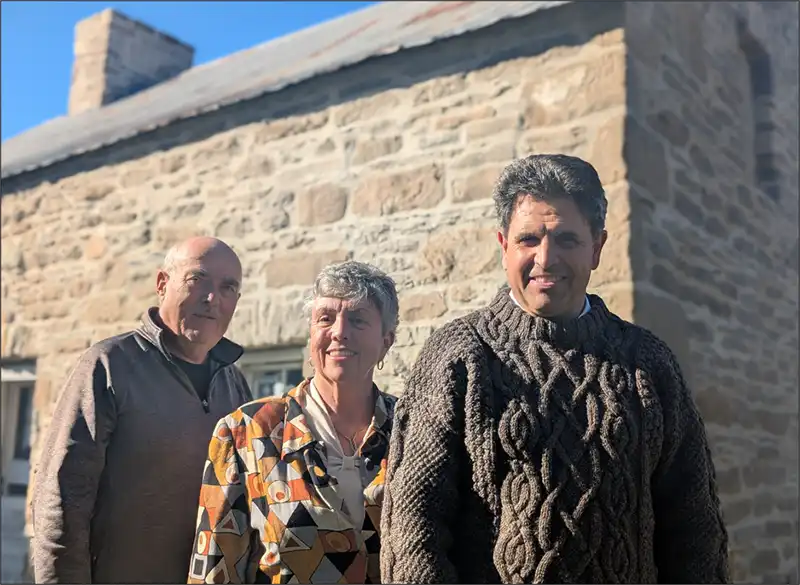
Ron Hartin of Carp, his cousin Laura (Hartin) Tupper of Kars and her brother John Hartin of Munster recently visited the old stone farmhouse where their great-great-great-grandmother Margaret Hartin lived with her husband Patrick from about 1840 until her death in the Great Fire of 1870. Ron’s great-grandfather, known as John Hartin Jr., is believed to have been born in the building — both his parents’ and grandparents’ home at the time — in 1866. The farmhouse became a City of Ottawa-designated heritage building on Oct. 2. [Photo © Randy Boswell]


Tupper’s cousin Ron Hartin — who lives just up the road from Stittsville in Carp —  has joined Laura and her brother John for a late-October visit to the stone cottage. Ron  remembers a time when two of his uncles still lived on the original farmstead. Back then, in the 1960s, the cottage was being used as a kind of hangout space, with a pool table as the main attraction.

Previously it had served as a blacksmith shop and all-purpose tool shed for generations after John Hartin Sr. and his family moved into the larger, fancier, two-storey stone house, built about 50 metres away in 1886. The property was passed on to John Jr. and his descendants.

Ron says the story of Margaret’s death was retold often when the farm was still in Hartin hands: “She died over behind us here somewhere in a low area, heading to the Poole Creek. That’s what we grew up being told. My uncles talked about it quite a bit. And my Aunt Minerva, who lived in Carleton Place, talked about that, too. I wish I’d asked her more when she was still with us.”

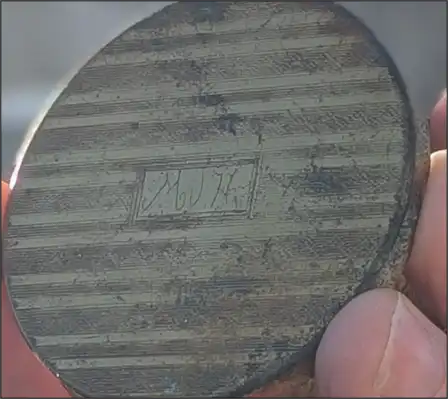
Recent renovation work on the 1886 farmhouse turned up a remarkable artifact lodged behind one of its walls: a young girl’s cosmetics compact from the 1920s or ’30s. The metal lid is engraved with the initials “MJH”; Ron’s aunt, Minerva Jane Hartin, turned 18 a century ago.

Laura’s brother, John Hartin of Munster, doesn’t recall visiting the stone cottage when he was young. “First time I came here was with Ron about a month ago,” he says.

A cosmetics compact from the 1920s or ’30s was discovered during recent renovations of the Hartins’ 1886 farmouse at 1837 Maple Grove Road, a stone’s throw from the 1840 stone cottage. The engraved initials “MJH” refer to Minerva Jane Hartin, one of Margaret’s descendants. [Photo © Randy Boswell]


John recently joined cousin Ron as a volunteer caretaker of the Huntley Presbyterian Cemetery along the Carp Road, where Margaret and Patrick Hartin and many of their descendants are buried. The surname of Patrick and some other relatives is spelled “Harten” on their headstones; such variation, even within families, was common in the 1800s.

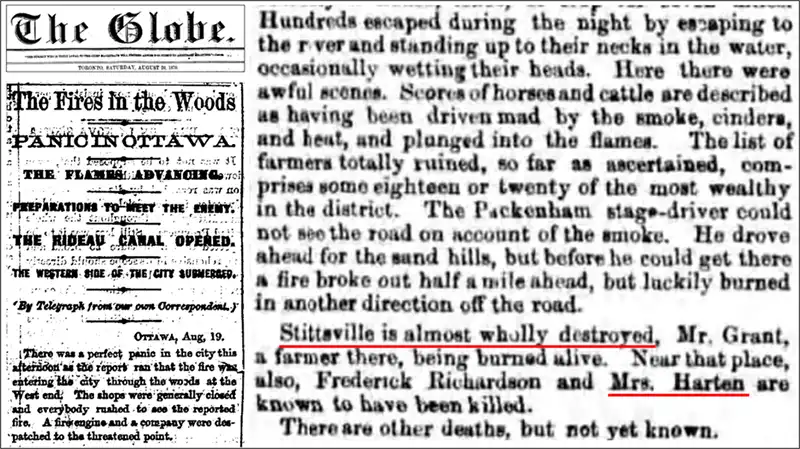
Margaret’s grave marker records her death as occurring on Aug. 19, 1870, but the actual date must have been Aug. 17 based on lists of victims of the Great Fire published in Ottawa newspapers on Aug. 18, 1870: “Stittsville is almost wholly destroyed, Mr. Grant, a farmer there, being burned alive,”  stated one account from that day that was widely circulated throughout North America. “Near that place, also, Frederick Richardson and Mrs. Harten are known to have been killed.”

On Margaret’s headstone, the lyrics of a popular 19th-century hymn about overcoming grief are engraved in weathered lettering: “I know thou art gone to the home of thy rest, Then why should my soul be so sad? I know thou art gone where the weary are blest, And the mourner looks up and is glad.”

Comforting words. But when the Great Fire tore through the region, there was only chaos, confusion, terror and misery. The city of Ottawa, which had been capital of the new Dominion of Canada for just three years at the time, was itself threatened with destruction by the galloping flames. And in the rural frontier to the west, all was devastation — the intensity and scale of the disaster unprecedented.

The catastrophic wildfire that killed Margaret Hartin was a worldwide news event. Grim details of the death toll and the colossal damage inflicted on farms and villages appeared in the San Francisco Chronicle, Sydney Morning Herald and countless other prominent newspapers of the day. There were vivid accounts, too, of the city of Ottawa’s monumental battle against the blaze — including its ingenious strategy to prevent the flames from reaching the core of the capital by breaching the St. Louis Dam at Dow’s Lake and sending canal floodwaters gushing north to the Ottawa River, creating a liquid barrier along present-day Preston Street.

The Great Fire was sparked by railway workers clearing brush near Pakenham, about 65 kilometres west of  Parliament Hill. The workers thought a controlled burn would accomplish the task, but it was a very bad idea. That summer had been the driest ever known in the region, and the woods and fields of the Ottawa Valley were crispy from the drought. Carleton County — roughly the same geographic area as the present-day city of Ottawa — was in an especially combustible state.

The deliberately-set fire was out of control in seconds and would wind up burning for days. And is often the case when the worst disasters occur, one triggering event was soon compounded by unanticipated, aggravating factors.

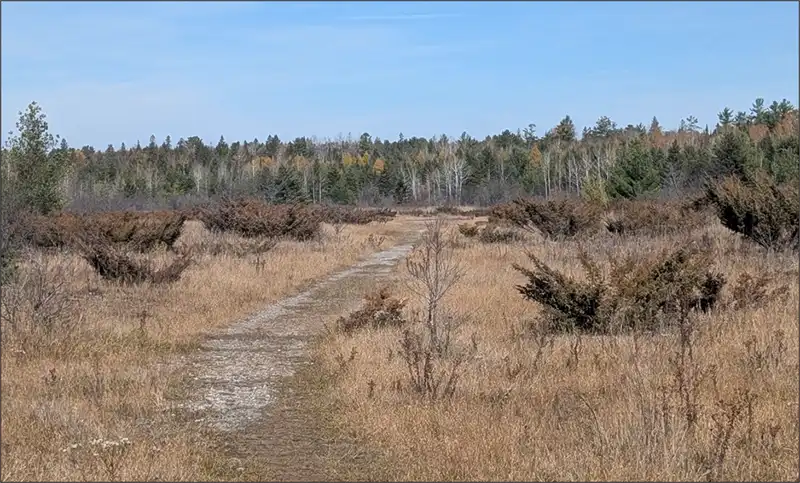
The dry, highly flammable alvar environment that quickly spread the Great Fire of 1870 from Lanark to Carleton County was blackened so badly it became known as the “burnt lands.” Hikers can follow a path across the strange landscape in Burnt Lands Provincial Park near Almonte. [Photo © Randy Boswell]


Along Ottawa’s western boundary, where old Carleton met Lanark County in the fields north of Almonte, there’s an unusual shrub and grassland environment known as an alvar. Created at the end of the last ice age as retreating glaciers scoured the earth, the alvar’s thin layer of topsoil over a semi-exposed, pavement-like bed of limestone retains little moisture and supports sparse vegetation.

It can become tinder dry in hot summers, and during the exceptionally arid July and early August of 1870, the parched alvar became the perfect medium for the fire sparked by the railway workers to spread rapidly and widely throughout the region. To this day, part of the alvar along the Ottawa-Lanark boundary line is known as the “Burnt Lands” because it was scorched so severely by the Great Fire.

Then came the windstorm. Seemingly out of nowhere, on the afternoon of Aug. 17, 1870, great gusts of wind that lasted for more than a day began fanning the flames and driving the wildfire from west to east towards Ottawa, and even north across the Ottawa River towards Aylmer and Hull, with countless new blazes ignited by the hot embers pushed upwards and onwards by the unrelenting gale.

“The night of August 17, 1870, will be long remembered in the burnt district,” the Ottawa Times reported. “Never since the day of its early settlement was such a spectacle witnessed; never did death in its most awful form seem to threaten the inhabitants so closely. Some, we know, fell victims to the flames, but when we see what havoc has been wrought all over the country, and hear from the lips of eye witnesses, of the force and fury of the fire and of the speed at which it travelled, we can only wonder that more did not perish . . .”

One of many news articles published about the Great Fire of 1870. [Base image from newspapers.com]


It’s eerie to read about how quickly and devastatingly the 1870 fire moved at a time when Canadians are hearing similar accounts of the speed and ferocity of the deadly grassfire at CFB Wainwright on Oct. 17 this year, sparked by a live-munitions training exercise at the Alberta military base. “The fire was a kilometre away when the wind shifted. It is not normal for a fire to move a kilometre in 30 to 60 seconds,” army commander Maj.-Gen. Liam Wade Rutland told reporters after the blaze killed four soldiers and badly injured dozens of others.

The extraordinary features of the Great Fire of 1870 have been captured well by Today in Ottawa History blogger James Powell of the Historical Society of Ottawa: “Fanned by gale and sometimes hurricane force winds, the fire moved as fast as a horse could trot, leaping from tree to tree, through the townships of Goulbourn, Huntley, March, Fitzroy, Torbolton and Nepean,” he writes. “One by one, farms cut into the parched forest were destroyed, their wooden homesteads, barns and stables consumed by the flames, along with their crops and livestock. Residents who couldn’t flee by road tried to find safety in rivers or lakes.”

Initially, municipal officials in Ottawa were not concerned about the city’s safety. But as the advancing front of the wildfire spread 15 kilometres wide, the situation became desperate along the western edge of the urban area. Only the breaching of the dam at Dow’s Lake and the flooding of the low-lying area through what is now Little Italy and LeBreton Flats stopped the fire from racing through Canada’s new capital.

Margaret Hartin is said to have died in the Great Fire of 1870 somewhere near this stretch of the Poole Creek west of today’s Huntmar Road in north-end Stittsville, a few minutes’ walk from the Hartin family’s stone house in former Huntley township, now 756 Kinstead Private. [Photo © Randy Boswell]


But the rural townships to the west had been decimated. Newspapers reported scenes of hundreds of homeless refugees from the countryside trudging towards Ottawa, many with charred clothing, on the old Richmond Road. Along with the many lives lost and the vaporized woods and cropland, nearly every structure across hundreds of square kilometres was consumed by the flames. It would take years for the region to recover, and local newspapers reported on disaster relief efforts for months after the fire.

Many news reports on the “great conflagration” of Carleton County referenced Margaret Hartin’s death. There were even brief stories about the search for her remains and their eventual recovery.

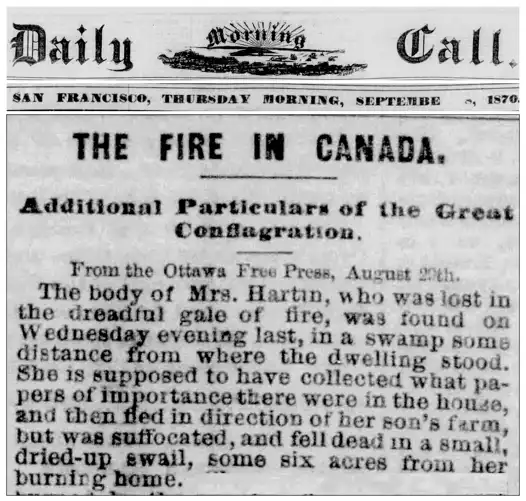
“The body of Mrs. Hartin, who was lost in the dreadful gale of fire, was found on Wednesday evening last, in a swamp some distance from where the dwelling stood,” stated a report from the Ottawa Free Press that was reprinted in the San Francisco Daily Morning Call in September 1870. This particular article, previously unreferenced by researchers, is noteworthy because copies of the Free Press — like those of the Ottawa Citizen — are missing from newspaper archives for much of 1870.

“She is supposed to have collected what papers of importance there were in the house,” the story continued, “and then fled in direction of her son’s farm, but was suffocated, and fell dead in a small, dried up swail, some six acres from her burning home.”

There is no mention of the clock in this brief account of Margaret’s demise, but the reporter doesn’t seem to have personally witnessed the discovery of the body.

The story of Margaret Hartin and the Great Fire of 1870 later became a staple of local histories.

According to a typical retelling published by the Stittsville Women’s Institute in 1969, it was at the height of the inferno on Aug. 17 when Margaret made the unlucky decision that ended her life.

San Francisco’s Daily Morning Call reprinted a news item from the Aug. 29 Ottawa Free Press reporting the discovery of Margaret Hartin’s body on Wednesday, Aug. 24 in a “dried up swail, some six acres from her burning home.” Six acres, expressed in linear form, would refer to a distance of several hundred metres. At the time of the Great Fire, her son David Hartin lost all of the buildings on his farm along Poole Creek south of his parents’ homestead.


“The great fire which swept over the hot dry countryside in the summer of 1870 dealt the Hartins a severe blow,” recounts the institute’s Farms and Families: Reflections from the Changing Countryside. “Mrs. Patrick Hartin, at that time an old lady, clutching in her arms a clock she had brought from Ireland, hurried toward the creek but was surrounded by the leaping flames.”

Killed steps from the water where others had taken refuge from the fire, Margaret was later memorialized by her grief-stricken husband, who “built a pile of fieldstone on the spot where his wife was found,” the book states.

The clock found “lying beside her had one corner charred. This clock is still in the family, a treasured reminder of pioneer forebears,” notes the institute’s chronicle. “On the homestead only the original stone walls of the house remained standing. The house was later rebuilt and used for a time.”

As the city’s heritage report noted, despite Margaret’s tragic death, “the use of stone likely prevented the Hartins from losing their home in the Great Fire . . .  The house was among only a few stone structures that survived the blaze.”

Patrick was living there at the time of the 1871 census, sadly listed that year as “widower.” He died in July 1875, and was buried alongside Margaret in the Presbyterian cemetery now maintained by two of their great-great-great grandsons, about seven kilometres northwest of the old stone farmhouse.

Lorraine Hartin-Gelardi is a teacher and professional storyteller from Beacon, N.Y., a Hudson River town between New York City and Albany. She’s another great-great-great grandchild of Margaret Hartin, and has been the guardian of the famous family clock for about the past 45 years since it was handed down to her by her father, Stuart Boucher-Hartin.

“I’ve always been fascinated by it. It conjured a lot of stories,” says Hartin-Gelardi. She recalls how her father — a teacher who was born and raised on a farm outside of Stittsville, and is another of the Hartin clan’s antique collectors — would “enter the world of the past” when he spoke about the clock and other souvenirs he came to possess from the old family homestead. “His voice changed. And that clock became my connection, through my father, to another world.”

There is some new information about the storied timepiece. Most accounts of Margaret’s tragic dash to save the clock, such as the one published in Farms and Families, describe the object as an heirloom that Margaret inherited and brought to Canada when the Hartins emigrated from Ireland around 1820. However, that can’t be the case.

Lorraine Hartin-Gelardi, a teacher and professional storyteller from Beacon, N.Y., often visited the Hartin family homestead near Stittsville when she was growing up, and became the guardian of the family clock about 45 years ago when her father handed it down to her. Lorraine’s daughter, Meghan Gelardi-Holmes — Margaret Hartin’s great-great-great-great-granddaughter — grew up fascinated by the clock and history of all kind, and is now a historian and museum curator.


A manufacturer’s label on the inside of the clock makes clear it was acquired by the Hartins no earlier than 1857 — long after their arrival in Canada, but early enough to have become an important family keepsake by 1870.

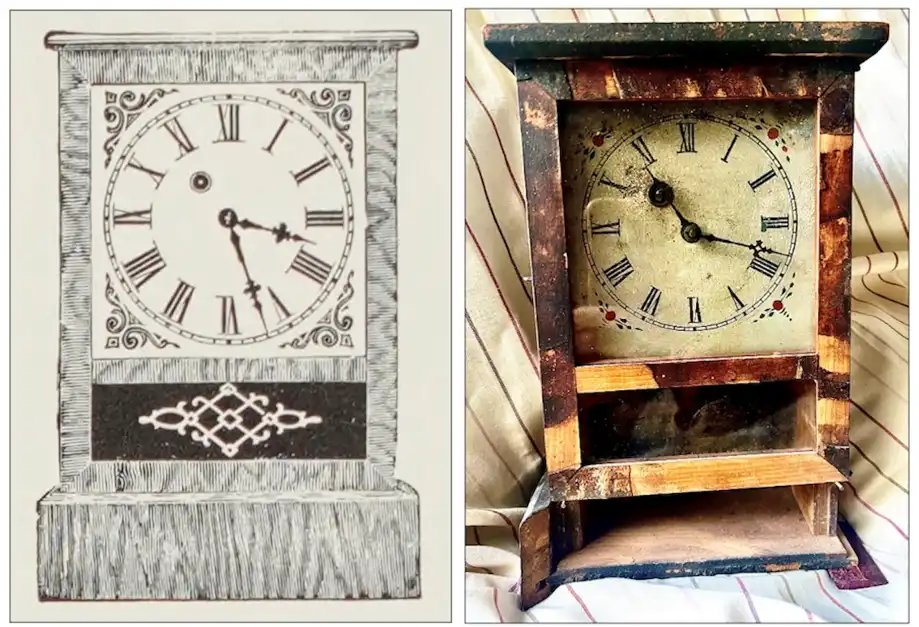
It’s now been identified as a wood-framed, “Cottage”-model Waterbury mantel lock, with a decorative glass door to be opened for daily winding with a metal key. It was built by the Waterbury Clock Company, a firm founded in March 1857 in Waterbury, Connecticut, and which grew to become the largest clock and watch manufacturer in the U.S. — Timex — in the 20th century. Newspaper ads show Waterbury clocks being sold in Canada at least as early as 1859.

The Hartin family clock (right), said to have been found in Margaret Hartin’s arms when her body was discovered on the north bank of Poole Creek after the Great Fire of August 1870, is an American-made “Cottage”-model mantel clock made by Connecticut-based Waterbury Clocks, and began selling in Canada soon after the company was founded in 1857. The illustration on the left shows the same style of clock from a 19th-century catalogue issued by Waterbury Clocks, which was renamed Timex in 1970. Although Waterbury exported its products to Europe in the 1800s, Margaret and Patrick Hartin had emigrated to Canada by the early 1820s and couldn’t have purchased the clock before the late 1850s. While the timepiece might have been a cherished possession at the time of the Great Fire, it couldn’t have been a family heirloom that Margaret had had brought with her from Ireland, as often stated in accounts of her death. [Clock illustration from 19th-century Waterbury Clock catalogue; Hartin clock photo courtesy of Lorraine Hartin-Gelardi]


Hartin-Gelardi says she has often thought about Margaret and her fatal choice to save the clock as the fire began to overwhelm the Hartin farm. “You always have questions. Like, why was this such an important thing that she would grab it and take it away? Why would you grab the clock?” she wonders. “Like so many things, we’ll never know . . . But this was obviously something held dear.”

Interestingly, an almost identical clock is in the collection of a Wyoming museum dedicated to the life of the famed American cowboy performer Buffalo Bill Cody. The object, a treasured possession of Cody’s mother, Mary, “indicates a shift in the family’s fortunes” in the 1850s after years of struggle as homesteaders in the U.S. Midwest.

The Hartin clock — like the family’s stone house in a township where log cabins were still overwhelmingly the norm — may have held a similar meaning for Margaret.

The clock does, indeed, have a burned upper corner that seems to confirm the story of Margaret’s failed bid to outrun the Great Fire with the clock in her hands. “The right back corner is completely charred right off,” says Hartin-Gelardi. “I can put my finger in it.”

The clock became the centrepiece of her children’s school presentations on their family history, she says. And her daughter, Meghan, became especially enthralled by the object and the story behind it.

She grew up to become a historian and museum curator. Meghan Gelardi-Homes — great-great-great-great-granddaughter of Margaret Hartin — is now the executive director of an American heritage conservation society that maintains three historic homes in Massachusetts from the 17th, 18th and 19th centuries, as well as the multitude of artifacts each of them contains.

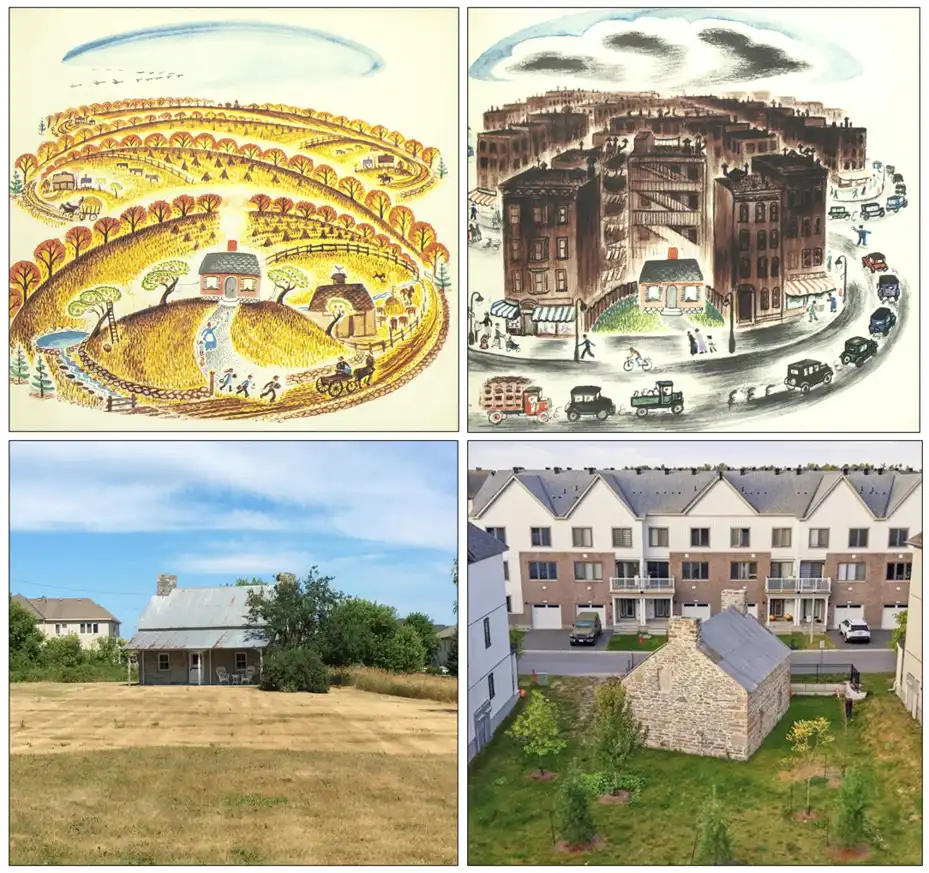
Lorraine Hartin-Gelardi, Margaret Hartin’s great-great-great granddaughter and a professional storyteller in New York, has visited the family’s 19th-century homestead often over the years, and compares the gradual encroachment of urban Ottawa onto the old Hartin farm to the fate of the rural home in the famous 1942 children’s book The Little House by U.S author Virginia Lee Burton. 


The professional pathways that she and her daughter have chosen, says Hartin-Gelardi, are a testament to the “tremendous power of objects” like Margaret’s clock. “I think it’s about connection and belonging. An object connects us through time and is proof that we belong to something that lasts.”

She laughs: “You know, I’ll be damned. If our house caught fire, that’d be the first thing I’d grab.”

Hartin-Gelardi has visited the site of the family’s 19th-century homestead in present-day Stittsville many times over the years. She compares the gradual encroachment of urban Ottawa onto the old Hartin farm to the fate of the rural home in the famous, beautifully illustrated 1942 children’s book The Little House by U.S author Virginia Lee Burton.

As the years pass in Burton’s story, the old farmhouse winds up surrounded by busy city streets and dark, looming apartment buildings. Likewise, says Hartin-Gelardi, the Hartin stone cottage “is a survivor” of Ottawa’s urbanization.

“My past is very entwined with that place. It’s very personal,” she says. “The little house was part of my growing up. My uncles had horse barns, which were really fascinating to me. And as time went on, Ottawa began to get closer and closer and closer until I remember one time I went over with (cousin) Ronnie . . . and I was, like, ‘Oh, my God? Where is all the property? Where are the fields?’ . . . I’ll be honest, it’s very heartbreaking in a way. But I am glad it’s still there — dear God, I am glad they didn’t tear it down.”

The historic Hartin farmhouses have been on Glen Gower’s radar for many years. The city councillor for Stittsville is into his last few weeks at city hall after honouring the pledge he made at the outset of his political career to serve no more than two terms in office. And the former journalist, who founded the local news site StittsvilleCentral.ca in 2014, had written about the 19th-century Hartin buildings before turning to politics.

Gower describes it as a gratifying, full-circle moment to see them sensitively preserved by a housing developer before gaining formal heritage status in October.

“This was an interesting file for me because it spanned my pre-councillor life and my councillor life, and the staff report on it quoted some research that I did, like, over a decade ago,” says Gower. “I’m a modest person, but I’ll take a little bit of credit,” he adds, for shining a spotlight on the old buildings as being among “a small number of late-19th century buildings that were still in existence in Stittsville. So that kind of flagged it for heritage staff initially, that there might be some value.”

The later, larger Hartin farmhouse, built in 1886, is currently being converted into the Stonehouse Café and Cocktail Lounge. The family’s older stone cottage is seen behind and to the right along Kinstead Private. [Photo © Randy Boswell]


“I remember Mattamy coming to my office to give me a preview of what they were planning for the development,” Gower recalls. “There’s a suburban neighborhood growing up all around this old building and the old farmland and everything. And Mattamy said, from the get-go, ‘We have no plans to demolish (these buildings).’  . . . We took Mattamy at their word that they wanted to incorporate (the old farmhouses) into their neighborhood.”

In the staff report recommending heritage designations for the Hartin houses, Gower commented that Mattamy’s preservation plan for the two buildings would ensure “a lasting link to the rural and agricultural heritage of Huntley and Goulbourn townships.”

Heritage Ottawa, the local advocacy group that champions the preservation of historic buildings, has also strongly supported the city’s move to officially recognize the importance of the Hartin farmhouses. The historical societies of former Goulbourn and Huntley townships are equally pleased.

“We thought that it was very fittingly inclusive of the human story of these two properties,” Heritage Ottawa board member Hunter McGill said of the designation. “They were a very prominent family in that part of Ottawa.”

He added that the group particularly applauds the city’s efforts to designate “significant rural properties. It’s certainly something that Heritage Ottawa has tried to give attention to, because there is a wonderful array of built heritage properties in the rural areas.”

A Google Earth satellite image from 2024 shows the Hartin family’s old stone farmhouse from the 1840s (bottom centre) surrounded by a partly finished Mattamy Homes townhouse development. The Hartin family’s later, larger stone farmhouse, built in 1886, can be seen about 50 metres away (above, to the left) from the “stone cottage.” [Google Earth image]


Kevin Murphy, Mattamy’s vice-president of land development in Ottawa, said: “We’d always seen these as heritage buildings even though they weren’t officially designated.”

He noted that the company had been keeping its eye one of the last parcels of the former Hartin farm — including the two stone houses — as it built out the Fairwinds community over the past 20 years. The property finally became available to the developer in 2020.

“When we put together our original purchase proposal, we incorporated (the stone farmhouses) into our plans right from the start . . . We saw what they provided to the area — the character they have. Sure, we build houses. But we like to say we build communities first. And these are pretty important elements in the overall community and that connection to Stittsville’s history.”

He added: “Yes, we could have attempted to put a clean slate down” — seeking demolition permits and building several additional units in the new housing development for greater profits. “But I think the value in the site itself really was augmented by the fact that we preserved that character . . . We feel a lot of pride in the community we’ve helped create there.”

The new neighbourhood is now complete, and the bigger former Hartin farmhouse on Maple Grove has already been sold to become the Stonehouse Café & Cocktail Lounge.

Now the stone cottage is up for sale.

The exterior has been restored at least twice since Patrick Hartin rebuilt the roof and moved back into the old farmhouse after the Great Fire of 1870 and Margaret’s heart-breaking death. He lived there until he died at age 80 in 1875.  John Sr. and his family continued to live in the cottage for more than a decade until the new two-storey stone house was completed in 1886.

The interior of the cottage, which can be glimpsed through one of the windows, includes a dirt floor, plain white walls and a white plank ceiling with exposed wooden crossbeams. There’s a simple fireplace and — most evocatively — a recessed shelf on the eastern wall, what was perhaps a perfect nook at one time for a fine-looking mantel clock.

Available for $449,990, the little cottage is touted by EXP — the local realtor handling the sale for Mattamy — as “a unique opportunity for a small business to make its mark in a distinctive stone building full of character and potential. Currently unfinished on the interior and ready for fit-up, this property offers a blank canvas to bring your vision to life.”

A blank canvas? Well, no. The squat little one-storey house, though abandoned for decades as the world around it was transformed into a bedroom community of Canada’s capital, is anything but a tabula rasa. Fashioned mostly from field stones hauled across the surrounding acreage, if the thick walls of the tiny house could talk — here, the cliché seems too apt to eschew — there would be volumes to speak.

A witness to epic human drama and nearly all of the 200 years of history Ottawa is commemorating in this bicentennial year — including the evolution of its western frontier from forest to countryside to satellite city — the old Hartin homestead stands today as solidly and stoically as it’s possible to imagine any symbol of the pioneer past.


Header image: The Hartin family stone farmhouse, built circa 1840, was preserved by developer Mattamy Homes as it built a new subdivision in north-end Stittsville over the past five years. The little house went on sale in September at about the same time city councillors were approving its designation as Ottawa’s newest heritage building — a decision formalized on Oct. 2 with the publishing of a City of Ottawa notice under the Ontario Heritage Act. The “stone cottage” was still the home of pioneer settlers Patrick and Margaret Hartin when Margaret was killed by the Great Fire of 1870 that swept across old Carleton County and parts of the Outaouais, leaving about 20 dead, thousands homeless and hundreds of farm families ruined. (BR) The stone cottage has witnessed the dramatic transformation of the original Hartin family farmstead in the southeast corner of old Huntley Township, which is now the 3,000-home Fairwinds suburb in north-end Stittsville, a kilometre southwest of the Canadian Tire Centre [Photo courtesy of EXP Realty].


ABOUT THE AUTHOR:

Randy Boswell is a journalism professor at Carleton University and a former city editor, feature writer and city hall reporter with the Ottawa Citizen. He was also a senior national writer with Postmedia News, specializing in historical subjects. His freelance articles have appeared in Rolling Stone, Canada’s History, The Globe and Mail, Toronto Star, iPolitics and many other publications.