

The NDP Leadership Race Is Adrift — and It Really Needs a Kinew
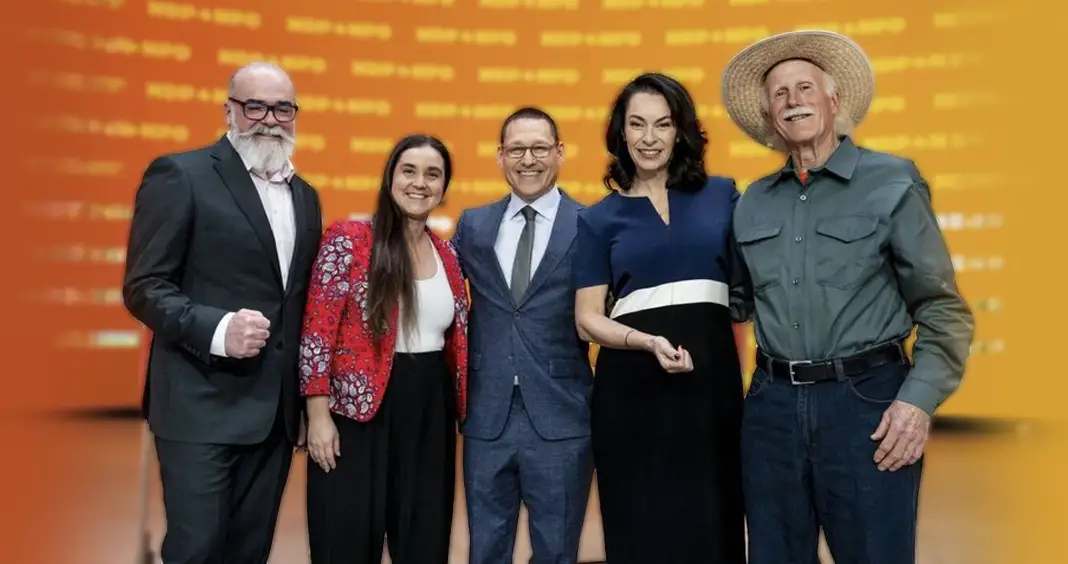
Last week’s federal NDP leadership debate in British Columbia brought together FIVE contenders who all insisted they were laser‑focused on rebuilding the party — though judging by the topics they chose, it’s unclear which planet they plan to rebuild it on.
Tony McQuail didn’t bother with the warm‑up; he just announced he’d be running for prime minister. Bold strategy, can’t fault the confidence. The remaining four — Alberta MP Heather McPherson, activist‑filmmaker Avi Lewis, union leader Rob Ashton, and social worker Tanille Johnston — spent 90 minutes enthusiastically agreeing with each other on issues that, while important, somehow managed to float several feet above the daily worries of ordinary Canadians. It had the distinct vibe of a political debate where everyone was determined to avoid conflict, controversy, or any mention of the things voters actually talk about while waiting in line at the grocery store.
If you didn’t follow Canadian politics and just tuned in, you might think you’d stumbled onto deleted scenes from Parks and Recreation — the ones where the Parks Department tries to draft a national platform using a whiteboard, a slogan, and a rapidly evaporating sense of self‑awareness. Watching the NDP leadership hopefuls last week, you could almost hear the faint hum of bubble wrap as each candidate carefully avoided any sharp object resembling reality. And if the official group photo of this merry band of would‑be leaders were a movie poster, the tagline practically writes itself: “Based on a true story… unfortunately.”
Welcome to the NDP Leadership Race: Please Consult the Identity Flowchart Before Proceeding.
The 2026 leadership rules say a great deal about where the party has ended up — or, depending on your level of optimism, where it has wandered off to. The criteria are so layered with identity requirements that even veteran organizers now approach the nomination process the way one approaches a malfunctioning printer: with hope, confusion, and a quiet sense that something important is about to jam.
To qualify, candidates must collect 500 member signatures. Half must come from members who do not identify as cisgender men. At least 100 must come from designated “equity‑seeking groups.” Ten percent must be youth. Regional quotas apply. At this point, the checklist reads less like a leadership contest and more like the onboarding paperwork for a very progressive escape room.
Supporters call the system inclusive. Critics note that the rules have become so intricate that it’s sometimes unclear whether the party is choosing a leader or conducting a taxonomy experiment — and despite its growing expertise in internal classification, the NDP still hasn’t managed to identify its natural habitat: the voting public.
And the complexity doesn’t end with who can run. It extends to who can vote — and how little the party seems to verify any of it.
Democracy Watch has raised concerns about the integrity of the leadership process itself, noting that the NDP has no voter‑verification system to confirm whether members casting ballots are actually Canadian citizens or permanent residents. Because the party relies on self‑attestation and allows members as young as 12 or 14 to vote, the organization argues the contest is unusually vulnerable to foreign participation and covert influence. At the same time, most leadership contenders are not MPs and therefore fall outside federal ethics rules and Criminal Code anti‑bribery provisions — a gap Democracy Watch says creates an environment where “it is essentially legal to secretly bribe or buy off party leadership contestants who are not MPs.” Combined with Canada’s weak disclosure laws for third‑party groups, the organization warns that leadership races across all parties — including the NDP’s — remain exposed to undisclosed spending, foreign‑funded front groups, and influence campaigns that leave no trace.
All of which naturally leads to the people now trying to navigate this maze. Because once you get past the paperwork, the quotas, the loopholes, and the verification gaps, you arrive at the five contenders vying to lead a party that can’t quite decide what it wants to be. And in their platforms and performances, the NDP’s internal contradictions come into even sharper focus.
The Candidates: Five Visions, One Fractured Party
The NDP leadership race has become a kind of political Rorschach test — five candidates, each offering a different answer to the same question the party has avoided for years: What exactly is the NDP now? The result is a field that captures the party’s ideological sprawl in real time, from sweeping transformation to moral theatre to labour nostalgia to rural reconnection. Taken together, the profiles reveal a party still struggling to decide whether it wants to govern, protest, or simply rehearse its greatest hits.
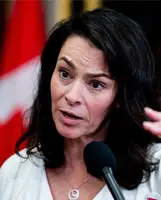
Heather McPherson
The Moral Clarity Mirage
Heather McPherson has styled herself as the candidate of principled conviction, but her record since October 7 has revealed something closer to curated moral ambiguity. She clearly sees herself as the humanitarian voice of the race, yet her foreign‑policy framing has repeatedly blurred the most basic distinctions between terrorism and resistance, victims and perpetrators. In her rush to cast Israel as the primary villain in every scenario, Hamas became a rhetorical afterthought — an inconvenient detail rather than the terrorist organization responsible for the October 7 attacks.
That selective framing didn’t just distort the conversation; it helped create a climate where antisemitism could slip into the discourse under the banner of “solidarity.” The moment that crystallized the problem came in March 2024, when McPherson and several colleagues walked into Parliament wearing keffiyehs, a visual echo of street protests where masked demonstrators shouted down Jewish Canadians and waved “From the River to the Sea” signs. If one is being generous, the most charitable explanation is that they didn’t understand the symbolism they were amplifying, which is its own indictment.
McPherson’s candidacy ultimately reflects the party’s broader drift: moral clarity replaced by moral posturing, and Jewish Canadians left watching their safety debated as though it were a secondary detail rather than the point.
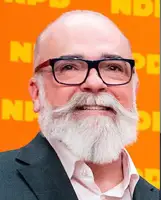
Avi Lewis
The ‘Leap in Logic’ Candidate
Avi Lewis — filmmaker, activist, and architect of the Leap Manifesto — clearly sees himself as the candidate of sweeping transformation. His platform calls for a climate revolution, democratic overhaul, and, in the moment that dominated post‑debate chatter, a proposal to create government‑run grocery stores as a solution to food inflation and the 2.3 million Canadians who visit food banks each month.
It was the kind of idea that instantly clarified just how far the party has drifted from political gravity. A government‑run grocery store is, in theory, a bold intervention — and in practice, a perfect solution if you’ve ever thought, “This banana would be better with more bureaucracy.” Nothing says affordability like produce priced by committee and a checkout line that moves at the speed of a passport office.
The proposal became the emblematic moment of the debate: a leap not just in policy but in logic, revealing a party increasingly comfortable with ideas that sound transformative in theory and faintly surreal in execution.
Lewis’s candidacy captures the party’s instinct to leap first and fact‑check later — a habit that has repeatedly left the NDP out of step with the broader electorate.
Rob Ashton
The Labour Traditionalist with a Familiar Script
Rob Ashton, longtime union leader and former head of the International Longshore and Warehouse Union Canada, enters the race as the most traditional figure — the candidate who believes the NDP can recover its identity simply by rewinding the tape. He clearly sees himself as the standard‑bearer of the party’s labour roots, calling for economic fairness, stronger workplace protections, and a renewed focus on working‑class voters who feel increasingly sidelined by the party’s activist turn.
Ashton’s pitch is earnest and familiar: put organized labour back at the centre of the NDP, and the rest will follow. But in a field dominated by ideological theatrics and sweeping transformation schemes, his message can feel like a dispatch from another era — a reminder of the party’s unresolved identity crisis.
Tanille Johnston
The Social‑Justice Maximalist
Tanille Johnston, a social worker and disability advocate, offers a platform built around accessibility, disability rights, and community‑based supports. She clearly sees herself as the candidate of expansive social justice — promising a guaranteed livable basic income, higher taxes on the wealthy, and an end to fossil‑fuel subsidies. Her message is straightforward: a more compassionate Canada requires a more interventionist state, and the NDP should stop apologizing for saying so.
Johnston channels the party’s activist energy into a coherent moral narrative, but her platform also reflects the same challenge that has dogged the NDP for years: how to sell maximalist policy ambitions to an electorate that just rejected them in 2025.
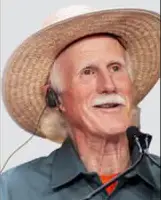
Tony McQuail
The Rural Reconnection Candidate
Tony McQuail, an organic farmer and long‑time rural organizer, brings a perspective that the federal NDP has neglected for decades. He clearly sees himself as the candidate who can reconnect the party with small‑town and rural Canada — the voters who once formed part of its backbone but have drifted away as the party’s centre of gravity shifted toward urban activist politics. McQuail focuses on food security, rural economic development, and environmental stewardship grounded in local realities rather than urban assumptions.
His candidacy highlights a long‑standing strategic blind spot: the NDP’s chronic inability to speak to rural voters without sounding like it is broadcasting from a different country. McQuail’s message is simple but pointed — a party that cannot win outside major cities cannot pretend to be a national force. Whether the NDP is willing to hear that message is another question entirely.
And if the leadership debate was any indication, the answer appears to be: not yet.
The Debate: Cognitive Dissonance with a Smile
What the debate revealed was cognitive dissonance delivered with such calm confidence it almost passed for competence. The candidates spent 90 minutes nodding through familiar talking points, showing they remain nearly as detached from political reality today as they were when voters flattened them at the polls a year ago — seemingly unbothered by the fact the country already rejected this script.
Rather than grappling with why the party keeps losing, they leaned back into the same inward‑looking priorities and ideological comfort food that thrill the most committed activists but leave most Canadians wondering what, exactly, the NDP thinks the country needs. It felt less like a leadership debate and more like a support group for a party still convinced the last election was some kind of administrative misunderstanding.
The result was a portrait of a party stuck in an identity crisis it won’t name, struggling to articulate a message that resonates beyond its own echo chamber, and projecting the unmistakable energy of a group still not quite ready for prime time.
A Sad Decline
For decades, the NDP was the party of prairie grit and labour pragmatism, a coalition forged in union halls, farm kitchens, and factory floors. It spoke plainly about wages, fairness, and the dignity of work. It understood the anxieties of ordinary Canadians because it lived among them.
Today, that legacy feels like a postcard from another era.
How the NDP Lost Its Compass and Its Purpose
The modern NDP is almost unrecognizable from the party that once carried the names Tommy Douglas, Ed Broadbent, Jack Layton, Thomas Mulcair, and Lynn McDonald. Those leaders built a movement defined by moral seriousness, institutional responsibility, and a clear sense of national purpose. Today’s party, by contrast, seems determined to abandon that inheritance in favour of a politics that is narrower, more insular, and increasingly detached from the country it hopes to govern.
The shift is most glaring in foreign policy. After the October 7 attacks, the federal NDP adopted a narrative so ideologically rigid that it collapsed distinctions most Canadians consider foundational — distinctions between terrorism and resistance, between civilians and combatants, between democratic obligations and political posturing. Instead of speaking plainly about the deliberate targeting of civilians, the party filtered the moment through an internal ideological lens that treated clarity as a liability.
The result was predictable and damaging. Many Canadians heard the party’s rhetoric as minimizing or excusing antisemitism at a time when antisemitic incidents in Canada were reaching record highs. A party once known for its moral clarity failed one of the most basic tests of political seriousness: the ability to identify victims and perpetrators without hesitation. Yet even as the consequences became obvious, the party’s leadership contenders showed little interest in recalibrating. If anything, they dug in.
This is not the NDP of Douglas or Broadbent — leaders who understood that social democracy required both compassion and judgment. It is not the NDP of Layton, who brought the party into the national mainstream, or of Mulcair, who came closer than any New Democrat in history to forming a federal government. Those leaders disagreed on plenty, but they shared a commitment to civil liberties, balanced foreign policy, and a politics that spoke to the country rather than to a faction.
The party’s origins make the contrast even sharper. Born from the Co‑operative Commonwealth Federation in 1932, the CCF set out to protect working people from economic instability and corporate excess. The 1961 merger with the Canadian Labour Congress created a party that helped build Medicare, strengthen labour rights, and give voice to those shut out of economic power. Ed Broadbent later gave the party national credibility; Jack Layton transformed it into a genuine contender; and in 2011, the NDP achieved its historic breakthrough with 103 seats and Official Opposition status.
After Layton’s death, Thomas Mulcair — disciplined, experienced, and widely viewed as a plausible prime minister — led the party into the 2015 election as the frontrunner. Strategic missteps cost the NDP its moment, but instead of giving Mulcair a second chance, the party replaced him with Jagmeet Singh.
The Singh Era: Alignment Without Growth — and “Universal” Condoms and Tampons
Jagmeet Singh’s leadership, launched on October 1, 2017, marked the moment the NDP discovered the limits of style‑first politics. His ascent — chosen more for the packaging than the contents — produced a party that looked impeccable on Instagram but increasingly hollow everywhere else. Singh governed through curated aesthetics, hashtag‑ready messaging, and a level of deference to the scandal‑ridden Trudeau Liberals so lopsided it should have come with a warning label for second‑hand embarrassment. In the process, he didn’t merely weaken the NDP’s independence — he gutted its credibility, binding the party to a government drowning in ethics breaches and policy failures, and supporting it no matter how badly it governed.
A Party That Could Trend Online But Couldn’t Pay Its Bills
Under Singh, the NDP didn’t just struggle to grow; it struggled to stay solvent. Fundraising collapsed so dramatically that by the 2021 election the party could not afford its own campaign plane — a first in modern NDP history. While the Liberals and Conservatives toured the country in branded aircraft, Singh was left flying commercial like a budget‑conscious backpacker. It was the perfect metaphor for his leadership: highly visible, endlessly photographed, and financially incapable of sustaining the performance.
The numbers told the same story. The NDP routinely trailed far behind the Liberals and Conservatives in quarterly fundraising, often bringing in less than half of what the major parties raised. For a party that once prided itself on grassroots strength, the Singh era revealed a movement that could generate clicks but not contributions — all sizzle, no steak; all spotlight, no infrastructure.
By April 2025, the NDP no longer resembled a national party rooted in class politics. It looked like a political accessory: fashionable, photogenic, and functionally ornamental. Its parliamentary strategy blurred the line between cooperation and absorption, leaving the NDP less an independent force than a permanent Liberal sidecar.
Meanwhile, the party’s language drifted into an activist dialect unintelligible to the working people it was created to represent. The vocabulary that once connected the NDP to farmers, factory workers, and union halls now sounded imported from academic conferences where tenured activists debate theory over catered lunches. It is no surprise that many working‑class voters in Ontario now gravitate toward Doug Ford — he speaks in terms they recognize.
The Emergencies Act: The Day the NDP Broke Faith with Its Principles and Forgot Tommy Douglas
The defining rupture came with the Emergencies Act. The NDP voted to suspend civil liberties for 40 million Canadians because it disapproved of the people protesting. It endorsed the freezing of bank accounts — an extraordinary power that should alarm any party with even a faint memory of its civil‑libertarian roots. The party of Tommy Douglas, once wary of concentrated state authority, now applauded as the state reached directly into citizens’ finances.
In 2024, the Federal Court ruled the government’s use of the Act unreasonable and inconsistent with the Charter.
The NDP had voted for it anyway.
For many longtime supporters, it was a moment of profound disorientation: the party that once warned against state overreach was now defending the most sweeping federal powers invoked in a generation.
The “Universal” Programs That Weren’t
Then came the great policy mirage. Singh and his caucus insisted their support for the Liberals was justified because they were delivering “historic” social programs — universal dental care and national pharmacare. The rhetoric was sweeping; the reality was microscopic.
What the NDP called “universal pharmacare” turned out to be a narrow list of items — including condoms, tampons, and a few select drugs — repackaged as a national plan. NDP MPs even claimed the program covered essential supplies for Type 1 diabetics, a statement that was not merely inaccurate but a blatant lie and deeply misleading to the very people whose lives depend on those tools.
This wasn’t ordinary political spin. It was the kind of patronizing assumption that Canadians wouldn’t notice the difference between a slogan and a system.
A Party with All Sizzle and No Steak
Under Singh, the NDP didn’t just “master visibility” — it became a party that excelled at being seen while accomplishing almost nothing that required being heard. It was politics as performance art: a movement that could choreograph a TikTok but couldn’t build a coalition; a party that could produce a vibe but not a voter.
By the 2025 election, the NDP recorded one of its weakest modern results, losing further ground among working‑class voters in resource and industrial regions — the very communities that once formed its backbone.
It was a remarkable reversal: a party founded to challenge concentrated power ended up defending it; a party built to represent workers drifted into a vocabulary workers could not decipher; a party that once prided itself on moral clarity became indistinguishable from the government it propped up. For many Canadians, the Singh era did not feel like renewal.
It felt like a party that had forgotten its own story — and hoped no one would notice.
And yet, the collapse of the Singh experiment revealed something important: Canadians haven’t rejected the NDP — they’ve rejected this NDP. When presented with leaders who behave like serious adults rather than lifestyle influencers, voters embrace New Democrats with enthusiasm. The success of provincial NDP governments proves the point. In British Columbia and Manitoba, leaders like David Eby and Wab Kinew win not because voters crave radicalism, but because they project competence, stability, and a reassuring sense that they are running a government, not curating a personal brand.
Their rise sets the stage for the next chapter — the contrast between the pragmatic NDP that wins and the aesthetic NDP that doesn’t.
Why Wab Kinew Wins Elections and Jagmeet Didn’t . . . and these FIVE Won’t
What makes the contrast so stark is that Wab Kinew succeeds precisely because he embodies the opposite of the Singh formula. Unlike the FIVE current candidates in the federal race, Kinew does not present like a man who just floated out of a hemp‑scented, kombucha‑fuelled, vegan knitting symposium where everyone had to introduce themselves with a land acknowledgment, a pronoun, and their favourite shade of ethically sourced turmeric. He talks like a premier: grounded, serious, and focused on governing rather than curating a personal brand or leaving the impression he just came from a bong show where he was smoking the devil’s lettuce and chewing cannabis gummies.
David Eby reinforces the point in British Columbia — a leader who radiates the energy of someone who reads budgets, not vibes — but it is Kinew who has become the clearest example of what a modern, electable New Democrat looks like. Together, they represent the version of the NDP Canadians actually trust: the one that shows up with a plan, not a ring light, a bicycle and a pronoun. Singh, by contrast, often looked like he was running a lifestyle channel that occasionally dabbled in politics, a leader more fluent in aesthetics than administration. Voters can tell the difference.
In Manitoba, Kinew governs with a notably pragmatic focus on health care, affordability, and provincial administration. After the 2025 federal election, he congratulated the re‑elected prime minister, acknowledged the difficult outcome for the federal NDP, and emphasized his commitment to provincial priorities. He has not intervened in the federal leadership race — a deliberate signal that his job is to run a province, not audition for a national fan club. However, make no mistake about it- if Kinew ran, he would win, and he clearly could be Prime Minister.
The contrast is instructive. Manitoba’s NDP government frames its agenda around practical governance. The federal party debates identity thresholds and ideological positioning. No quotation marks are needed to see the divergence.
The NDP can choose to reconnect with its working‑class roots, rebuild institutional credibility, and reassert practical governance. Or it can continue down its current path of ideological abstraction that narrows its coalition further. Because in the end, a party can only ignore its own contradictions for so long before voters decide to ignore the party.
The real question is not who wins in Winnipeg. It is whether the NDP, and Canada, intend to build strength through sovereignty and resilience, or drift further into governance by bureaucracy and ideology.
Photo: Courtesy Winnipeg Sun