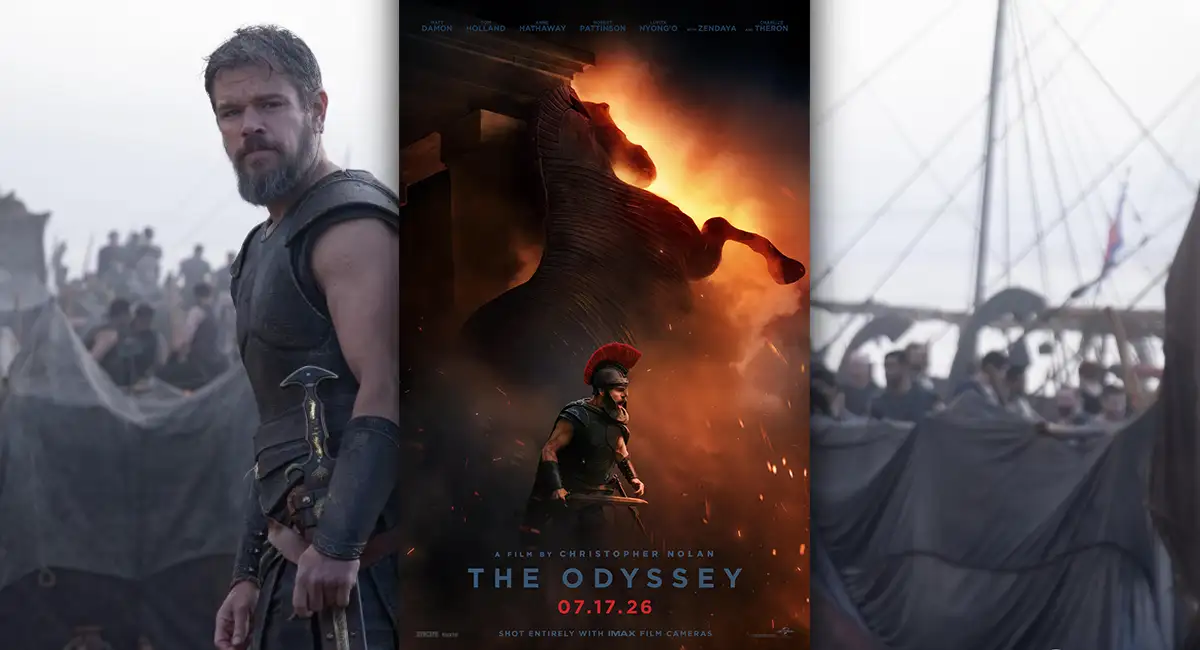
‘The Odyssey’ (2026): Christopher Nolan Delivers What Might Be His Best Film

Synopsis: After the Trojan War, Odysseus faces a dangerous voyage back to Ithaca, meeting creatures like the Cyclops Polyphemus, Sirens, and Calypso along the way.
Director: Christopher Nolan
Stars: Matt Damon, Tom Holland, Anne Hathaway, Robert Pattinson, Lupita Nyong’o, Zendaya, Charlize Theron


On July 17, 2025, tickets for Christopher Nolan’s thirteenth feature film, The Odyssey, went on sale—a full year before its release. At the time, I remember thinking, Who knows what any of us will be doing a year from now? Yet that didn’t stop moviegoers around the world from buying tickets months before a single review had been published or a full trailer had been released. Screenings in the coveted IMAX 70mm format sold out globally within minutes.

That worldwide sellout speaks volumes about the excitement surrounding a Christopher Nolan film. He has become one of the most respected filmmakers working today, and his movies are no longer simply releases; they are cultural events. Audiences don’t just watch a Christopher Nolan film; they anticipate it, debate it, and make plans around it. Following the enormous success of Oppenheimer, which finally earned Nolan the Academy Award for Best Director while the film itself collected seven Oscars, expectations for The Odyssey reached an almost impossible level.

To say there was a great deal of anticipation would be a significant understatement. Before I had seen a single frame of the movie, I boldly predicted it would receive ten Academy Award nominations. Having now seen it, I realize I may have been underselling its awards potential.

I’ll also be the first to say that not every movie needs a reported $250 million budget to be effective. Great stories can be told for far less. However, The Odyssey unquestionably looks like every dollar is on the screen. When you consider that Nolan’s debut feature, Following (1998), was made for approximately $6,000, his journey as a filmmaker is nothing short of remarkable. Very few directors have earned the level of trust that studios now place in him, allowing him to bring projects of this scale to life exactly as he envisions them.

Based on Homer’s epic poem, The Odyssey follows the legendary Greek king Odysseus (Matt Damon) as he struggles to return home following the Trojan War. Waiting for him is his devoted wife, Penelope (Anne Hathaway), and their son, Telemachus (Tom Holland), who are facing dangers of their own back in Ithaca.

The story unfolds along two compelling paths. One follows Odysseus’ perilous journey across the sea as he battles mythical creatures, impossible odds and his own determination to survive. The other remains in Ithaca, where Penelope is besieged by increasingly ruthless suitors who believe Odysseus is dead. They compete for her hand in marriage while plotting to eliminate Telemachus and seize the throne. The most intimidating among them is Antinous, played with chilling intensity by Robert Pattinson.

Nolan has taken one of history’s greatest stories and transformed it into one of the most visually breathtaking films I have ever seen.

The achievements of both the cast and the crew deserve equal recognition, but it makes sense to begin behind the camera because every technical aspect of this production is operating at the highest possible level.

The production design is extraordinary, creating massive kingdoms, ships and landscapes that feel tangible rather than artificial. Every location feels lived in; every set is meticulously crafted. There is never a moment when the world feels manufactured—it completely immerses you in ancient Greece.

You expect greatness from cinematographer Hoyte van Hoytema whenever he collaborates with Nolan, and somehow he continues to raise the bar. The Odyssey is the first feature film shot entirely with IMAX cameras, and the results are simply spectacular. Every frame is rich with detail, scale and beauty. The phrase “see it on the biggest screen possible” has become something of a cliché when discussing blockbuster films, but in this case it is absolutely true. This isn’t marketing hype—it’s the only way to fully appreciate what Nolan and van Hoytema have accomplished.

Costume designer Ellen Mirojnick also deserves enormous praise. Every costume feels authentic to the era while simultaneously helping define each character’s personality and status. The attention to detail throughout the wardrobe is exceptional, adding another layer of authenticity to the film.

Perhaps the most overlooked member of Nolan’s creative team is editor Jennifer Lame. Film scores are often described as another character in a movie, but editing can be just as essential to storytelling. Lame keeps this nearly three-hour epic flowing with incredible precision, seamlessly weaving together flashbacks, present-day events and moments of foreshadowing without ever confusing the audience. Her work on Oppenheimer earned her an Academy Award, and after seeing The Odyssey, I wouldn’t be surprised if another Oscar is headed her way.

Nolan also deserves credit for his approach to casting. Predictably, there has been criticism in some corners regarding the inclusion of Lupita Nyong’o, but my response is simple: if you have the opportunity to cast one of the finest actresses working today, an Academy Award winner, no less, you cast her. Great filmmakers hire the best performers available, and Nolan has assembled an embarrassment of riches.

His loyalty to actors is also evident. Many members of this ensemble have appeared in previous Nolan films, creating a sense of familiarity and trust that translates directly onto the screen. There is a clear understanding among everyone involved that they are working together to create something special.

Matt Damon delivers one of the strongest performances of his career as Odysseus. He captures both the physical toughness and emotional vulnerability of a man who desperately wants to return home to his family. Damon has always been an excellent actor, but Nolan seems to bring out something even deeper in him. Their creative partnership continues to grow stronger with every collaboration.

Anne Hathaway is equally impressive. Penelope could easily have become a passive character waiting for her husband to return, but Hathaway gives her remarkable intelligence, resilience and emotional depth. She commands every scene she appears in and reminds audiences once again why she remains one of Hollywood’s finest performers.

Robert Pattinson continues his remarkable evolution as an actor. Every performance feels completely different from the last, and Antinous is no exception. He is charismatic, manipulative and genuinely frightening, making for an unforgettable antagonist.

Tom Holland delivers perhaps his most mature dramatic performance to date, while Zendaya, despite having less screen time, once again demonstrates why she has become one of the most consistently impressive young actors working today. Even in a smaller role, she leaves a lasting impression.

What makes these performances particularly effective is how collaborative they feel. Nobody is trying to steal the spotlight. Every actor understands the larger story Nolan is telling and contributes to making the film stronger as a whole.

There were multiple moments during the film where I genuinely found myself holding my breath. At just under three hours, the pacing is extraordinary. The runtime never becomes an issue because the story remains engaging from beginning to end.

In many ways, The Odyssey feels like an unofficial greatest-hits collection of Christopher Nolan’s career. You can see echoes of Memento (2000) in its structure, The Prestige in its obsession with sacrifice, The Dark Knight Trilogy in its larger-than-life scope, Dunkirk in its relentless tension and Interstellar in its emotional core. Yet despite these familiar touches, the film never feels repetitive. Instead, it feels like the culmination of everything Nolan has learned throughout his career.

This is epic filmmaking in its purest form. At a time when so many movies are rushed to streaming platforms within weeks of release, The Odyssey reminds audiences why the theatrical experience still matters. This is not a film that should be watched for the first time on a television or tablet. It demands to be experienced in a cinema.

Ironically, my only disappointment is that my first screening was in standard 70mm rather than IMAX 70mm. That means I still haven’t experienced the format Nolan specifically designed this movie for. Thankfully, that’s a problem I intend to correct very soon.

This. Is. Cinema.

The Odyssey doesn’t simply live up to the enormous hype surrounding it—it surpasses it. Christopher Nolan has once again demonstrated why he stands alone as one of the defining filmmakers of his generation.

Every element of filmmaking is operating at the highest level, from the performances and screenplay to the cinematography, editing, production design and score. It’s the kind of film that reminds you why movies matter.

Recency bias tempts me to call this Christopher Nolan’s greatest achievement. I want to resist making that declaration immediately, but I will say this: it has been a very long time since I walked out of a theatre this awestruck.

For those of you who rarely go to the movie theatre and need something special to drive you to the nearest cinema . . . . The Odyssey is here!

Grade: A


Watch the movie trailer: