The Power of Songs and Storytelling: Minoshkite Indigenous Music & Arts Festival is Amplifying Indigenous Voices
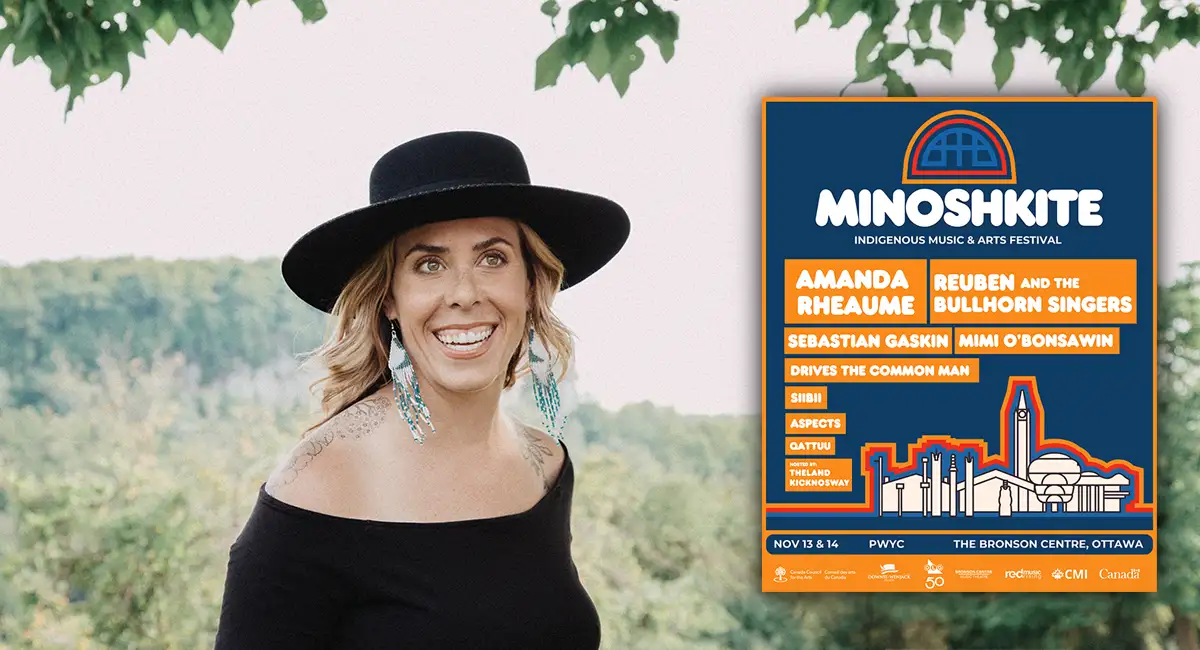
Now in its second year, the Minoshkite Indigenous Music & Arts Festival has expanded to two days, running November 13–14 at The Bronson Centre. The event follows a pay-what-you-want ticket model, with all proceeds supporting The Gord Downie & Chanie Wenjack Fund.
The Gord Downie & Chanie Wenjack Fund is a charity created to build cultural understanding and promote reconciliation between Indigenous and non-Indigenous peoples in Canada. Their partnership with the Minoshkite Indigenous Music & Arts Festival is a reconciliACTION aimed at encouraging awareness and learning.
Minoshkite (pronounced Mee-No-Shkeet) is an Algonquin word that translates to “music to the ears”. The Minoshkite Indigenous Music & Arts Festival is a celebration of Indigenous artistry and culture, with live performances from Indigenous musicians.
Performing live at the festival are Amanda Reheaume, Reuben and The Bullhorn Singers, Sebastian Gaskin, Mimi O’Bonsawin, Drives The Common Man, Aspects, Qattuu, and Siibii.
Amanda Rheaume, a Métis folk singer-songwriter from Ottawa, will be headlining the festival’s first day.
As a member of the Métis Nation in Ontario with Métis roots from Red River and having Objiwe/Anishinaabe ancestors from Lac Seul, Rheaume says storytelling heavily influences her songwriting.
“I’ve been really interested in making songs from stories. Some are mine, and some are from my family, and some are from other places,” she says.
Rheaume says attendees can expect a lively, engaging performance from her and the five-piece band accompanying her, with music and storytelling woven together throughout the set.
“I do like to tell stories before several of the songs. I think that when the audience has a bit more information, they can kind of dig into the song a little bit deeper,” she says.
While travelling across Canada to meet and perform for different Métis communities, Rheaume says she discovered why storytelling through music was so important.
“I started to realize that there were all these stories and all these experiences that were untold,” she says. “I think that the Métis experience can oftentimes be misunderstood or unknown”.
Rheaume is not the only person who shares these thoughts. Theland Kicknosway, an Anishinaabe and Cree hoop dancer, storyteller, and online creator and educator, will be hosting the festival for both nights.
He says storytelling is something he has grown up with, including stories passed down through generations and more recent ones.
“I’ve always grown up listening to my parents share stories. My aunties and uncles, and my relatives, they’ve shared different stories with me as well,” he says. “A lot of those stories come through lived experiences, and sometimes those are just as powerful, if not even more”.
Kicknosway says he hopes attendees will leave feeling uplifted and inspired by the different Indigenous artists.
“Indigenous artists are beautiful, and we’ve been sharing our art through different mediums for many many generations. I think having our ancestors’ voices in this modern space is really beautiful.” he said.
Likewise, Amanda Rheaume says the festival is not just a chance for communities to come together, but for Indigenous artists to have the same opportunities as other Canadian artists.
“Indigenous artists are telling some of the most important and critical stories of our time, and I think that Indigenous artists have often been left out of the conversation,” she says.
“There can be unique barriers for Indigenous artists to have the same opportunities as Canadian artists, so when there’s a festival amplifying and celebrating Indigenous music, that is a beautiful way for all communities to gather together”.