• By: Dan McCarthy

‘The Road Between Us’: A Harrowing True Story of Courage and Family in the Face of Terror

Please note: this film review contains some spoilers. 


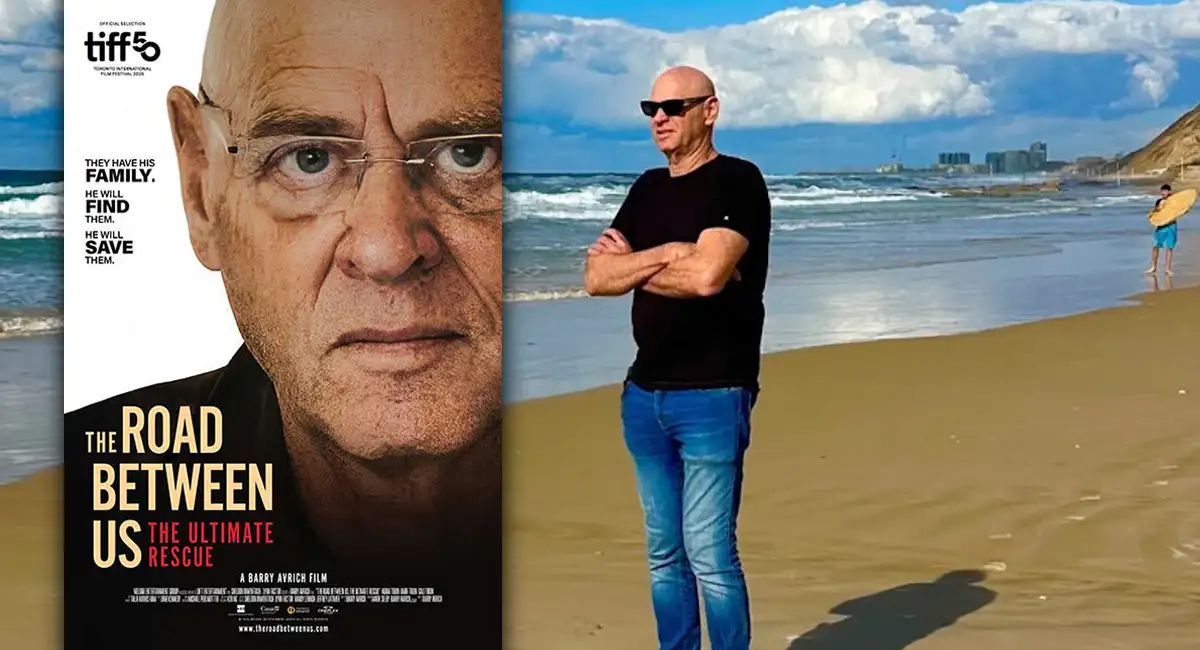
“Saba is here”! Grandfather is here! With those words from his 3-year-old granddaughter, retired Israeli general Noam Tibon’s improbable rescue mission was successful; his son Amir, his daughter-in-law and two young granddaughters had survived the October 7, 2023, Hamas attack on Kibbutz Nahal Oz. A quarter of the communities’ residents were not so fortunate as they were killed or taken hostage and dragged back to Gaza.

The Road Between Us: The Ultimate Rescue was presented in Ottawa on Sunday by Friends of JNF Canada, the Jewish National Fund, which supports environmental and social infrastructure projects in Israel, and was screened by Cineplex. This was not just another movie outing, though. One had to pre-register, and the location of the showing was emailed to registrants 36 hours in advance. Once at the theatre, your ID was checked against the registrants’ list, and you were directed to one of the theatres where additional security awaited. All to avoid the ubiquitous pro-Palestinian protests that threaten any gathering seemingly supportive of Israel or the Canadian Jewish community.

But this is neither a pro-Israel nor an anti-Palestinian film–it was simply a re-telling of the extraordinary measures a grandfather took in a 12-hour period on that horrendous day to save his family. In anticipation of seeing the film, I thought about Hollywood’s depictions of fictional fathers in similar circumstances: Liam Neeson in the Taken series, Harrison Ford in Air Force One or Tom Cruise in War of the Worlds. To paraphrase Neeson’s character, he tells the criminals holding his daughter of a “particular set of skills gained over a long career” that he will bring down upon their heads. Noam Tibon draws upon his experience from a 35-year career in the Israeli Defence Force (IDF); familiarity with firearms, field tactics, close-quarters combat, and evasive driving. However, his persona is more along the lines of an aging lion than leading man Cruise.

After seeing the documentary, though, and listening to Noam’s and his wife Gali’s thoughtful reflections on that day, I am more drawn to the character of Papa from Cormac McCarthy’s post-apocalyptic thriller The Road. Father and son – the boy – are travelling through a devastated landscape in search of good people. Unbeknownst to the boy, Papa is sick, very sick and is desperate to find a new family for his son. Armed with a pistol, a handful of bullets and their love for each other, the two wander through blowing ash under a grey sky, and “carry the fire”, desperate to maintain their basic goodness and decency. Noam and Gali were not motivated by ideology or hatred of the enemy but simply blind fear and foreboding as to the potential fate of their family. Papa “knew only that the child was his warrant. He said: If he is not the word of God, God never spoke.” Noam could have said this just as easily.

Nahal Oz is situated right on the border along the northeastern tip of Gaza, literally separated by a half-mile of fields and high fencing. A mortar barrage began hitting the community at 6:30 am on October 7, and within minutes, automatic gunfire could be heard throughout the Kibbutz. The family of four rushed to their safe room – a small concrete-reinforced room with a fortified door and window – just off their living room. By 7:15 am, they could hear Hamas gunmen speaking in Arabic on their front porch. The latest intifada had literally come into their home. During these early hours, Amir was texting with his father, Noam – what is happening, where is the army, what should we do? Noam basically said, Hang tight, stay quiet and hidden, I’m on my way. He and Gali packed a few supplies along with Noam’s pistol and began driving south from Tel Aviv, 86 km north of the kibbutz. We often fail to recognize how small the land mass of Israel is. Tel Aviv to the northern border of Gaza by the main highway is just over 40 km.

En route, Noam and Gali save fleeing concert-goers from the massacre perpetuated by Hamas at the Nova Music Festival, and several wounded Israeli soldiers. Noam says that he wasn’t leaving anyone behind that day. He kills several terrorists in a series of battles but takes no pride in this or gloats; he simply had to reach his family. The film is not pro-war, and in fact, Gali expresses misgivings about the IDF’s conduct of the war in Gaza, saying, “It has an aspect of revenge that is not good for Israel”.

The documentary, written and directed by Canadian filmmaker Barry Avrich, had its world premiere at the Toronto International Film Festival (TIFF) in September, although not without controversy. Following protests from staff and pro-Palestinian voices, the film was pulled from the line-up. TIFF explained there were copyright issues, as much of the footage comes from a GoPro war-porn shot that day by Hamas terrorists. This ridiculous stand did not survive more than a couple of days. The film was aired once and was voted the People’s Choice Award for documentary at the festival. Avrich himself says that the film is not political, “It was wrapped in the flag of a family, not a country.”

Aesthetically, the film is rather roughly shot, and the insertion of Hamas footage throughout is jarring. It will not win any cinematography awards. Noam is not a polished, Hollywood action figure; think a laconic, fit though stiff 65-year-old. But it is gripping, harrowing and inspiring, all the more so because it is true. The film demonstrates that goodness still exists. That valour and courage can prevail.

Almost 1,200 Israelis were killed on October 7, including 379 members of the IDF and other security services. Thousands more were wounded. More than 360 young music lovers were murdered in brutal fashion at the Nova music festival, in many cases chased down through surrounding fields. Eight Canadians died, and 251 Israelis were taken hostage; dozens died in captivity and 50 – alive and dead – remain in Hamas hands. Yet many in the Arab and Western world seek to minimize the extent and brutality of this attack. In response, Avrich says, “The story stands taller than all the lies.”

There was silence as the film concluded, and no one left their seat for what seemed like minutes. As a collective, it was as if we had been stunned by the presentation. The entire crowd then exited the theatre into a brilliant, warm October afternoon in Ottawa. I didn’t go to Mass Sunday morning, but I felt rejuvenated, uplifted and moved as I walked to my car.

Regardless of your personal views on the Israeli-Hamas war, do not miss this film.