
• By: Keith Whittier

TIFF Review: ‘The Smashing Machine’ Showcases a Career-Best Dwayne Johnson Performance

Synopsis: The story of mixed-martial arts and UFC champion, Mark Kerr.
Director: Benny Safdie
Stars: Dwayne Johnson, Emily Blunt, Ryan Bader


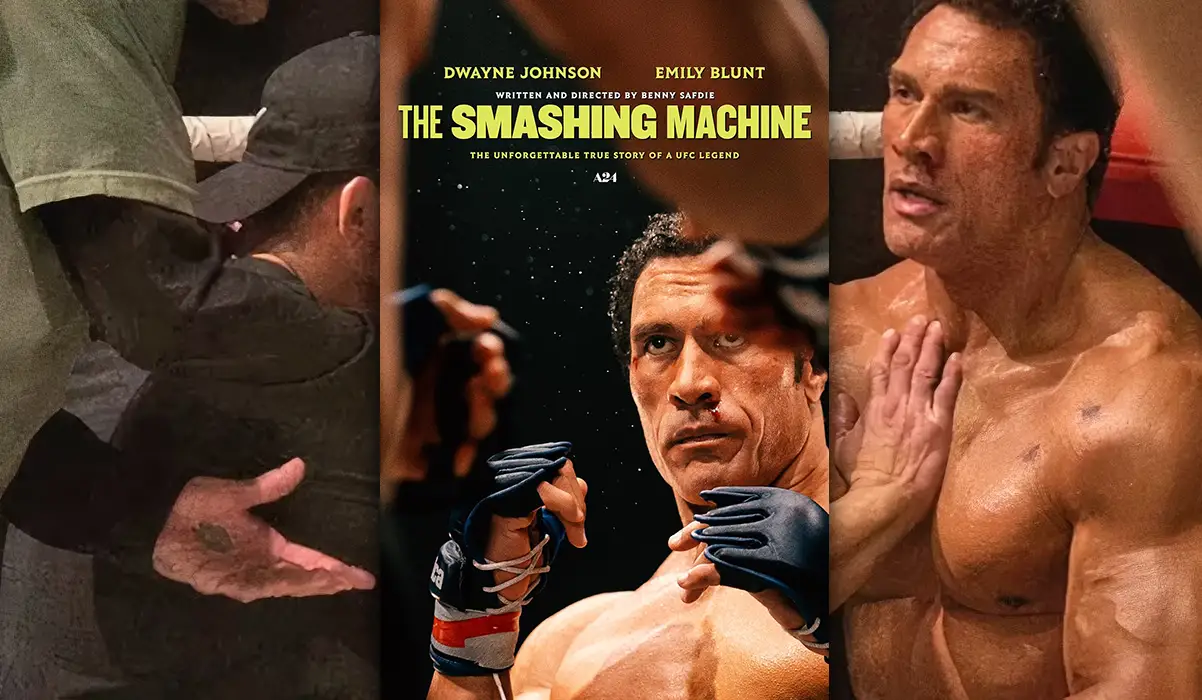
Benny Safdie’s The Smashing Machine is a gripping biographical drama about Mark Kerr, the legendary MMA fighter whose rise in the late 1990s was as turbulent as it was triumphant. Known for his work on Uncut Gems and Good Time, Safdie brings his signature intensity and realism to this story, crafting a film that is as emotionally devastating as it is viscerally thrilling. At the heart of the film are Dwayne Johnson and Emily Blunt, whose performances elevate the material into something unforgettable.

Johnson, long associated with blockbuster franchises and larger-than-life charisma, disappears completely into the role of Kerr. Through prosthetics, weight gain, and a complete physical and vocal transformation, he sheds the persona of “The Rock” to embody a man broken by addiction, fame, and inner demons. His portrayal is authentic and heartbreaking, capturing both Kerr’s ferocious presence in the ring and his vulnerability outside of it. Johnson’s performance has already drawn praise from industry heavyweights like Christopher Nolan, who called it one of the best of the year. It’s a revelation: proof that Johnson is capable of profound dramatic depth when given the right material.

Emily Blunt, as Kerr’s girlfriend Dawn Staples, matches Johnson beat for beat. Her performance is raw, unflinching, and deeply human. Blunt portrays Dawn not as a mere supporting character but as a fully realized individual caught in the chaos of Kerr’s life. Their relationship is toxic, tender, and tragically believable, with Blunt bringing nuance to every moment—from explosive fights to quiet scenes of despair. She has spoken about how emotionally gruelling the role was, even admitting that one scene left her physically ill. That level of commitment shows onscreen, making Dawn’s struggles resonate with painful authenticity.

Safdie’s direction is what ties these performances together. Known for his ability to create suffocating tension, he applies the same approach here, but with a more intimate focus. The fight sequences are brutal and immersive, shot with documentary-like realism that places the audience inside the cage. Yet the true drama lies outside the ring: Safdie captures the contradictions of Kerr’s world, where violence and love coexist, and where ambition collides with self-destruction. His decision to emphasize the emotional toll of fame and addiction ensures that The Smashing Machine is not just a sports film, but a human tragedy.

The supporting cast, including Ryan Bader, Bas Rutten, and Oleksandr Usyk, adds authenticity, grounding the film in the MMA community. Cinematographer Maceo Bishop’s work heightens the realism, while Nala Sinephro’s score underscores the film’s emotional highs and devastating lows.

Ultimately, The Smashing Machine is a triumph of performance and direction. Johnson and Blunt deliver some of the finest work of their careers, while Safdie crafts a drama that feels both authentic and deeply affecting. It’s a film that refuses to glamorize its subject, instead presenting a raw portrait of ambition, addiction, and the fragile humanity behind the fighter’s mask.

Grade: B


Watch the movie trailer: