Trump Threatens New Tariffs After Carney Walks Away from U.S. Trade Talks; Poilievre Demands Parliament Return
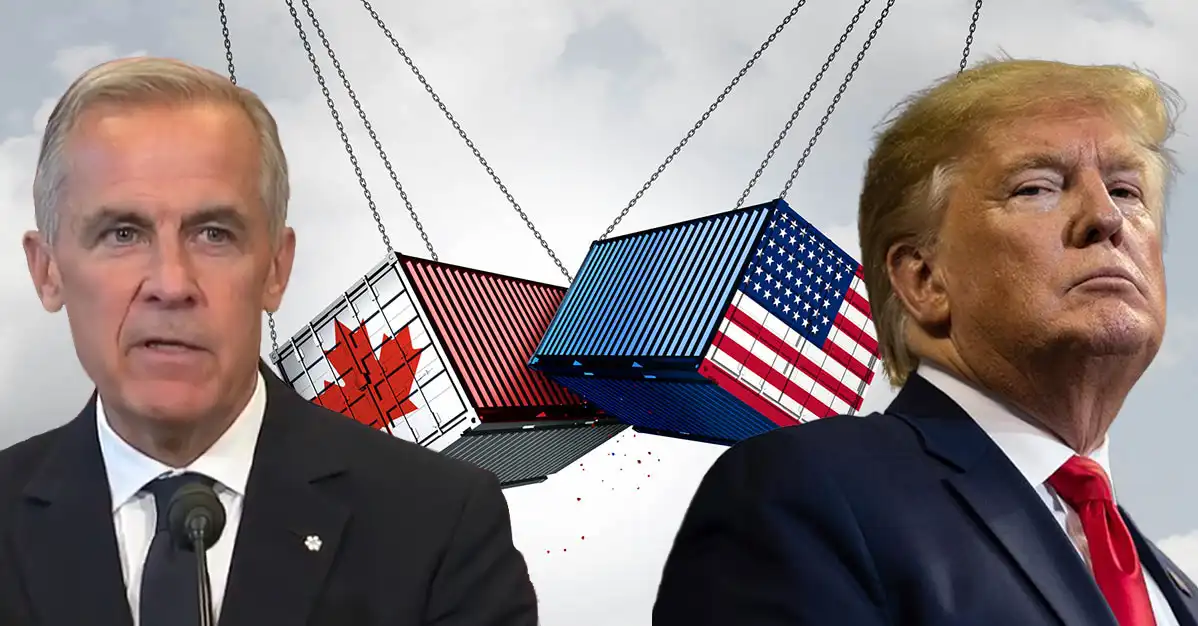
Canada’s already difficult trade relationship with the United States has entered a significantly more dangerous phase after Prime Minister Mark Carney broke off trade negotiations with Washington, President Donald Trump threatened another round of tariffs, and Conservative Leader Pierre Poilievre called on the government to bring Parliament back immediately.
The sequence of events has left Canadian businesses facing another period of uncertainty and raised a fundamental question: was walking away from the negotiating table the right decision for Canada? Carney says it was.
Late Friday, the prime minister suspended further trade negotiations with Washington and recalled Canada’s negotiating team after the talks broke down. The United States subsequently imposed 50 per cent tariffs on roughly $20 billion worth of Canadian goods. Carney defended the decision over the weekend, saying Canada had been moving toward a potential agreement but ultimately concluded that the price was too high. “We cannot accept what they’ve offered, and we will not give what they’ve asked,” Carney said Saturday.
He characterized the proposed agreement as a “bad deal” and said Washington had introduced new conditions late in the process that could have restricted Canada’s ability to negotiate future trade agreements with other countries and affected Canadian cultural and language protections. Carney was particularly emphatic Monday that Canada is not prepared to return to negotiations simply to obtain an agreement at any cost. “When the Americans go to the negotiation table first, with the right attitude toward our industries and a true partnership, of course we’ll come to the negotiating table,” he said.
He also rejected the idea that Canada should accept a subordinate economic relationship with the United States. “An attitude at the negotiation table that Canada is a subsidiary of the United States … that’s not something we’re going to accept,” Carney said. For Carney, the dispute extends beyond tariffs. The government says some of the American demands touched on issues involving Canadian sovereignty, trade policy, culture and language. But while the government maintains that walking away was necessary, the economic consequences of the breakdown are already becoming a central concern.
Catherine Swift, president of the Coalition of Concerned Manufacturers & Businesses of Canada, has been among those warning about the potential consequences for Canadian companies and workers. Her concern is particularly focused on small and medium-sized businesses, which generally have less ability than large multinational corporations to absorb prolonged uncertainty, higher costs and reduced access to the American market.
That warning deserves attention. For many Canadian businesses, the United States is not simply one market among many. It is the dominant market, integrated into supply chains that have developed over generations. Replacing that trade overnight is not realistic.
The potential economic cost is therefore difficult to dismiss. Estimates being cited in current coverage put the potential impact of a no-deal scenario at roughly 0.4 per cent of Canadian GDP and as many as 90,000 jobs. Those figures are estimates, not confirmed outcomes, but they illustrate the scale of the economic risk being discussed.
And then Donald Trump raised the stakes again.
On Monday, Trump announced that U.S. tariffs on Canadian cars, trucks, automotive parts and steel would rise to 50 per cent beginning January 1, 2027. The announcement came just days after the collapse of the negotiations and represents a potentially serious new threat to Canada’s highly integrated automotive sector.
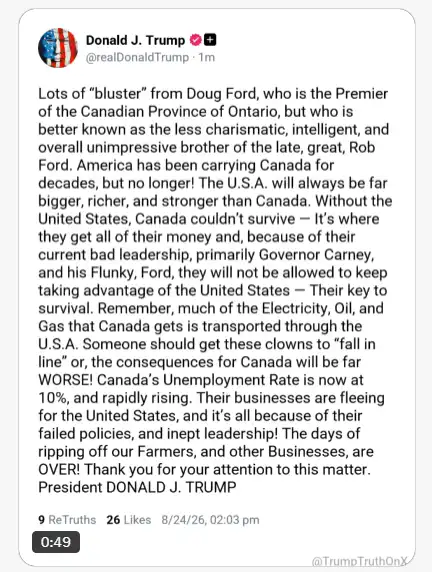
Trump also took direct aim at Carney and Ontario Premier Doug Ford in a sharply worded social-media post. He accused Ford of “bluster” and referred to him as Carney’s “Flunky.” Trump wrote that the United States had been “carrying Canada for decades” but would no longer do so. He then warned Canadian leaders to “fall in line,” adding that otherwise the consequences would be “FAR WORSE.” The language underscores just how far the relationship between the two countries has deteriorated. For Ontario, the implications are particularly serious.

Canada’s automotive industry is deeply integrated with the American manufacturing system, with vehicles and components crossing the border multiple times during production. A 50 per cent tariff could affect automakers, parts suppliers, transportation companies and workers on both sides of the border. Reuters reported Monday that shares of major automakers fell following Trump’s announcement, while industry participants warned that tariffs could disrupt supply chains in both countries. The uncertainty extends well beyond automobiles to steel, aluminum, lumber, agriculture and other Canadian industries that depend heavily on American customers.
Carney’s answer is that Canada must stand firm, retaliate where necessary and accelerate efforts to diversify its economy and develop markets beyond the United States. “We got attacked,” Carney said Saturday when asked about the new American tariffs. He announced that Canada would respond with dollar-for-dollar retaliatory tariffs beginning September 8, 2026.
That strategy may ultimately strengthen Canada’s economic independence. But diversification is a long-term proposition, while the American market is immediate. The United States remains overwhelmingly Canada’s most important trading partner, and Canadian companies cannot replace decades of integrated North American commerce overnight by developing new customers in Europe, Asia or elsewhere.
That is why the warnings from business leaders such as Swift deserve serious consideration. The question is not simply whether Canada should stand up to Trump. Canadians can reasonably expect their government to defend the country’s interests and protect its economic sovereignty. The more difficult question is how Canada can do that without inflicting unnecessary damage on its own economy. That is now the central political debate.
And it is precisely why Conservative Leader Pierre Poilievre is demanding that Parliament return.
In a letter released Monday, Poilievre called on Carney to reconvene Parliament without delay, arguing that Canadians deserve greater transparency about what happened during the negotiations and what the government intends to do next. “We must put the national interest first,” Poilievre wrote.
His first demand is transparency. He wants the government to release the text of the proposed agreement that Carney ultimately rejected. “What precisely was in the proposed deal that you appeared willing to accept until late last week when you suddenly decided to end talks?” Poilievre asked. His argument is that Canadians should be able to see what was offered, what Canada was being asked to concede and why the prime minister concluded that the agreement was unacceptable. “Canadians must see it to judge what options are on the table,” Poilievre wrote.
His second concern is the cost to Canadian families. Poilievre is asking the government to explain how retaliatory tariffs will affect the price of groceries, gasoline and other goods, and what Ottawa intends to do with the revenue generated by those tariffs.
His third concern is Canadian industry. He specifically cited steel, aluminum, lumber and automotive jobs and called for Parliament to examine what additional measures are required to make Canada’s economy more competitive. He also called for tax and regulatory reforms intended to stimulate investment and economic growth. “The Official Opposition has a duty to ask questions and hold the government to account,” Poilievre said.
The demand for Parliament to return is difficult to dismiss regardless of one’s political affiliation. Carney may be right that Canada should not accept an agreement it considers fundamentally damaging. Trump may believe that the United States has legitimate complaints about Canadian trade barriers. Poilievre may be right that Parliament needs to scrutinize the government’s decision.
All three propositions can exist at the same time. What Canadians need now is clarity.
What exactly did the United States offer? What did Canada offer in return? What changed during the final hours of negotiations? What concessions were demanded? What concessions was Ottawa prepared to make? And what will the government’s retaliatory tariffs actually cost Canadian consumers and businesses?
Those questions are particularly important because this is no longer simply a disagreement over negotiating tactics. It is becoming an economic confrontation.
Carney has made clear that Canada will not accept being treated as subordinate to the United States. Trump, meanwhile, is demonstrating that he intends to use the enormous economic leverage of the American market to pressure Ottawa.
At the same time, Trump’s January 2027 deadline leaves open the possibility that the two countries could return to negotiations before the new auto tariffs take effect. The Washington Post noted that the more than four-month delay provides time for talks to resume.
That leaves Canadian businesses caught in the middle.
For generations, the Canada-U.S. economic relationship was regarded as one of the safest and most predictable trading relationships in the world. That assumption has now been badly shaken. Carney’s answer is to stand firm, retaliate where necessary and diversify. Swift’s warning is that Canadian businesses cannot afford prolonged uncertainty and that jobs and investment are at risk. Poilievre’s answer is that Parliament should be sitting now to examine the government’s decisions and hold it accountable. Trump’s message is that the United States intends to use its economic power to pressure Canada back toward the negotiating table.
The coming weeks will determine which approach proves most effective.
For now, one thing is clear: Carney’s decision to walk away from the U.S. trade talks has not ended the dispute. It has moved the dispute into a far more consequential phase, one in which tariffs, jobs, investment and the cost of living for Canadians are increasingly at stake.
Before the government asks Canadians to accept the costs of this new economic confrontation, Canadians deserve to know exactly what was offered, why Ottawa walked away and what comes next.