Recommended Articles
Film Review: The Fate of The Furious
Album Reviews: March 9, 2019

Film Review: The Lego Batman Movie



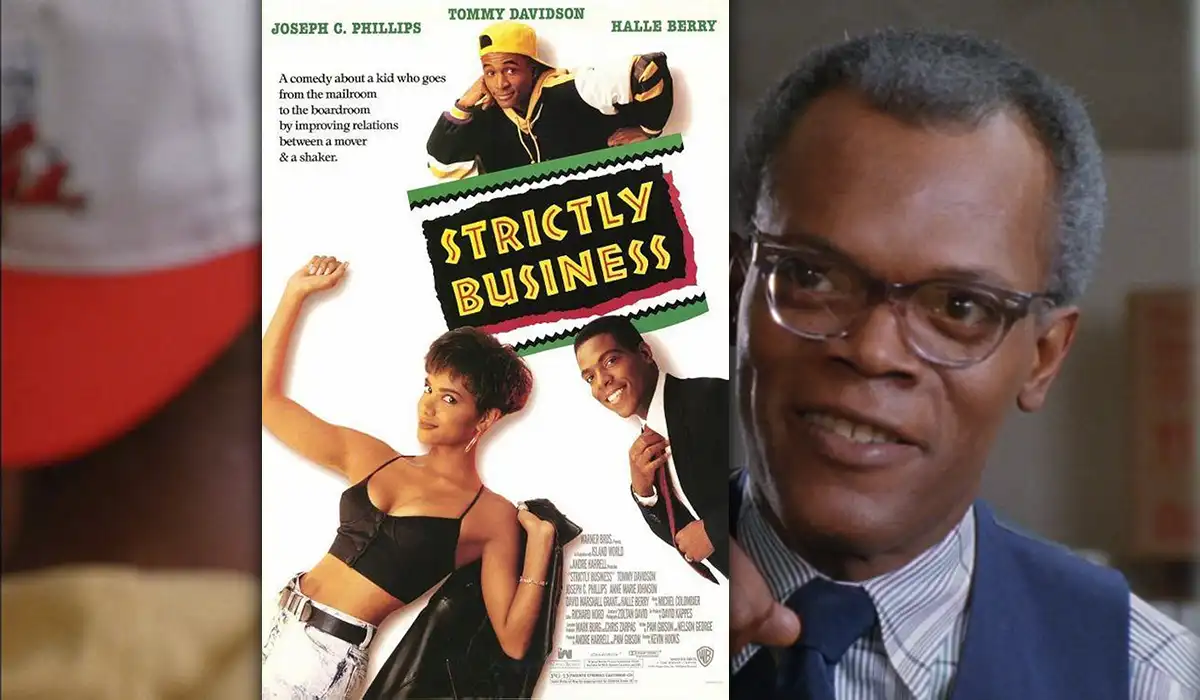
Synopsis: Sharp social satire in which the uneven friendship between an ambitious Black businessman and his streetwise pal is thrown into further confusion when the professional falls in love with a mind-numbingly gorgeous waitress.
Director: Kevin Hooks and Rolando Hudson
Stars: Tommy Davidson, Joseph C. Phillips, Anne-Marie Johnson, Samuel L. Jackson, Halle Berry
There is a special collection of movies with strong ‘rewatchability’ — films that may not be award show darlings but are enjoyable nonetheless.
I call these films Whittier Classics, and to share some of my favourites, I’m launching a series of classic reviews. First up is Strictly Business (1991), a comedy that lands differently through a 2026 lens, but it still holds up today.
It’s the tale of Waymon Tisdale III (Joseph C. Phillips), a Black businessman making his way up the corporate ladder. Waymon is hardworking and focused, perhaps to the point where he has forgotten what it’s like to have fun. Waymon is dating Diedre (Anne-Marie Johnson), but it seems they’ve settled for each other because they meet each other’s checklist of what an ideal partner should be.
On the opposite end of the spectrum, Bobby (Tommy Davidson) is far from hardworking. He parties late and gets into work even later, which means he regularly has to deal with the disapproval of his supervisor, Monroe (Samuel L. Jackson).
Waymon has promised to get Bobby into a trainee program, but complications arise when Bobby’s fellow mailroom colleague Gary (Sam Rockwell) has recently been placed into the program by David (David Marshall Grant), a peer of Waymon’s who is quietly attempting to outmanoeuvre him for a promotion.
Meanwhile, Waymon’s world is about to turn upside down, and it’s not because of the partner role he is chasing. Everything changes when he lays eyes on Natalie (Halle Berry), whose presence leaves him speechless. To say he is crushing is a massive understatement.
As luck, and cinema magic, would have it, Bobby happens to know Natalie and strikes a deal with Waymon: He’ll clean up his act at work and introduce Waymon to his dream girl, and in return, Waymon will finally get Bobby placed in the training program.
While none of us can plan for when love arrives, the timing isn’t great for Waymon, who must deal with a controlling girlfriend, a vengeful co-worker and figure out how to woo his new crush. How hard can that be?
What makes Strictly Business especially interesting is revisiting its cast more than three decades later. Berry’s film career was in its infancy, and Samuel L. Jackson was still far from being a household name. The two also appeared in Spike Lee’s Jungle Fever (1991), where they were given heavier dramatic material and showed glimpses of the powerful performers they would become.
And they’re not alone. The cast includes a young Sam Rockwell, long before his own Oscar-winning career. In addition, Tommy Davidson would become synonymous with In Living Color (1990-1994), and Joseph C. Phillips would go on to have a lengthy television career.
It’s fascinating watching Strictly Business today knowing what lay ahead for so many members of this cast.
But one of the biggest stars of the movie isn’t actually on screen.
It’s the soundtrack.
Strictly Business is a genuinely outstanding time capsule of early 90s R&B, hip-hop and New Jack Swing. The film arrived during an incredible period for Black music, and the creators behind the soundtrack understood exactly what they had.
The production talent is ridiculous. Heavyweights including Heavy D, Leaders of the New School, LL Cool J, Nice & Smooth, Jodeci and other major figures from that era helped give the movie an unmistakable sound. The soundtrack doesn’t simply accompany the film; it gives Strictly Business much of its personality.
This is one of those movies where the music immediately transports you back to a particular time. The clothes, hairstyles, clubs, dancing and soundtrack combine to make the film feel like a snapshot of Black culture in the early 1990s.
There is also something else about Strictly Business that deserves more appreciation.
Waymon Tisdale III is a Black professional who wants to succeed. That may not sound revolutionary in 2026, but context matters. This was 1991.
Hollywood wasn’t exactly overflowing with mainstream movies centred around young Black professionals climbing the corporate ladder. Waymon isn’t presented as someone’s sidekick or simply a supporting character helping someone else’s story move forward. His career, ambition, relationships and future are the story.
He’s educated. He’s successful. He’s ambitious. He walks into corporate spaces with the expectation that he belongs there, even when some of the people around him might think otherwise.
There is an empowering quality to that.
The movie also creates an interesting contrast between Waymon and Bobby. They come from different worlds and seem to have very little in common, but each has something the other needs. Waymon can open a professional door for Bobby, while Bobby can introduce Waymon to a world outside the corporate bubble he has built around himself.
Waymon needs to loosen up, but the movie doesn’t suggest that his ambition is something he should apologize for. Bobby needs to become more responsible, but his personality and connection to his community aren’t treated as weaknesses.
That dynamic is where Tommy Davidson shines. Davidson brings tremendous energy to the movie, and his chemistry with Phillips is a major reason Strictly Business works. Bobby could have easily become an irritating character, but Davidson makes him incredibly likeable. He’s funny, charismatic and brings an unpredictability that balances Waymon’s more reserved personality.
Now, is Strictly Business perfect?
Absolutely not.
Some elements haven’t aged particularly well. It reminded me of my annual watch of Love Actually (2003). It’s a great movie, but you look at it differently with a present-day lens.
Waymon’s pursuit of Natalie can feel superficial, and at times she’s framed more as the beautiful woman Waymon needs to win than a fully developed character. With a run time of less than 90 minutes, there was room to flesh this out more. Instead of seeing that his attraction runs deeper than the superficial, we are left with . . . how would we say it today . . . Waymon be thirsty! Certain relationship dynamics and workplace situations would be handled very differently if the movie were made now.
There are also moments where the movie feels like it’s juggling too many things at once. It’s a romantic comedy, workplace comedy, buddy movie and social commentary all rolled together, and those ingredients don’t always blend perfectly.
But perfection isn’t a requirement for becoming a Whittier Classic.
Enjoyment is.
And I still enjoy Strictly Business.
There’s an infectious confidence running through the movie. The music is fantastic. The cast is loaded with future stars. Tommy Davidson is hilarious. Joseph C. Phillips makes Waymon someone you want to see succeed, and watching an extremely young Halle Berry and Samuel L. Jackson before their careers exploded adds another level of enjoyment all these years later.
This was before Halle Berry went on to become the one and only Black woman to win an Academy Award for Best Actress and before Sam Rockwell won a Best Supporting Actor Oscar. And of course before Samuel L. Jackson was inhabiting characters that were warming us for “I’ve had it with these motherfing snakes on this motherfing plane!”
Most importantly, there is something genuinely inspiring about a movie from 1991 placing an ambitious Black businessman at the centre of its story.
Waymon wants the career. He wants the promotion. He wants love. He wants happiness. And the movie allows him to pursue all of those things without suggesting he has to choose between professional success and being true to himself.
More than 30 years later, some of the jokes have aged, some of the situations have aged, but the energy hasn’t, and the music certainly hasn’t.
Watching a young Black professional unapologetically pursuing success while discovering that there’s more to life than what’s written on his résumé remains as appealing today as it was back in 1991.
Strictly Business has flaws, but it also has heart, humour, an incredible soundtrack and an empowering message underneath all the early-’90s fashion and New Jack Swing.
That’s more than enough to earn a place among my Whittier Classics.
Grade: C+