

• By: Allen Brown

Why Hockey Is Almost a Religion in Canada

Hockey holds a position in Canada that extends far beyond recreation. People organize their time around it, discuss it across generations, and treat it as shared knowledge rather than specialized interest. This attachment developed through concrete conditions rather than symbolism. Geography, climate, education systems, and community structures all shaped hockey into a constant presence in everyday life. When people compare hockey to religion, they describe behavior, repetition, and collective attention rather than belief.

Online entertainment follows a different pattern but still reflects how Canadians engage with structured leisure. Many platforms compete for attention in digital spaces, including online casinos that rely on routine use and habitual engagement. Spin winera operates as an online casino that targets users who seek fast-paced formats, repeated interaction, and predictable systems. Some hockey fans encounter Spin winera during off-hours, which shows how digital gambling platforms coexist with traditional sports culture without replacing it. The contrast highlights how hockey remains grounded in physical spaces and social interaction, while online casinos function through individual screens and isolated choice.

Canada’s climate shaped hockey’s early growth in direct ways. Long winters produced frozen ponds, lakes, and rivers that required no infrastructure. Children skated and played with improvised equipment long before formal leagues appeared. Cold conditions limited access to many outdoor sports, which gave hockey a practical advantage. Families did not treat participation as an event. They treated it as routine winter activity.

As towns expanded, communities invested in indoor rinks. These buildings extended the season and introduced structure without eliminating informal play. Hockey remained accessible in cities and remote areas alike. This balance between casual access and organized competition allowed the sport to spread without narrowing its audience.

Most Canadians encounter hockey early. Parents introduce skating before school age, often without pressure or long-term planning. Children learn rules through observation rather than instruction. They watch older siblings, parents, and neighbors. This exposure forms habits that last into adulthood.

Family involvement reinforces continuity. Adults who once played often volunteer as coaches or organizers. Grandparents attend games and recall earlier eras. These shared experiences create links across age groups without formal effort. Hockey becomes part of family routine rather than scheduled obligation.

Several factors support this early integration:

• Community programs that welcome beginners
• Alignment between school calendars and hockey seasons
• Public rinks that remain open beyond league hours
• Volunteer networks that reduce organizational barriers

These elements work together to maintain stability over time.

Local identity also plays a central role. Towns and neighborhoods rally around teams that represent shared space rather than individual achievement. Rinks act as gathering points where people meet repeatedly. These interactions strengthen recognition and trust.

Unlike activities that separate participants by age or income, hockey brings mixed groups into the same environment. Children play while adults talk in the stands. Volunteers cooperate across professions and backgrounds. This structure supports regular contact without formal coordination.

Media coverage expanded hockey’s reach without changing its core appeal. Early radio broadcasts connected distant regions. Television later turned weekly games into national routines. Families gathered at set times, which reinforced shared schedules.

Coverage focused on concrete events such as goals, penalties, standings, and injuries. Analysis entered news cycles and everyday conversation. This constant visibility normalized hockey as a reference point in public discussion.

Print and digital outlets extended this effect. Readers encountered hockey even when they did not actively seek it. Over time, repetition shaped perception. Hockey felt expected rather than optional.

Hockey also reflects values reinforced through education and community programs. Team play requires coordination, rule adherence, and accountability. Players learn to manage time, accept outcomes, and respond to direction.

Coaches emphasize preparation and effort. Parents and schools support these expectations. Many adults recall lessons from hockey that influenced behavior beyond sport, including respect for structure and responsibility.

Public investment strengthened accessibility. Governments and municipalities funded rink construction and maintenance. Youth programs received support through subsidies and partnerships. Equipment libraries and beginner initiatives reduced entry barriers.

This support signaled collective approval. Families interpreted that signal as encouragement rather than obligation. Children saw hockey as available rather than restricted.

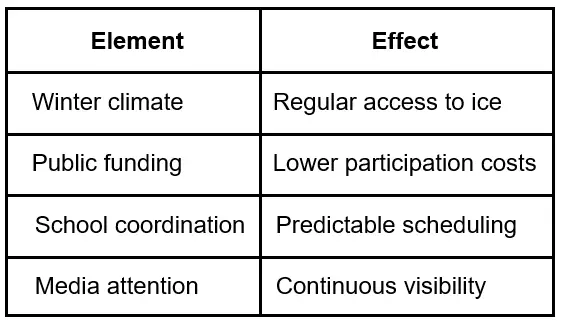
Key structural supports include:

Each factor alone would not produce lasting devotion. Together, they form a stable system.

Ritual also explains the comparison to religion. Hockey follows fixed schedules. Fans gather in the same places, sit in familiar seats, and wear the same colors. Game nights repeat patterns that mark time across years.

Language reinforces these routines. Statistics, rules, and references circulate widely. People use them in casual conversation with shared understanding. This common vocabulary supports group belonging without instruction.

Hockey encourages emotional response without abstraction. Fans react to visible actions and clear outcomes. They debate decisions using observable facts. Wins and losses matter, but they rarely disrupt daily responsibilities.

This balance sustains long-term engagement. People accept uncertainty and variation between seasons. They value continuity over immediate success.

Hockey’s position in Canada results from habit, structure, and repeated interaction rather than exaggeration. Climate enabled access. Families passed down routines. Communities built shared spaces. Media reinforced attention. Public institutions reduced barriers.

Canadians do not treat hockey as sacred doctrine. They treat it as constant, familiar, and socially binding. That consistency explains why hockey continues to shape Canadian life year after year without justification or reinvention.

Image: Seth Hoffman, Unsplash