Why More Ottawa Men Are Skipping the Rack and Having Their Suits Made
Ask around the Hill and you’ll hear a version of the same story. The two-suit-a-year habit is gone. Business casual won the argument somewhere around 2021 and never gave the ground back. But the occasions that still require a proper suit — a swearing-in, a call to the bar, a funeral, a wedding, a first day in a new role — haven’t disappeared. They’ve just become rarer and, for that reason, more consequential.
The result is a shift you can see in Ottawa’s menswear market: fewer suits bought, more attention paid to each one. And for a growing number of men in the capital, that has meant leaving the rack behind entirely.
The capital has always dressed on its own terms
Ottawa’s dress code is a specific thing. It is not Toronto’s finance-floor formality and it is certainly not Montreal’s. It’s a mix of public service restraint, legal-profession convention and a diplomatic circuit that still runs on black tie several times a year. Add a wedding season compressed into roughly four months and a climate that demands an overcoat you’ll actually wear, and you get a wardrobe that has to work harder than most.
That combination has always supported good menswear here, from long-standing independents like Jimmy Suits on Gladstone Avenue to the tailoring counters at the Rideau Centre. What’s changed is where the growth is.
Made-to-measure, bespoke, off-the-rack: the difference matters
These terms get used interchangeably in advertising, and they shouldn’t be.
Off-the-rack is a finished garment in a standard size, altered afterwards. Bespoke starts from a paper pattern cut from scratch for your body, usually involves multiple basted fittings, and is priced accordingly — think five figures and several months. Made-to-measure sits between the two: an existing block pattern is modified to your measurements, posture and proportions, then cut and made to order.
For most people, made-to-measure is the sensible middle. You choose the cloth, the lapel, the lining, the buttons, the pocket style, the trouser rise. You get a fit built around your actual shoulders rather than a size chart. And you avoid the compromise that trips up most rack purchases, which is buying for your chest and then paying a tailor to fight the rest of the jacket into submission.
The fabric is where the money goes
The single largest variable in a custom suit is cloth. Most reputable showrooms in Canada work from swatch books supplied by European mills — Dormeuil, Holland & Sherry, Vitale Barberis Canonico, Drago, Loro Piana — with weights typically expressed in grams per metre.
That number matters more here than it does in London or Milan. A 240g summer-weight cloth is unwearable in an Ottawa January; a 400g flannel is punishing in July. If you’re commissioning one suit, a mid-weight worsted wool in the 280–320g range will carry you through most of the year. The Woolmark Company publishes useful primers on how weave and weight affect drape and durability, and it’s worth ten minutes of reading before your first appointment.
Whatever you choose, expect to be shown far more options than you need. That’s the point — and the reason a first appointment runs closer to two hours than twenty minutes.
Where to start in Ottawa
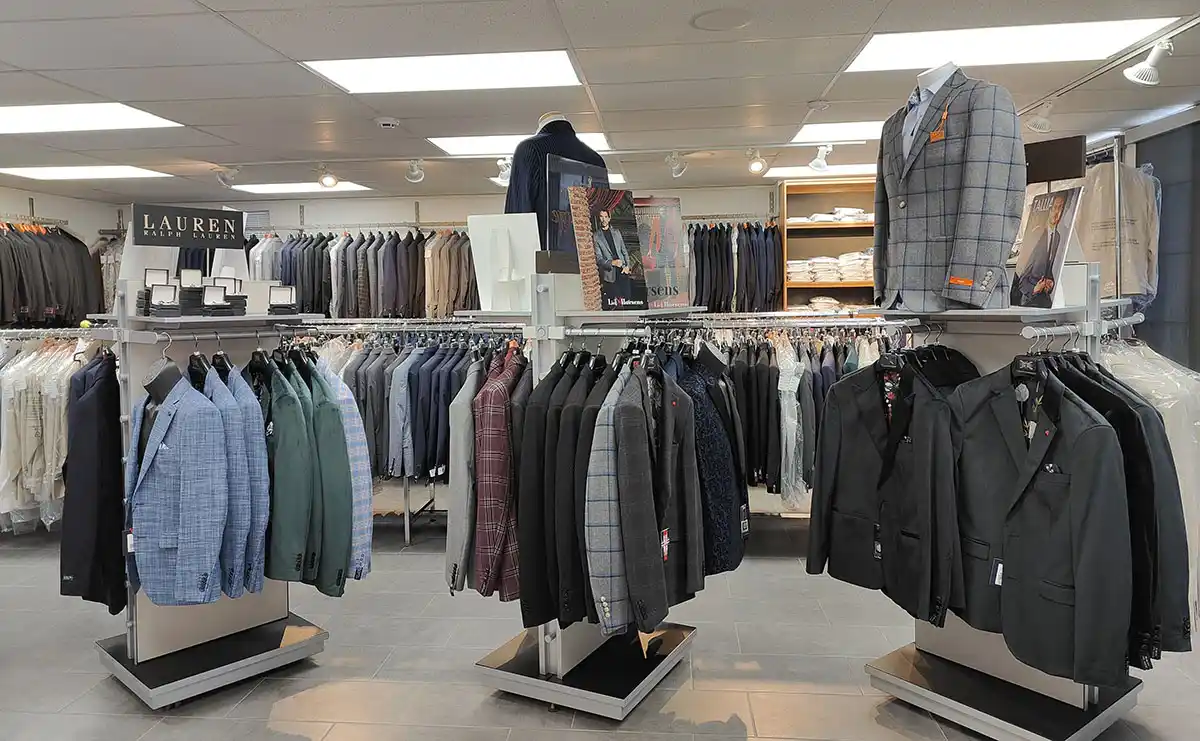
The capital’s made-to-measure options have quietly multiplied. French tailoring house Blandin & Delloye has operated a showroom at 251 Laurier Avenue West since 2023, a two-minute walk from Parliament Hill, working on an appointment-only basis. Surmesur and Mario Uomo both serve the market with their own approaches, and several established retailers now run made-to-measure programs alongside their regular stock.
What they share is a process rather than a storefront. There is no browsing. You book, you’re measured, you choose, you wait. Delivery generally runs six to eight weeks, followed by a fitting and any alterations. Plan backwards from the date you need the suit, not forwards from the day you feel like shopping.
Wedding season: start earlier than you think
If there’s one piece of advice worth repeating, it’s this. Ottawa’s wedding calendar clusters heavily between May and October, and showrooms book out accordingly. A groom starting in April for a July wedding is cutting it fine. Three to four months gives room for the fitting, any adjustments, and the weight fluctuation that tends to accompany the run-up to a wedding.
It also gives you time to coordinate. If the wedding party is being outfitted together, the fabric needs to be reserved in one lot — mills don’t always have unlimited stock of a given cloth, and a second order placed six weeks later can come back a shade off.
If your work pulls you down the 401
A practical note for the significant number of Ottawa professionals who spend part of their month in Toronto. Once a house has taken your measurements and built your pattern, that file typically travels with the brand rather than the branch. Blandin & Delloye, for instance, keeps client patterns across its network, so someone measured on Laurier Avenue can later order custom suits in Toronto at the firm’s Davenport Road showroom without repeating the whole process.
It’s a small thing that turns out to matter. If you’re in Toronto for a Tuesday meeting anyway, a fitting appointment slots into the afternoon far more easily than a dedicated trip home. Worth confirming with any tailor before you commit — not every operation shares patterns between locations.
Before your first appointment
Four things will make the experience better. Bring the shoes you intend to wear with the suit, because trouser length is set against them. Have a clear occasion in mind, since a wedding suit and a working suit are different garments. Be honest about how you actually sit, walk and carry your phone. And resist the urge to be adventurous on your first commission — the interesting cloth is much easier to justify once you already own something navy that works.
The broader trend is one we’ve tracked in these pages for a while: quality over volume, fewer pieces, longer lives. Made-to-measure is simply that idea applied to the most structured garment most men own.
Photo: Beryl Menezes