
Silent Architect in Ottawa: The NCC Shapes (and Misshapes) Our Capital City
Canada’s capital didn’t always resemble the polished landscape of monuments, green spaces, and ceremonial boulevards we see today. In the late 1800s, Ottawa was often described as a cluttered industrial town—hardly befitting a national capital. That perception began to shift thanks to leaders like Prime Minister Wilfrid Laurier, who envisioned a capital that would reflect the country’s dignity and aspirations. This vision eventually led to the creation of the National Capital Commission, or NCC, in 1959, through the National Capital Act.
Today the NCC remains the federal Crown corporation tasked with planning, preserving, and managing federal lands and heritage in the National Capital Region, in Ottawa and Gatineau, Quebec. Its purpose is to ensure that the capital isn’t just functional—it’s symbolic. From overseeing Gatineau Park and the Greenbelt to managing official residences like Rideau Hall and 24 Sussex Drive, the NCC plays a central role in shaping how Canada’s capital looks and feels.
But while the NCC has helped transform Ottawa-Gatineau into a more cohesive and ceremonial space, its legacy hasn’t been without controversy. Over the years, it has faced legitimate criticism for cost overruns, bureaucratic delays, and questionable decision-making. One notable example was its insistence that the western extension of Ottawa’s LRT be buried underground to preserve scenic views—an aesthetic choice that added significant costs to the project. Critics, including former city councillors, have argued that such decisions impose unnecessary financial burdens on local taxpayers while serving a national vision that doesn’t always align with local needs.
The NCC has also struggled with infrastructure upkeep. According to an auditor general’s report, a significant portion of its assets—including bridges, parks, and heritage buildings—are in poor or critical condition due to chronic underfunding. The Hog’s Back Swing Bridge, for instance, has faced repeated closures due to mechanical and electrical failures, frustrating commuters and raising questions about long-term maintenance planning.
Beyond infrastructure, the NCC has been accused of political manoeuvring. In 2015, a controversial shake-up of its board—stacked with appointees tied to the governing party—sparked concerns about partisanship in what is supposed to be a non-partisan institution. In the case of the Château Laurier addition, the NCC was criticized for remaining silent during a heated public debate over the design of a new wing to one of Ottawa’s most iconic buildings, despite its proximity to federally managed lands.
Governance of the NCC is another point of contention. Its board members are appointed by the federal government and come from across Canada—not necessarily from Ottawa or Gatineau. While this ensures a national perspective, it can also mean that decisions affecting local communities are made by individuals with either limited or no connection to the region.
Despite these challenges, the NCC remains a powerful force in shaping Canada’s capital. Its mandate—to create a capital that reflects the country’s values and heritage—is ambitious and necessary. But as Ottawa continues to grow and evolve, the NCC must balance national symbolism with local practicality, and ensure that its decisions serve not just the image of Canada, but the people who live at its heart.
Moments of Success: When the NCC Shines
The NCC River House
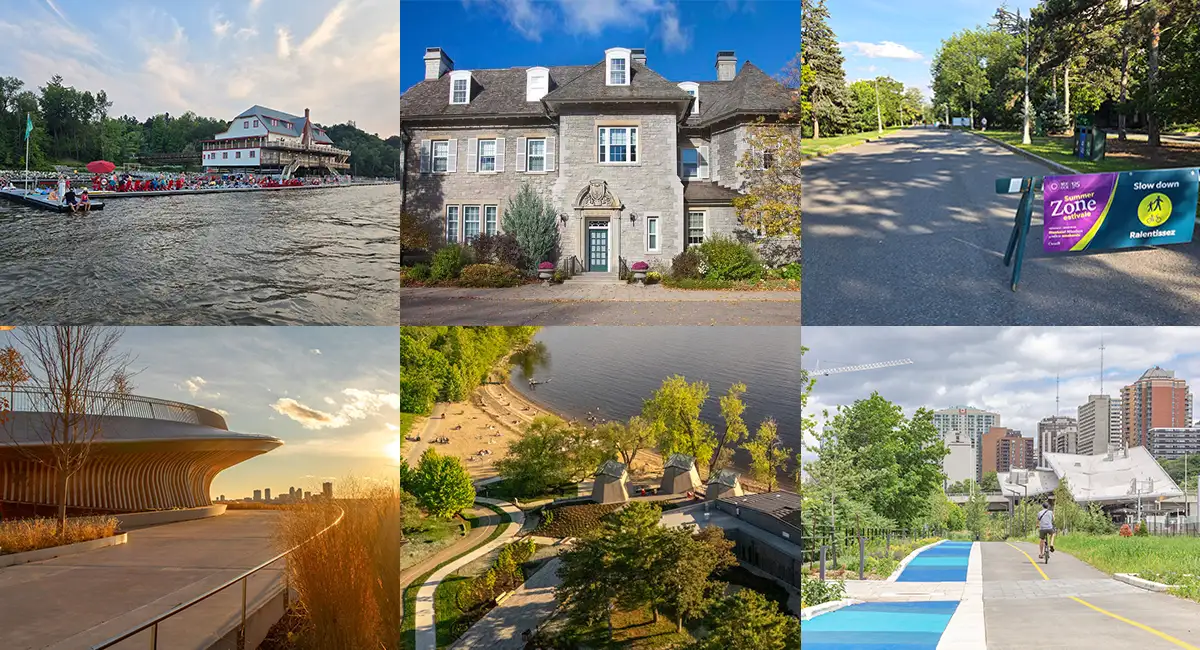
The NCC River House, located along the Ottawa River near Rockcliffe Park, is a century-old heritage building that has been thoughtfully restored into one of the capital’s most inviting public waterfront destinations.Originally built between 1914 and 1925 by the Ottawa New Edinburgh Canoe Club (ONEC), the building was designed by architect C.P. Meredith and served as a hub for boating, canoeing, and community recreation. It was designated a Federal Heritage Building in 2010.By the late 2010s, the structure had fallen into disrepair. In 2019, the NCC launched a major revitalization project to preserve the building’s heritage character while making it accessible and functional year-round.
Over four years, a team of architects, engineers, and heritage specialists carried out extensive upgrades: restoring wood siding, replacing windows, installing thermal insulation, and adding a new pedestrian bridge to connect the site to the Sir George-Étienne Cartier Parkway. Accessibility was a key focus. The renovation included universal access paths, an elevator serving all three levels, and improved parking and pedestrian crossings. The shoreline was also reimagined to include a public dock and enclosed swimming area, with lifeguard supervision and regular water quality testing by the Ottawa Riverkeeper.
The NCC River House officially reopened in July 2023, with a total renovation cost of approximately $20 million, funded through federal deferred maintenance programs. The River House has swiftly earned its place as one of Ottawa’s most cherished waterfront destinations, drawing both locals and tourists alike with its unique mix of historical charm, riverside tranquility, and laid-back recreation.
Now a go-to summer hangout, it offers casual dining, event rentals, and expansive balconies that overlook the Ottawa River. Guests come to swim, paddle, enjoy a scoop of gelato from the onsite café, or unwind in Muskoka chairs lining the dock—all just minutes from downtown, yet a world away in atmosphere. As NCC CEO Tobi Nussbaum put it, “This was a real centre of recreation in the National Capital Region a hundred years ago… In some ways, it’s back to the future”.
Westboro Beach Redevelopment
One recent success has been the redevelopment of Westboro Beach, featuring a new pavilion and upgraded amenities. The revamped beach fully reopened to public access for the 2025 summer season, with the public praising the NCC for its work improving the area. The project cost the NCC $21 million to complete, with $13 million of the funds contributed by the City of Ottawa. The new pavilion features accessible amenities, including a café, ample public seating, updated washrooms, and new lifeguard stations, as well as sports areas and other upgraded amenities.
Construction of Kìwekì Point
Kìwekì Point, formerly known as Nepean Point, stands as one of Ottawa’s most iconic lookouts—a hilltop perch between the National Gallery of Canada and the Alexandra Bridge, offering sweeping views of the Ottawa River and the city beyond. Managed by the National Capital Commission (NCC), the site has been a cultural landmark for over a century.
Originally named after British colonial administrator Evan Nepean, the hill became home to a statue of French explorer Samuel de Champlain in 1915, famously depicted holding his astrolabe upside-down. In 1918, a sculpture of a kneeling Anishinabe scout was added to recognize the guidance Indigenous peoples gave Champlain on his travels. That statue was relocated to Major’s Hill Park in 2013 and renamed Kitchi Zibi Omàmìwininì, honouring Algonquin heritage.
For decades, Nepean Point was a popular destination for summer concerts, public art, and quiet reflection. It was home to the Astrolabe Theatre—an outdoor amphitheatre space that hosted countless performances. In 2017, as part of celebrations marking Canada’s 150th anniversary, the National Capital Commission launched a design competition and ultimately selected the “Big River Landscape” concept by Janet Rosenberg & Studio. The Canadian team, which included architects, landscape designers, structural engineers, and heritage specialists, envisioned a modern, inclusive public space to honour the site’s layered history and deeper cultural significance.
Throughout the planning, the NCC worked closely with Algonquin representatives from Kitigan Zibi and Pikwàkanagàn to ensure their cultural perspectives were reflected not only in design, but in meaning. In 2022, the site was renamed Kìwekì Point—an Algonquin word meaning “returning to one’s homeland”— acknowledging its location on unceded Algonquin territory and underscoring a broader commitment to reconciliation.
In May 2025, the site officially reopened to the public with a final redevelopment cost of $45 million. It features gently sloped pathways, panoramic viewing platforms of the Ottawa River and city skyline and a sculptural shelter. A pedestrian bridge connects Kìwekì Point directly to Major’s Hill Park, making it more accessible to visitors from across the city. “The renaming and naming of these assets demonstrates the NCC’s commitment to the recognition of Indigenous peoples, particularly the Algonquin Nation as the host nation of the National Capital Region,” said NCC Chief Executive Officer Tobi Nussbaum in a statement following the renaming.
Failures And A Growing Disconnect
The NCC has delivered some standout WINS in recent years—but those wins are offset by a disconcerting string of tone-deaf decisions that suggest a disconnect between vision and execution.
24 Sussex Drive
When Justin Trudeau became prime minister in 2015, he declined to move into 24 Sussex Drive, citing serious health and safety concerns. The residence—Canada’s official home for its head of government—was riddled with asbestos, outdated electrical systems, and structural decay. Instead, Trudeau opted for Rideau Cottage, located across the street on the grounds of Rideau Hall.
That decision marked the beginning of a long vacancy at 24 Sussex. By 2022, the National Capital Commission (NCC) formally decommissioned the property, closing it to visitors and launching a $4.3 million abatement project to remove asbestos, strip out obsolete infrastructure, and salvage what remained of the building’s heritage elements.
Today, Prime Minister Mark Carney also resides at Rideau Cottage. Despite its modest name, the building is a 10,000-square-foot Georgian Revival home with 22 rooms. Originally built in 1867 for the Governor General’s secretary, it has since served as a guest residence and temporary home for dignitaries. While not ideal for a sitting prime minister—security and space limitations persist—it remains the most viable option while 24 Sussex languishes in limbo.
For nearly a decade, 24 Sussex has stood empty, deteriorating under the NCC’s watch. Once a symbol of Canadian leadership, the residence now represents decades of deferred maintenance and bureaucratic paralysis. In a 2024 interview with CFRA Radio, Ottawa developer Steve Barkhouse described the building’s condition as “a clear sign of neglect,” pointing to widespread water damage, mould, and structural issues. Barkhouse estimated that the cost to restore the property—originally pegged at $36.6 million in 2021—has now climbed to roughly $42 million when adjusted for inflation.
That figure may sound excessive, but it’s in line with the cost of luxury homes in Toronto’s Bridle Path or Vancouver’s Billionaire’s Row. The difference? 24 Sussex isn’t a luxury home—it’s a gutted shell with rodent infestations, asbestos contamination, and no functioning infrastructure. The NCC has spent more than $680,000 between 2018 and 2023 solely to maintain the vacant property, covering expenses such as boiler repairs, pest control, janitorial services, and even pool cleaning.
Despite its reputation, there’s a strong case to be made that 24 Sussex is not a true historic building. Constructed between 1868 and 1888 by lumber baron Joseph Merrill Currier, it wasn’t designated as the prime minister’s residence until 1951. Its heritage classification by the Federal Heritage Buildings Review Office (FHBRO) is largely based on its symbolic role, rather than its architectural distinction. Unlike Rideau Hall or Laurier House, 24 Sussex lacks the craftsmanship, public accessibility, and historical continuity that typically define national heritage sites.
For over four decades, successive governments and the NCC have avoided making a decision about the future of 24 Sussex. Proposals to renovate, rebuild, or relocate the residence have circulated since the 1980s, yet no action has been taken. Prime Minister Carney recently stated that resolving the issue is “not a challenge for this mandate,” effectively kicking the can further down the road.
The reality is clear: Canada needs a modern, secure, and functional residence for its prime minister—one that reflects national values and meets today’s standards. Rebuilding on the existing site, while preserving select heritage elements, would be more practical and cost-effective than pouring tens of millions into a structure that no longer serves its purpose.
24 Sussex may carry symbolic weight, but symbols alone don’t justify endless spending. It’s time to stop romanticizing a building that’s become more liability than legacy—and start building one that actually works.
Closing Crucial Roadways
The NCC’s handling of Queen Elizabeth Driveway (QED) closures offers a textbook example of how the agency can act unilaterally—even when its decisions clash with public sentiment, city leadership, and basic logic. NCC Bike Days began in the 1970s as a well-received initiative to promote active transportation by temporarily closing scenic parkways to vehicles. The program has grown steadily, and by 2020, the NCC expanded it to include Queen Elizabeth Driveway (QED), closing a two-kilometre stretch daily from May to October.
What started as a pandemic-era measure to support physical distancing morphed into a full-season closure, even during peak commuting hours. In 2023, Ottawa Mayor Mark Sutcliffe publicly challenged the NCC’s decision, posting a video that questioned the rationale behind keeping QED closed to cars seven days a week. He cited traffic data showing that the road was often empty for long stretches—sometimes 30, 45, or even 90 seconds at a time—while other streets saw thousands of cyclists daily. Sutcliffe called for a more balanced approach: open QED to vehicles during busy hours and reserve it for cyclists during off-peak times.
The NCC’s Queen Elizabeth Driveway saga is a perfect example of what happens when bureaucracies dig in their heels and forget who they’re supposed to serve.
Local businesses echoed the concern. The Ottawa Sports and Entertainment Group warned that the closure was hurting access to Lansdowne Park and discouraging tourism. Residents in the Glebe reported a surge in traffic through quiet residential streets, turning playground zones into commuter corridors. One citizen told CTV News, “We have great bike paths in this city—we don’t need all the major scenic streets as well.”
But the NCC wasn’t budging. CEO Tobi Nussbaum defended the closure in a letter to the Ottawa Citizen, citing the city’s official plan to “reimagine” QED and Colonel By Drive as pedestrian-first corridors. The problem? That plan also calls for balancing mobility and access—something the NCC appears to have overlooked.
Behind the scenes, things got even messier. Internal emails obtained by PressProgress revealed that the NCC accused the City of Ottawa of using flawed traffic data and stonewalling efforts to collect better information. It was a bureaucratic standoff that felt more like a turf war than a public planning process.
Eventually, the NCC scaled back the closure for 2025, limiting it to weekends and holiday Mondays. But the damage was done. The episode laid bare a deeper dysfunction: two levels of government locked in a petty, passive-aggressive battle over a two-kilometre stretch of asphalt, while the people who pay their salaries sat in traffic, wondering if anyone in charge had ever tried commuting without a motorcade.
In the end, it wasn’t about bikes or cars. It was about bureaucratic infighting at the expense of the citizenry. Eventually, in response to mounting pressure, the NCC scaled back the QED closure for the 2025 season, limiting it to weekends and holiday Mondays. But the episode left a lasting impression. It reinforced the perception that the NCC often acts arbitrarily—pushing forward with plans that lack public support, ignore local realities, and create unnecessary disruption.
The QED saga isn’t just about bikes versus cars. It serves as a metaphor about leadership, judgement, ego and governance. And it’s a reminder that when a federally appointed body controls key parts of a city without democratic oversight, even well-intentioned programs can veer into absurdity.
A Real Need to Recalibrate or Reform the NCC
The National Capital Commission (NCC) has earned praise in recent years for its revitalization of public spaces like Kìwekì Point and the River House, and for advancing long-stalled projects such as LeBreton Flats. These efforts reflect a renewed focus on placemaking, heritage recognition, and environmental stewardship. Yet despite these successes, the NCC continues to face persistent criticism over its governance structure and lack of public accountability.
At the heart of the issue is how the NCC is run. Its board of directors is appointed entirely by the federal government, with no public election or direct citizen input. While the mayors of Ottawa and Gatineau were granted seats on the board in 2016, they remain non-voting, ex-officio members. This means that even the elected leaders of the cities most affected by NCC decisions have no formal say in what gets approved. The arrangement has been described by former Ottawa mayor Jim Watson as “unacceptable,” especially when decisions directly impact municipal planning, infrastructure, and housing.
This governance model has led to growing frustration among residents, civic leaders, and urban planners. Major projects—such as the future of 24 Sussex Drive, the redevelopment of LeBreton Flats, and shoreline access—often move forward with limited public consultation. While the NCC does host public meetings and livestreams its quarterly board sessions, these forums rarely offer meaningful influence. A 2018 stakeholder study commissioned by the NCC itself found that many participants viewed the organization as distant and unresponsive to local concerns.
Calls for reform have grown louder. In a 2022 Ottawa Citizen op-ed, municipal affairs columnist Ken Gray argued that the NCC should include elected representation, stating that a body with such sweeping control over the capital should not operate without democratic oversight. Others have proposed revising the National Capital Act to include clearer accountability mechanisms, creating a citizen advisory council to provide input on planning decisions, and mandating binding public consultations for major land-use changes.
These proposals reflect a broader desire for transparency and responsiveness. As Ottawa grows and diversifies, the institutions that govern it must evolve to reflect the voices of those who live here. The NCC has the potential to be a national leader in civic planning—but only if it’s willing to listen, adapt, and share power.
An Opportunity for Change
With the election of the Mark Carney Liberal government, Ottawa finds itself at a crossroads. The capital’s future—its livability, accessibility, and identity—depends not just on visionary projects, but on how they’re shaped, approved, and governed. For years, the National Capital Commission has operated with limited public input, making decisions that often feel disconnected from the communities it affects. From the Queen Elizabeth Driveway saga to the long-stalled fate of 24 Sussex Drive, the pattern is clear: top-down planning with bottom-up frustration.
Public outcry has grown louder, and not without reason. Residents, business owners, and even city officials have repeatedly called for more transparency, more collaboration, and more accountability. Yet, the NCC continues to operate with an appointed board, where even the mayor of Ottawa has no vote. It’s a structure that belongs to another era—one that no longer reflects the complexity or diversity of the city it governs.
Now, with a new federal mandate and a prime minister who has promised to modernize government operations and improve responsiveness across departments, there is a rare window to act. Reforming the NCC isn’t just about fixing a few policies—it’s about restoring trust, empowering communities, and ensuring that the capital reflects the country it represents.
Ottawa doesn’t need another round of consultations that go nowhere. It needs leadership willing to challenge the status quo, dismantle the silos, and build a governance model that actually listens. Because if the capital is meant to be a symbol of Canadian democracy, then surely it’s time we let democracy have a say in how it’s run.
Photos: ncc-ccn.gc.ca