

unemployed Canadian youth and young adults

Generation at Risk: Youth Jobs and Canada’s Economic Future

With Murray Simser


A couple of weeks ago, I wrote in OttawaLife that Canada’s job market was crushing young Canadians; a situation that, in a societal sense, is criminal. And that all Canadians will pay the price if youth unemployment is not given a higher priority. Response to that article was swift and sharp — a strong view that if anything, I had understated the problem. The bleakness and despair in some of the comments cast my mind back to Styx’s Crystal Ball, a favourite in the dorm rooms at St. Francis Xavier University in the mid to late 70s.

“I wonder what tomorrow has in mind for me, Or am I even in its mind at all. Perhaps I’ll get a chance to look ahead and see. Soon as I find myself a crystal ball.”

“Or am I even in its mind at all”?

Sad but sobering that they may not be on the mind of the current federal government.

Street-level perspective confirms Statistics Canada figures that entry level jobs are disappearing – down nearly 25 perecent since 2022. In a report published August 26th, CIBC stated that “the increase in youth unemployment has gone above and beyond what we would have expected to see given the broader economic backdrop”. The report emphasized that teenage workers were experiencing great difficulty finding part-time work; similarly, those over age 20 and recent graduates could not find full-time work.

One respondent who works in the field of youth services expressed the frustrations of training and mentoring young people, often from marginalized backgrounds only to see them lose jobs to temporary foreign workers or students, or worse, frozen out of the application entirely. The competition is not just for entry level full-time employment but on every level — for student placements, summer jobs through the Government of Canada’s programs, and for other employment supports. The cost to young people is not just monetary and in wages; they lose the opportunity to build their skills and social networks that assist career development down the road.

Some readers provided leads to Reddit sites that feature posts from individuals experiencing difficulties, and other sites that outright allege blatant fraud and scams related to the Temporary Foreign Workers (TFW) program, and the Labour Market Impact Assessment (LMIA) reports that must be filed prior to hiring a TFW. Just one example: “Imagine you’re a small business owner. An immigration consultant approaches you, offering a substantial sum in the thousands of dollars per applicant if you hire foreign workers instead of locals. They also assure you that you can pay these foreign workers low to lowest wages and these imported workers will also pay you a percentage of their wages for the next 2-3 years. 

Just one example, and yes, unsubstantiated, but when dozens of these comment sites proliferate across the country, with thousands participating, something is rotten in the state of Denmark, as the Bard wrote. Don’t believe Reddit? How about CBC? In a story published online in July of last year, CBC alleges the growing problem of fraud and extortion with respect to TFWs and the LMIA process. An entire column could easily be written on this pathetic program!!

The feedback included a number of specific recommendations for change including:

– fixing the credentials bottleneck so that highly qualified individuals can work in their chosen fields rather than compete for entry level jobs;

– renewed focus on the trades, beginning in high school. Not to suggest a return to streaming but we need to build more awareness of the attractiveness of jobs in the trades;

– relevant to this point, is the need to encourage, incentivize and catalyze, youth entrepreneurship;

– as former Prime Minister Jean Chretien campaigned in 1993, “jobs, jobs, jobs”. We need a relentless focus on jobs in the private sector, particularly in the resource sectors. Not everyone lives in a large urban centre; and

– finally, take a serious look at some form of national service, whether mandatory or voluntary as I referenced in my earlier piece.

If you remain unsure as to the depth of the anger that exists, and will continue to grow among young Canadians, let’s take a look at a few Reddit streams, one specific to the Ottawa region. Reddit Ottawa (r/ottawa) claims 352,000 members. A sub-Reddit entitled Ottawa Business LMIA Applicants Name and Shame, highlights local businesses that seek to hire under the TFW program, most of which are in the hospitality/food services sector paying $17 – $25/hour. I’m told that young people in the city are applying en masse to these jobs, knowing they will not get the job but simply to gum up the works.

A second site r/LMIASCAMS which appears to be written by an insider, frankly states that the Trudeau government turned a blind eye to fraudulent LMIAs but recent procedural changes have improved the situation; “I think you guys are doing a good job of naming and shaming these people (bad actors) and it’s gotten results, and will pressure the government to continue on the path that they are on.”

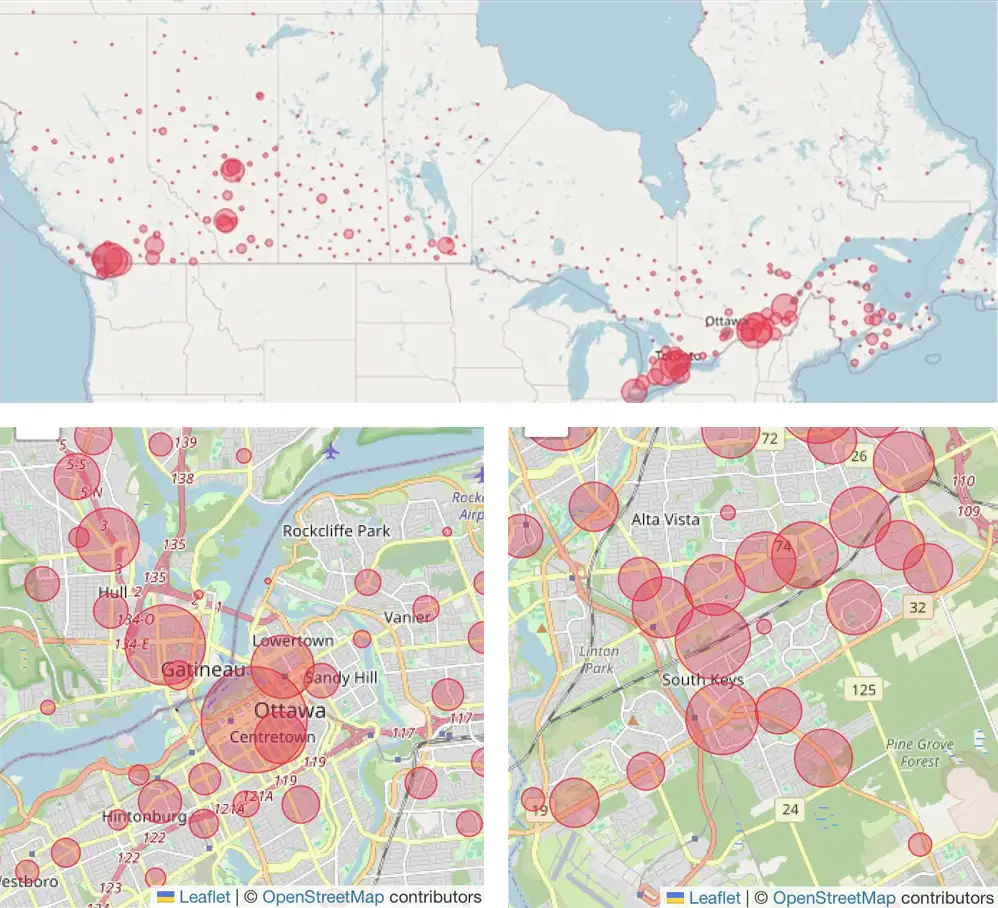
Finally, www.imiamap.org has created a national heat map – basically a visual of the geographical representation of data – of employers seeking TFWs compiled from Statistics Canada quarterly data going back to Q1 2022, searchable by city and, in fact, your own neighbourhood. The following three photos show heat maps for Canada, central Ottawa/Gatineau and the Alta Vista/Heron Gate neighbourhood. Citizen sleuths are taking action and the Government of Canada needs to catch up.

ABOVE: Circles in these visuals show the geographic distribution of employers seeking temporary foreign workers. The larger the circle, the greater the demand. (Screencaptures via www.imiamap.org)


A Multi-tiered Action Plan for Young Canadians

So, what’s to be done? If the Carney government is serious, it needs to act quickly and boldly. Half-measures won’t cut it. That starts with a dramatic overhaul of the TFW program, but it shouldn’t stop there. Young Canadians need employment services that reflect their very different realities — a 16-year-old high schooler doesn’t face the same hurdles as a 28-year-old with a graduate degree. Add to that real progress on credential recognition so highly trained newcomers aren’t forced into entry-level jobs, plus tax rebates to encourage youth hiring, and support for those who want to try their hand at entrepreneurship.

Entrepreneurship deserves its own spotlight. Imagine a Canada where more young people become job creators rather than job seekers — not just looking for work but building businesses, solving problems, and shaping their own futures. The skills that come with it — leadership, financial literacy, adaptability — are exactly the kind of tools young people need to survive in an economy that seems to reinvent itself every five minutes. Youth entrepreneurship may more quickly identify market gaps, craft innovative new products and services that both meet consumer needs and tackle complex societal challenges. We’ll dive deeper into this theme in an upcoming piece.

On the TFW file, it’s time to return to basics. Agricultural workers and a narrow set of highly specialized professions — fine. But a work visa should be for months, not years. Employers still have the International Mobility program to draw on for genuine skill gaps. Announce a clear wind-down and give notice: in six months to a year, this program will be tied off.

And corporate Canada needs to be called out. The Prime Minister should host a high-profile summit with CEOs and lay it out plainly: hire young Canadians first. If you don’t show up to that table, you’re sending a message, and not a flattering one. There is no good reason why giants like Tim’s, Canadian Tire, or Walmart should be staffing front-line positions with foreign workers while young Canadians sit idle. Federal departments should lead by example too — no more hiring non-citizens into entry-level roles.

Funding matters too. The YESS (Youth Employment and Skills Strategy) is running on fumes compared to the size of the challenge. It’s impossible to scale community programs that provide training, mentorship, and placements without serious new investment. The next Budget needs a dedicated envelope that matches the scale of the crisis.

Looking longer term, there are five areas that deserve special attention:

1. Tax incentives for youth hiring. Make it easier for companies to give young people a shot, perhaps through EI reform that also accounts for gig workers.
2. A national co-op program. No more entry-level coding jobs going to TFWs while Canadian grads wait.
3. National service. Time to have a real conversation about what that could look like.
4. AI literacy and training. The Americans have laid out a bold workforce plan; Canada should not be left behind.
5. Entrepreneurship. Not an afterthought, but a core strategy for building resilience and experience.

To Govern Is to Choose

Pierre Mendès-France once said, to govern is to choose. Nigel Lawson sharpened the line: to appear unable to choose is to appear unable to govern. And choices are exactly what the federal government faces.

Take a look at the numbers. Budget 2024 set aside $351 million for YESS — including $200M for Canada Summer Jobs — leaving just $150M to cover the rest. Compare that to a $3.7 billion bump for seniors’ pensions, $791M for refugee health care, another $2B for Ukraine, or the billions flowing to EV battery plants. All defensible in their own way, but when it comes to youth employment, the cupboard is bare.

Money is always found for other priorities. The question is whether this government is prepared to choose young Canadians. As the Templar knight told Indiana Jones, “You must choose. But choose wisely.”


Murray Simser is the CEO of CITIZN AI. He is a Silicon Valley founder, alumnus and serial entrepreneur on youth entrepreneurship whose first love is politics in all its forms.