
Carney’s Agenda Is Power. The Risk Is Execution

Prime Minister Mark Carney is attempting to reorient Canadian governance around power rather than posture. He is speaking openly about a “new world order,” economic coercion, and the end of the comfortable assumptions that defined the post-Cold War period. In doing so, he is acknowledging something Canadian politics has long resisted: sovereignty today is earned through capacity, not rhetoric.

That diagnosis is largely correct. The question is whether his government’s response is sufficiently grounded in execution, alignment, and discipline to match the scale of the challenge he has identified.

Carney’s agenda is not ideological. It is managerial. He is trying to shift the federal government away from a culture of process and toward one of delivery. The Major Projects Office, the Building Canada Act, and a federally backed housing delivery vehicle all point in the same direction. Ottawa is being retooled to decide how projects get built, not merely whether they should proceed.

This is a meaningful departure from recent practice. For more than a decade, federal power was exercised through incentives, consultations, and symbolic alignment with social objectives. Responsibility for outcomes was fragmented. Timelines were elastic. Results were often secondary. Carney is clearly trying to reverse that logic. But intent alone does not confer capability.

Regionally, the agenda remains politically brittle. Western provinces want speed and export capacity. Ontario wants competitiveness and housing supply. Quebec wants infrastructure without federal overreach. Atlantic Canada wants connectivity and opportunity. These interests do not naturally converge. They must be actively reconciled through sequencing and delivery.

That reconciliation will only hold if projects actually move. Announcements without approvals, approvals without construction, and construction without completion will quickly expose the limits of central coordination.

Internally, the Liberal Party is an immediate constraint. The removal of the consumer carbon tax was a tacit admission that policy legitimacy matters. Voters will not tolerate visible costs without visible benefits. Carney appears to be substituting household-level pain with industrial-level systems: pricing where emissions are produced and investing where reductions can be delivered.

That substitution is rational. It is also unstable. A party long accustomed to moral certainty on climate must now reconcile itself with energy development, carbon capture, and tradeoffs that resist activist simplification.

The greatest risk lies in foreign policy and trade. Carney’s rhetoric increasingly signals strain and confrontation. Some of this may be descriptive. Some may be strategic. Viewed through the lens of game theory, the pattern raises a legitimate question: is the government pursuing an escalate to de-escalate strategy? In strategic terms, escalating to de-escalate involves heightening tension to improve one’s negotiating position before stepping back toward compromise. Used carefully, it can create leverage. Used loosely, it invites miscalculation.

There are signs this logic may be at work. Confrontational language toward Washington shores up domestic political opinion. Signals of diversification create the appearance of optionality ahead of CUSMA. Heightened rhetoric establishes resolve that can later be softened.

If this is the strategy, it carries real danger. Canada does not control escalation dynamics with the United States. Its leverage depends less on posture than on throughput, reliability, and credibility. Creating confrontation without fully built alternatives risks turning strategy into exposure.

There may also be a short-term electoral dimension. Heightened tension abroad can consolidate Liberal support at home for a spring election. But elections reward performance, not theory. If escalation is not matched by visible execution, the gap will be exposed quickly.

Ultimately, this agenda will succeed or fail on delivery. Canadians are no longer persuaded by fluent diagnoses. They want permits issued, homes built, projects completed, and timelines met. Mark Carney is right that the world has changed. He is right that Canada must rebuild its capacity to act. But power is not declared. It is earned through results.

If this agenda delivers, it will mark a genuine turning point. If it does not, it will confirm a harder truth: that escalating rhetoric is far easier than executing power, and far more dangerous when execution falls short.


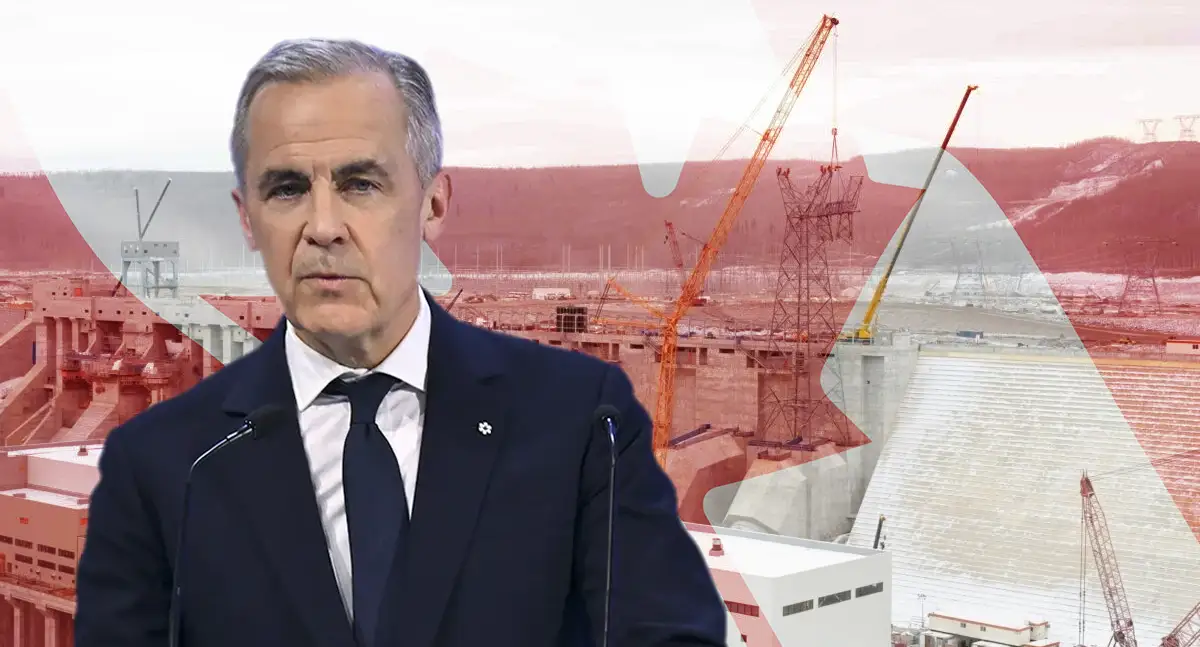
Header image: Mark Carney speaks at the 56th World Economic Forum in Davos, with visuals overlaid on BC Hydro’s major infrastructure project.