
Canada’s Energy Moment: A Country That Can’t Execute Cannot Lead
Canada is not failing because it lacks resources. Canada is failing because it cannot execute.
At a moment when the world is scrambling for reliable energy—when war in the Middle East threatens supply routes, global markets are tightening, and allies are actively seeking stable suppliers—Canada should be indispensable.
Instead, we remain constrained. Not by geology. Not by demand but by our inability to build.
This Is Not a Crisis. It Is a Test
We are once again facing a global energy shock. Oil prices are rising. Supply chains are under pressure. Inflation risks are returning.
But as political strategist Rick Anderson told me, this is not catastrophic.
North America is more resilient than in past shocks — more diversified, more energy secure, and better positioned to absorb disruption.
Which leads to a more uncomfortable conclusion: If this moment does not benefit Canada, it is not because of the world. It is because of us.
Energy Shocks Now Reshape Entire Economies
Today’s energy shocks do not stay in the energy sector. They move through fertilizer, chemicals, plastics, and ultimately the food supply. They ripple across entire economic systems.
Greg Vezina, CEO of Hydrofuel, put it plainly: “These disruptions ripple through the entire system — and they take years to unwind.”
This is not short-term volatility. This is long-term positioning.
And moments like this reward countries with the capacity to respond.
Canadians Understand the Stakes
What makes this moment particularly important is that Canadians understand it.
Pollster John Wright told me that two-thirds of Canadians are worried about the economy, a level of concern that has persisted since inflation and interest rates surged.
At the same time, confidence in leadership remains relatively strong. Canadians are prepared to give governments time to act.
But Wright cautions that this patience is not permanent. It is a window. If economic conditions do not improve, if progress is not visible, that support will erode.
This is a moment of alignment between public concern and political opportunity. And it will not last.
Canada Has the Resources But Not the Capacity
Canada produces roughly five million barrels of oil per day. It has vast natural gas reserves. Its energy is among the lowest in greenhouse gas intensity globally.
In a world seeking reliable, democratic energy suppliers, Canada should be central.
But resources alone do not create power. Capacity does.
Pipelines. Export terminals. Processing infrastructure. Trade access. These are what turn resources into influence.
And Canada has underbuilt them for decades.
The Infrastructure We Never Built
Canada’s energy constraint is not theoretical. It is physical.
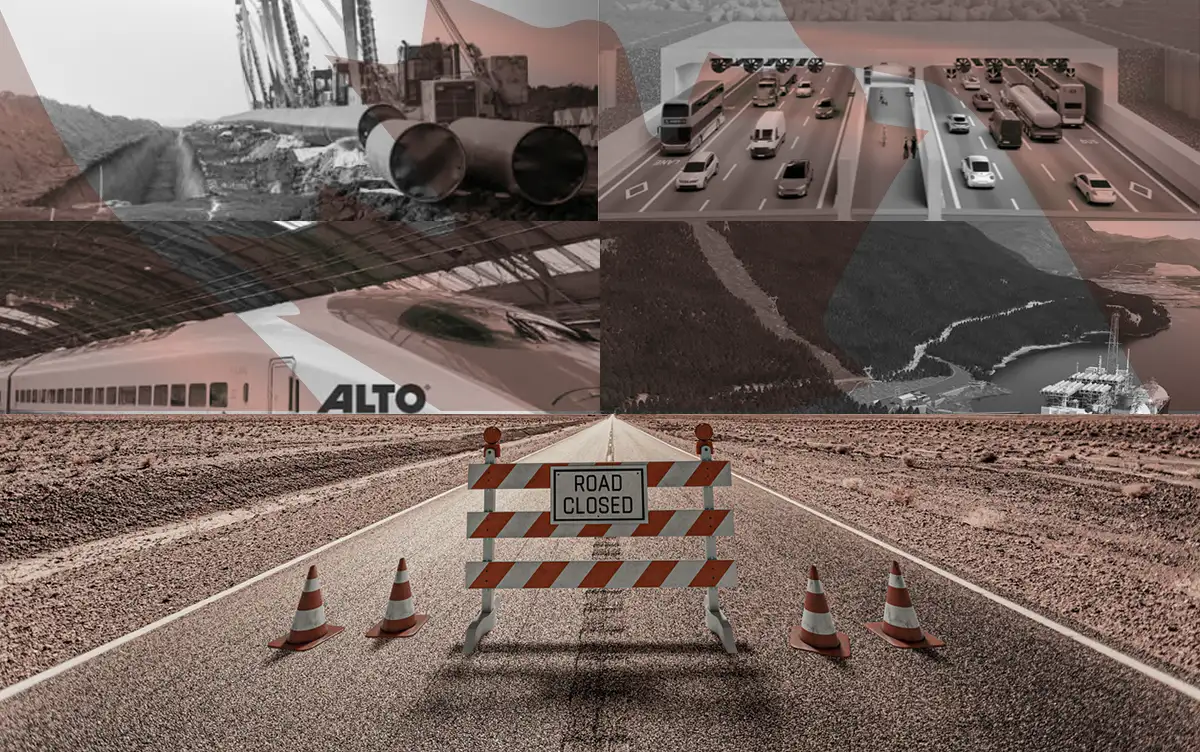
We lack sufficient pipeline capacity to tidewater. We remain heavily dependent on the United States as our primary export market. Projects like Energy East were abandoned. Opportunities to expand westward capacity were delayed or constrained.
The result is structural.
Canada can produce energy. But it cannot always deliver it to the markets that need it most.
As Greg Vezina noted, Canada is effectively selling to one primary buyer—often at a discount—when it should be competing globally.
No well-run business would accept that level of concentration risk. Yet Canada has built exactly that system.
Strategy Without Execution
There are signs of strategic change.
Canada is talking about diversifying trade, strengthening relationships with Europe and Asia, and acting more like a true middle power.
Rick Anderson supports that direction. So do I. But strategy without execution does not change outcomes.
You cannot export energy to Europe without the infrastructure to move it. You cannot diversify trade if your physical systems lock you into a single market.
Execution is what turns strategy into power.
Policy Has Become a Constraint
Even where projects are possible, policy uncertainty continues to slow progress.
Industrial carbon pricing ambiguity. Carbon capture requirements. Clean electricity regulations that affect project economics.
Energy policy expert Heather Exner-Pirot has pointed out that Canada could become an energy superpower, but inconsistent policy frameworks are discouraging investment.
Capital requires clarity. And increasingly, it is going elsewhere.
The Real Problem Is Institutional
But the deeper issue is not just infrastructure or policy. It is institutional.
Eugene Lang, a former senior public servant and now professor at Queen’s University, argues that Canada’s public service is not structured to execute the kind of economic strategy the country now requires.
He identifies three key barriers: A deeply embedded culture of risk aversion, an over-reliance on the United States built into decision-making, and a long-standing discomfort with industrial policy.
In other words, even when political leadership wants to move, the system resists.
Canada’s public institutions have been optimized over decades to avoid mistakes, manage process, and reduce risk.
But in a world that requires speed, scale, and strategic execution, those same instincts become constraints.
You cannot implement a new national strategy with an institutional culture built for a different era.
If Canada Does Not Act, Others Will
The global demand for energy is not going away.
If Canada does not supply it, others will. Often with higher emissions. Lower environmental standards. Greater geopolitical risk.
This is the central paradox.
By not building, Canada is not preventing energy production. It is simply shifting it elsewhere.
This Is Also a National Unity Issue
Energy policy is no longer just economic policy; it is national policy.
Western alienation reflects a deeper structural issue: regions that produce feel constrained by systems that prevent them from fully participating in national growth.
That tension is not theoretical. It is rooted in real economic limitations.
Addressing energy infrastructure is therefore not just about growth. It is about cohesion.
A Narrow Window
Right now, Canadians are aligned with reality. They are concerned about the economy. They understand global instability. They are open to change.
But this alignment is temporary.
If this moment passes without action, if nothing gets built, the opportunity will close.
From Potential to Power
Canada does not lack ideas; it lacks execution.
We analyze. We regulate. We debate. But too often, we do not build.
This energy shock is not simply an external event. It is an internal test.
A test of whether Canada can make decisions, build capacity, and act with urgency.
Because in a world defined by instability, the countries that matter will not be those with the greatest resources.
They will be those with the capacity to deploy them.
The Choice
Canada now faces a choice: remain a country of potential or become a country of power.
Because in the end, countries that cannot execute cannot lead. And the world is not waiting.