Recommended Articles
The Catholic Church is badly adrift

What will Canada do?
Message to Trudeau government – pipelines make sense


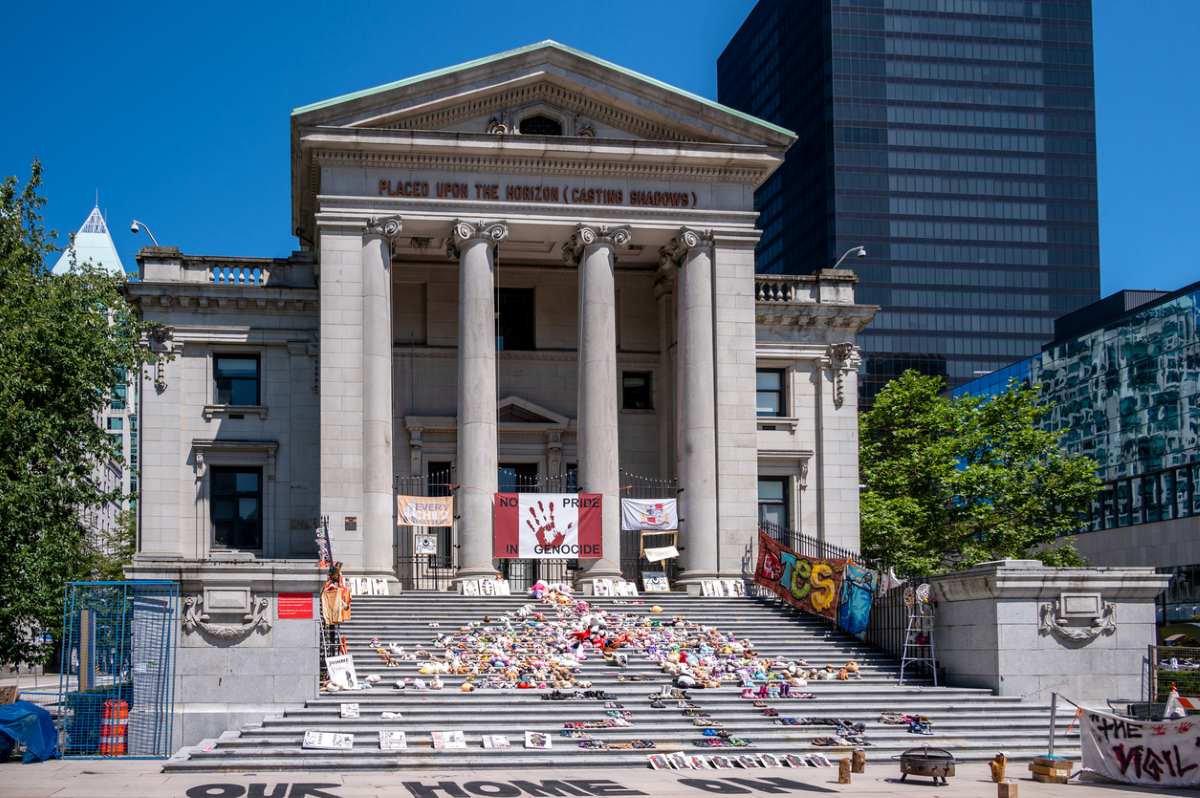
In 2021, Canadians were told that a mass grave had been discovered at the former Kamloops Indian Residential School. The announcement shocked the country. Flags were lowered. Statues were removed. Churches were vandalized and burned. Governments issued statements of collective shame. Canadians were told that a horrifying secret had finally been uncovered.
What had actually been announced, however, was the detection of ground disturbances through ground‑penetrating radar (GPR), not the discovery of human remains. The lead researcher, Sarah Beaulieu, emphasized at the time that the findings were “preliminary” and required excavation to confirm their nature. GPR does not identify bodies; it identifies soil anomalies that may or may not be graves.
Yet almost overnight, tentative findings became established facts. Potential graves became graves. Graves became mass graves. Questions became heresy.
Five years later, Tk’emlúps te Secwépemc has not publicly reported confirmed human remains from excavations at Kamloops. This does not mean graves do not exist — only that the evidence assumed to be present has not yet been demonstrated. Even some of the country’s largest media organizations have begun to acknowledge shortcomings in how the story was reported. In May 2026, The Globe and Mail published an editorial acknowledging that its coverage ‘fell short’ and that journalists should have applied greater scrutiny to early claims .
The Kamloops story exposed a broader problem within Canadian public life. Too many institutions abandoned skepticism precisely when skepticism was most needed. Politicians, academics, media organizations, school boards, corporations, and advocacy groups rushed to endorse conclusions before the facts had been established. The normal standards of inquiry — verification, corroboration, and evidentiary caution — were suspended because the narrative was considered too important to question.
That is not how a serious country conducts itself. A democratic society depends upon the willingness to follow evidence wherever it leads. That principle applies whether the evidence confirms popular beliefs or challenges them. It applies whether the subject is politics, science, religion, or history.
The history of Indian residential schools is neither a simple story of evil nor a simple story of benevolence. Some students suffered abuse, neglect, loneliness, and family separation. These experiences deserve acknowledgment and historical scrutiny. The Truth and Reconciliation Commission documented thousands of accounts of trauma, and these testimonies must be treated with seriousness and respect.
At the same time, many students received education, vocational training, medical care, religious instruction, and opportunities that would otherwise have been unavailable in remote communities. Scholars such as Scott Hamilton, who has studied burial practices at residential schools for the National Centre for Truth and Reconciliation, have noted that many known residential school cemeteries appear consistent with burial practices of the time and are not, in themselves, proof of clandestine burials. Some former students later spoke positively about teachers, mentors, and experiences that helped shape their lives. Both realities can be true at the same time. A mature society should be capable of discussing both without fear and without ideological pressure.
Unfortunately, much of the public discussion over the past decade has encouraged Canadians to see only one side of this history. Complexity has been replaced by ideology. Nuance has been replaced by slogans. Historical inquiry has too often been replaced by moral certainty.
The result has been damaging. Dozens of churches—more than sixty burned and many others vandalized—were attacked in the months following the Kamloops announcement. Public trust in institutions declined. Entire generations of Canadians were encouraged to view their country through the lens of allegations that had not yet been substantiated. Meanwhile, those who asked reasonable questions were frequently denounced rather than answered.
Canada’s relationship with Indigenous peoples remains one of the most important issues facing the country. Addressing present challenges requires honesty about the past. But honesty demands that we distinguish between what is known, what is suspected, and what remains unproven. This distinction is not an obstacle to reconciliation — it is the foundation of it. History deserves better than assumptions presented as facts.
Some Indigenous leaders have emphasized the need for careful, methodical investigation and access to records, rather than relying solely on early assumptions. Skepticism, when applied responsibly, is not disrespect; it is a commitment to truth.
National maturity begins when we stop treating history as a weapon and start treating it as a search for truth. Only then can Canadians confront the past with confidence, fairness, and intellectual honesty. Truth comes before judgement. It always must.
Photo: iStock
For further insights, read the additional commentary by Bryan Brulotte: Canada Does not Have a Diversity Problem — it has a Cohesion Problem.