How Canada’s Indigenous Story Is Being Twisted to Spread Antisemitism
The conversation about Israel in Canada has taken a strange and troubling turn. Over the past few years, anti‑Israel and antisemitic activists have increasingly wrapped themselves in the language of Indigenous struggle, borrowing the symbols, vocabulary, and moral authority of Indigenous peoples to advance a political agenda that has little to do with Indigenous rights and even less to do with historical truth.
Last week at the University of Ottawa, two respected Indigenous leaders — Dr. Sheree Trotter and the Hon. Harry S. LaForme — finally said what many have been thinking: Canada’s Indigenous story is being twisted, manipulated, and weaponized to spread antisemitism and Jewish hatred in Canada.
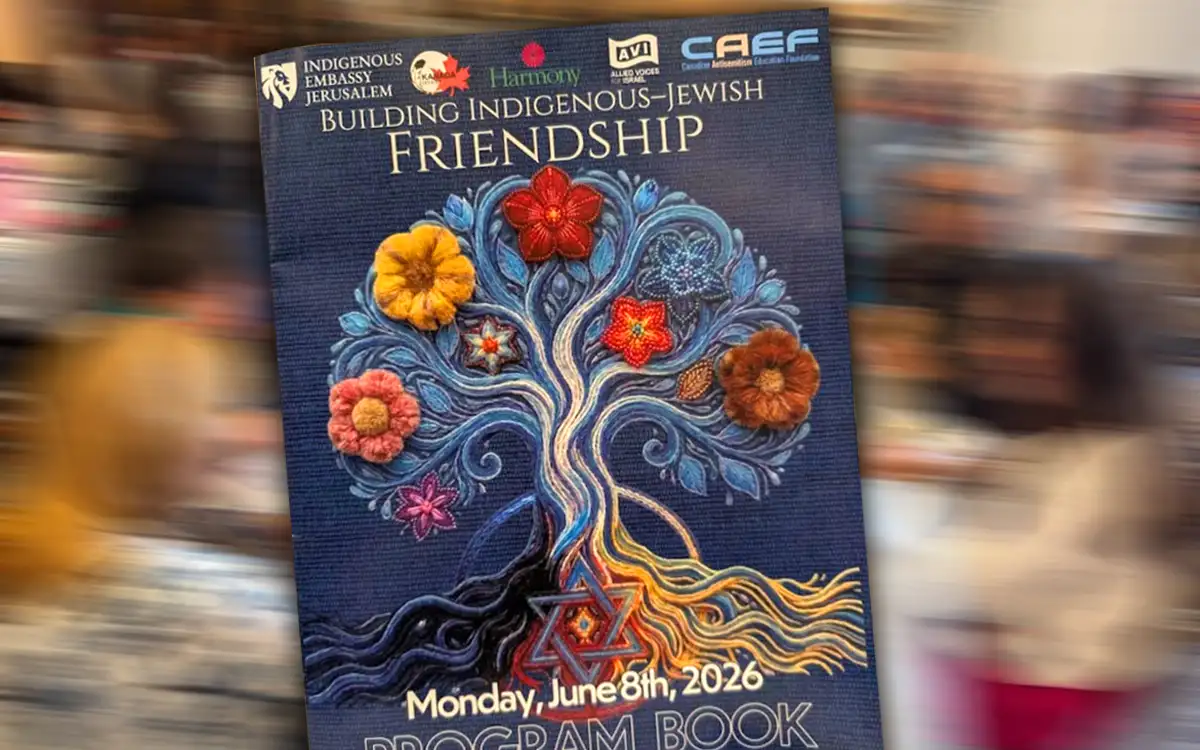
Their event, titled “Antizionist Colonization of Indigenous Movements – and our Response,” was not another campus shouting match. It was a sober, fact‑driven intervention from two people who understand exactly what indigeneity means and what it does not. They came to Ottawa as representatives of the Indigenous Embassy Jerusalem, an initiative dedicated to restoring accuracy and integrity to a debate that has been hijacked by activists who treat Indigenous identity as a political prop.
Dr. Trotter, a Māori scholar and co-founder of the Embassy, began by grounding the discussion in the fundamentals of Indigenous identity. Indigeneity, she explained, is not a metaphor or a slogan. It is defined by ancestral connection, cultural continuity, and the lived experience of a people rooted in a specific land over millennia. “Indigenous identity is not something you can borrow when it suits your politics,” she told the audience. “It is something you inherit, preserve, and fight to protect.” By that standard, she argued, the Jewish people are one of the world’s oldest Indigenous nations, with continuous presence in the land of Israel long before the rise of modern states or the political movements that now claim to speak for the region.
Justice LaForme, a former judge of the Ontario Court of Appeal and one of Canada’s most respected voices on Indigenous law, brought a Canadian legal and historical lens to the conversation. He warned that anti‑Israel activists have been attempting to graft the language of Indigenous struggle onto a conflict with entirely different origins. “Our history is not a tool for someone else’s agenda,” he said. “When people misuse Indigenous identity to attack another people’s legitimacy, they are not standing with us. They are exploiting us.” He argued that this appropriation does more than distort the Middle East; it undermines the integrity of Indigenous movements in Canada by turning their history into a rhetorical weapon for unrelated political goals.
Both speakers challenged the popular claim that Israel is a colonial project. They noted that the region’s borders shifted repeatedly under Ottoman, British, Jordanian, and Egyptian control, and that the Jewish state emerged not as a foreign implant but as the national revival of an Indigenous people who maintained continuous presence in the land for thousands of years. They reminded the audience that the wars of 1948 and 1967 were initiated by surrounding states seeking to prevent or reverse Jewish independence, and that the refugee crises on both sides were the tragic result of those wars, not the product of a single narrative of victimhood.
Their presentation also confronted a second distortion that has taken root in Western activism: the idea that the conflict is fundamentally about people rather than land. Historically, the opposite is true. Early political movements in the region focused on preventing Jewish sovereignty, not on advancing the rights of a distinct national population. Even the refugee definitions created in the late 1940s were based on residency during a narrow two‑year window, not on ethnicity or national identity. The modern Palestinian national identity is real and meaningful today, but it was not the driving force behind the early conflicts. Understanding this history is essential, they argued, because the Canadian debate often treats history as optional.
What lingered after the event was not the politics but the clarity. Dr. Trotter closed her remarks with a line that cut through the noise: “Indigenous identity is not a weapon. It is not a slogan. It is a story of survival — and no one has the right to twist it to attack another people.” She reminded the audience that the Jewish story in the land of Israel is not a modern invention but “a continuous Indigenous narrative that has endured exile, empire, and erasure.”
Justice LaForme echoed that sentiment with the bluntness of someone who has spent a lifetime defending Indigenous rights in Canadian courts. “When activists try to use our history to delegitimize the Jewish people,” he said, “they are not standing with Indigenous peoples. They are standing on us. They are using our trauma to fuel their politics.” He warned that this trend is not solidarity but exploitation — and that it ultimately harms Indigenous communities by diluting the meaning of their own struggle.
Both leaders stressed that acknowledging Jewish indigeneity does not negate Palestinian identity or aspirations. What it does negate is the false narrative — now common in parts of the activist left — that Jews are foreign to their own homeland. “Truth is not a threat to peace,” Dr. Trotter said. “But lies always are.”
The Indigenous Embassy Jerusalem is not trying to win a culture war. It is trying to restore honesty to a conversation that has been warped by years of propaganda, miseducation, and the casual misuse of Indigenous language by people who have never lived an Indigenous experience. Their visit to Ottawa was a reminder that facts still matter. History still matters. And identity — real identity — cannot be borrowed, twisted, or weaponized without doing violence to the people it belongs to.
Justice LaForme left the audience with a final warning that felt aimed not just at activists but at Canadian institutions themselves. “If you care about Indigenous rights,” he said, “then you must also care about Indigenous truth. And that means respecting the truth of other Indigenous peoples — including the Jewish people.”
Whether Canada is ready to hear that truth is another question. But after last week’s event at the University of Ottawa, it is clear that many Canadians are more than ready to listen.
Photo: Courtesy Indigenous Embassy Jerusalem