




US vs Canadian Online Gaming in 2026: What Players North of the Border Are Watching
The border between Ontario and New York State is roughly a two-hour drive from downtown Ottawa, but the gap between how the two sides handle online casinos is far wider than that stretch of highway. A player in Cornwall can open a licensed casino app that a resident of Massena, right across the St. Lawrence, cannot legally touch. Same river, same time zone, two completely different rulebooks.
That contrast has grown sharper heading into 2026. Canada spent the past three years building an open, provincially run online casino market that now moves tens of billions of dollars a year, while the United States has moved slowly and unevenly, state by state, with most of the country still offline for real-money casino play. For Ottawa readers who follow business and consumer trends, the comparison says a lot about how two neighbouring economies treat the same product.
Canadians who keep an eye on the American side of the industry often check a US online-casino guide such as PlayUSA to see which states have switched on legal play, which are still debating it, and which are leaning on free-to-play alternatives instead. Read next to Ontario’s own numbers, that American picture helps explain why players here talk about their market with a certain quiet confidence.
Two countries, two rulebooks
The simplest way to understand the difference is to look at who holds the pen. In Canada, gambling is a provincial matter. Each province and territory decides whether to run its own online casino, license private operators, or keep a tighter grip through a government monopoly. Ottawa the city answers to Ontario’s rules, not to a single national code, and a player who moves to Halifax or Calgary falls under a different provincial system entirely.
The United States splits authority a different way. Federal law sets some outer limits, but the decision to legalize real-money online casinos sits with each individual state legislature. That has produced a patchwork where a short drive can take a player from a fully regulated market into one where the same app is blocked by geolocation. The result looks less like one national market and more like fifty separate experiments running at different speeds.
Neither approach is inherently better, but they lead to very different experiences for the person holding the phone. Canadian players tend to ask which province they live in. American players have to ask which state they are physically standing in at the moment they place a wager.
The split also shapes how each side talks about the industry. In Canada, the conversation is usually framed around consumer protection and provincial revenue, since the province either runs or licenses the sites and collects the money directly. In the United States, legalization debates lean harder on tax dollars and on competition with neighbouring states, because a legislature that says no watches its residents cross a border or drift to offshore sites while another state banks the revenue. Ottawa readers who followed Ontario’s own rollout will recognize the revenue argument, even if the American version carries a sharper competitive edge.
How Ontario opened the Canadian door
Ontario is the reason this comparison is even interesting. The province launched its regulated online casino market on April 4, 2022, ending a long stretch when the only legal option was the government-run platform. Private operators could now apply for licences and compete openly, and players gained a legal home for games many had already been reaching through offshore sites.
The scale since then has surprised even the people who built the system. In its 2024-25 fiscal year, the provincial market recorded more than 82.7 billion dollars in total wagers and about 2.9 billion dollars in gaming revenue, with roughly 50 operators active and more than 2.6 million active player accounts. Casino products, the slots and table games rather than sports betting, made up around 75 percent of that revenue. A survey run alongside the regulator suggested that the large majority of Ontario players had shifted onto licensed sites rather than staying offshore.

Those figures matter for the cross-border story because nothing on the American side compares to a single province producing that kind of channelling in three years. Ottawa readers sometimes forget that Ontario alone now runs one of the larger regulated online casino markets in the world, and it did so from a standing start.
Beyond Ontario: how the rest of Canada plays
Ontario is not the whole country, and the rest of Canada is where the comparison with the United States gets more familiar. Most provinces still run a single government platform rather than an open licensing system. British Columbia has PlayNow, Quebec has its Loto-Quebec offering, and the Atlantic provinces share a regional operator. In those markets a player has one legal site, not a competitive field of them.
Alberta is the province to watch. It has passed legislation to open its own private-operator market along lines similar to Ontario’s, and if that launch holds to schedule it would give Canada a second competitive jurisdiction rather than one flagship and a row of monopolies. Observers who track how Canada’s market is shifting province by province tend to treat Alberta as the test of whether the Ontario model travels.
This is where Canada and the United States start to rhyme. Both countries are really collections of separate markets rather than one unified system. The difference is that Canada’s provincial patchwork is filling in faster and with clearer public revenue than the American state map, which still leaves most of its population without a legal real-money option.
The American map is drawn state by state
On the American side, the headline is how few states have legalized real-money online casinos at all. Only a small minority run fully legal internet casino play. New Jersey has done it since 2013 and remains the deepest market, with dozens of licensed sites. Michigan came online in 2021 and grew quickly. A handful of others permit it, and Maine has been discussed as a possible next entrant, though timing there remains uncertain.
The gap widens when you separate casino play from sports betting. Many more states allow legal online sports wagering than allow online slots and table games, so a resident might be able to bet on a hockey game legally while the casino tab on the same operator’s app stays dark. That split confuses even seasoned players, and it is one reason Canadians sometimes assume the American market is larger and more open than it actually is.
Geography drives a lot of this. A legal state that shares borders with several non-legal neighbours effectively serves players from across the region, at least for anyone willing to drive in and connect once inside state lines. New Jersey has benefited from exactly that dynamic for years, drawing play from the dense corridor around it. The flip side is that a non-legal state watches its residents and their money slip next door, which is the argument reformers lean on most heavily when they push a bill. So far that argument has carried in only a handful of places, which tells you how much other resistance it runs into.
For the states that have not legalized, the practical choices are retail casinos, cross-border trips, offshore sites that operate in a legal grey area, or the free-to-play sweepstakes model that has grown to fill the vacuum. That last category deserves its own section, because it is easy to misread from the Canadian side.
A side-by-side look at 2026
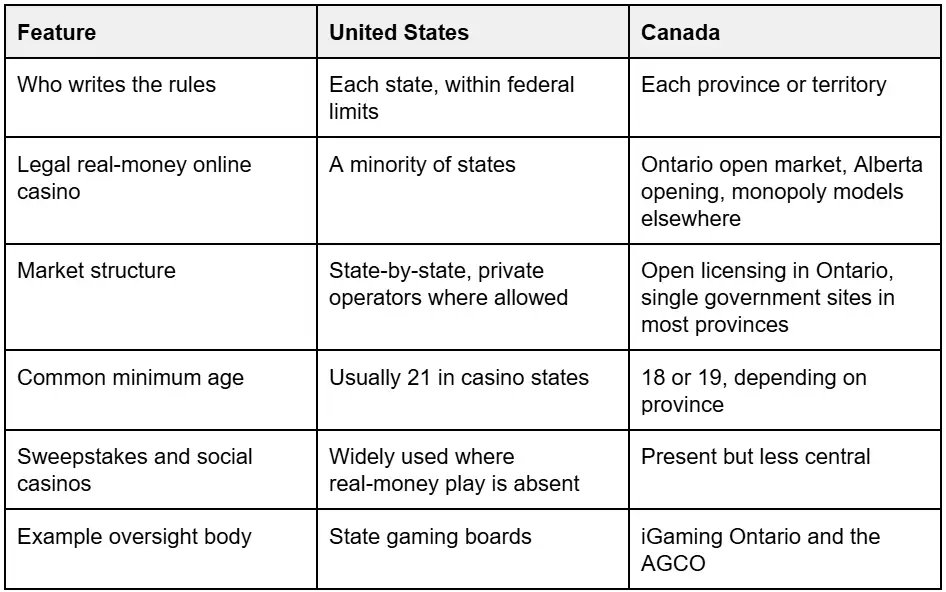
It helps to lay the two systems next to each other rather than describe them in turn. The table below sketches the broad shape of each market as it stands in 2026. Details shift and any specific figure should be checked against current sources, but the structural contrast holds.


The table makes the core point quickly. Canada’s system is more consistent in its public-revenue structure, while the American one offers more raw variety but far less coverage. A visitor moving between the two would notice the age limits first, then the sheer difference in how many legal options actually appear once geolocation confirms where they are.
Where sweepstakes and social casinos fit
This is the piece Canadians most often misunderstand, so it is worth slowing down. Sweepstakes and social casinos are a separate, free-to-play model. They are not real-money online casinos. Players use virtual currencies, and while some formats allow prize redemptions under specific promotional rules, the core product is legally distinct from a licensed casino that takes cash bets and pays cash winnings.
In the United States, this model spread precisely because so many states have no legal real-money option. For a resident of a state without licensed casinos, a social platform can feel like the only game in town. That framing has drawn regulatory attention. Online casinos are not legal in California, and the state’s AB 831 tightened the rules around the dual-currency sweepstakes model as of January 1, 2026, a change that reshaped how those sites can operate there.
Canadian readers should not map the sweepstakes boom onto their own market too neatly. In Ontario, a regulated real-money option already exists, so the free-to-play category plays a smaller role than it does south of the border. The lesson runs the other way: sweepstakes growth in the United States is a symptom of missing legal supply, not a sign of a healthier market.
What players north of the border are watching
So what actually holds the attention of Canadian players who follow the American story? A few things come up repeatedly. The first is legalization momentum, or the lack of it. Every legislative session that passes without a new casino state tells Canadians that their own provincial route moved faster than the larger economy next door.

The second is product quality and payout speed. Players compare how quickly a regulated Ontario site returns funds against the stories they hear from offshore or grey-market American play. The third is consumer protection. Ontario built mandatory harm-reduction features into its licensed sites, and Canadians increasingly judge any market, foreign or domestic, by whether those guardrails exist. When an American state debates legalization, Ottawa readers who follow the file tend to ask less about tax rates and more about whether players there will get the same protections that are now standard at home.
The money questions: taxes, payouts, and cashouts
Money mechanics differ in ways that catch travellers off guard. In Canada, gambling winnings for a recreational player are generally not taxed as income, a point that surprises many American visitors. Professional gambling is treated differently, but the casual player who wins on a licensed Ontario site usually keeps the full amount.
The American picture is stricter. Gambling winnings are generally taxable, and larger payouts can trigger reporting and withholding at the federal level, with some states adding their own layer on top. A Canadian who plays legally while physically inside a US state would step into that system, not the friendlier Canadian one, so the assumption that a win travels home untouched does not hold.
Cashout experience also varies. Regulated markets on both sides have pushed toward faster, verified withdrawals, but the identity checks that come with a licensed account can feel slower than the loose offshore sites some players remember. Most regulators treat that friction as a feature rather than a flaw, since it supports both anti-money-laundering rules and self-exclusion tools.
Currency and payment methods add another wrinkle. Canadian sites price everything in Canadian dollars and support local banking, e-transfer, and increasingly instant-verification tools, while American sites run in US dollars with their own mix of processors. A cross-border player therefore deals not just with different tax treatment but with conversion and payment rails that were never designed to work together. It is one more reason the two markets, though they sit side by side, rarely function as a single pool of players.
What 2026 could still change
Several threads could move over the year ahead. On the Canadian side, the big question is whether Alberta’s open market launches cleanly and whether any other province follows. A second successful open jurisdiction would strengthen the argument that Ontario’s approach is repeatable rather than a one-off.
On the American side, the pace of new casino states remains the story, and it has been slow. Budget pressure sometimes pushes legislators toward legalization as a revenue source, while opposition from existing retail interests and concerns about problem gambling push back. Anyone forecasting a sudden wave of new states should stay cautious, because the past few years have rewarded patience over hype. For readers who want a grounded benchmark, iGaming Ontario’s latest annual report figures show what a mature provincial market can produce, and they set a useful bar for judging whatever the United States does next.
The broader takeaway for an Ottawa audience is that the two countries are running the same experiment at different speeds. Canada chose a provincial route and, in Ontario at least, filled it in quickly. The United States chose a state route and has moved carefully. Watching both at once is the clearest way to understand where regulated online gaming is actually headed.
Frequently Asked Questions
Can someone in Ottawa legally play at online casinos in 2026?
Yes. Ontario has run a regulated online casino market since April 2022, so a resident of Ottawa can play on licensed private-operator sites or on the government platform. The player must be of legal age and physically located in the province when they wager.
Are US online casinos open to Canadian visitors?
Only in the states that have legalized real-money play, and only while the visitor is physically inside that state. Geolocation and identity checks confirm both location and age, so a Canadian cannot log in from Ottawa and play on a US site. Winnings there would also fall under American tax rules rather than Canadian ones.
What is the difference between a regulated casino and a sweepstakes site?
A regulated real-money casino takes cash wagers and pays cash winnings under a provincial or state licence. A sweepstakes or social casino uses virtual currencies and operates as a free-to-play product, with any prize redemption governed by promotional rules rather than a gambling licence. They are legally distinct categories, even when the games look similar.
Why do players in some US states only have social or sweepstakes options?
Because most American states have not legalized real-money online casinos. Where no licensed option exists, residents often turn to free-to-play social platforms instead. That is why the sweepstakes model grew so quickly in the United States, and why some states, including California through AB 831, have started tightening the rules around it.
How can Canadians check which US states allow real-money play?
The legal map changes as legislatures act, so it is best to check a current, US-focused reference rather than rely on older lists. Industry guides and state gaming board pages both track which states permit online casino play and which allow only sports betting or nothing at all.
All images: Rafael Quintero