Stop Counting Housing Units. Start Building Homes and Communities.
Canada’s housing crisis will not be solved by announcing ever-larger construction targets. We need to make homes economically viable to build, offer Canadians far more choice in how and where they live, and remember that the ultimate objective of housing policy is not the production of units, but the creation of communities.
I recently devoted an entire week of The Brian Crombie Hour to one of the most consequential economic and social challenges facing Canada: housing affordability. I spoke with Professor Murtaza Haider about the kinds of housing Canadians actually want, Darrell Bricker about the demographic forces reshaping demand, Paul Smetanin about the increasingly difficult economics of development, Carolyn Whitzman about affordable and non-market housing, and David Graham about what governments and the development industry need to do differently.
They came at the problem from very different directions, but taken together, the conversations reinforced something I have increasingly come to believe: Canada does not have a shortage of housing announcements. We have a shortage of homes people can actually afford, in places where they actually want to live.
Fixing that will require much more than another government program or another ambitious target for the number of “units” we intend to build by some future date. It requires us to rethink the economics of housing, the way we plan our cities, the types of homes we build, how we finance growth and, ultimately, what we are trying to create in the first place.
We Have Made Housing Too Expensive to Build
The most immediate contradiction in Canadian housing policy is remarkably simple. If governments believe we desperately need more housing, why do we tax new housing so heavily?
Development charges, HST, community benefit charges, parkland charges, permit fees and application fees all ultimately find their way into the economics of a new development. We then express surprise when the finished home is unaffordable or, increasingly, when the project does not get built at all.
My proposal is deliberately dramatic: reduce residential development charges to zero for two years and measure what happens. We do not have to make the policy permanent. Treat it as an experiment during a housing emergency and determine how many stalled projects become economically viable and how much construction activity returns.
We should conduct the same examination of other taxes on new housing, including HST. If we desperately need more of something, imposing enormous taxes on its production is at least worthy of reconsideration.
There is, of course, a legitimate counterargument. Growth requires infrastructure. New residents need water mains, sewers, roads, transit, parks, recreation facilities and other municipal services, and somebody has to pay for them.
But that raises a different question: why should the first buyer of a new home pay upfront for infrastructure that will serve a community for perhaps 50 or 100 years?
Governments routinely finance long-lived infrastructure over long periods. Municipalities and provinces should make greater use of bonds and debentures to finance growth infrastructure and repay those obligations over time, including from the incremental property-tax revenue that new homes and businesses generate. Growth should pay for growth, but it does not follow that the entire cost of decades of growth must be imposed as an upfront tax on today’s new-home buyer.
Approvals Need to Become About Getting to Yes
The second fundamental problem is time. It should not take years to approve good housing in the middle of a housing crisis.
We know that many projects caught in lengthy planning processes will ultimately be approved in some form. Yet developers, planners, consultants, politicians and residents can spend years producing studies, revisions, reports and appeals before arriving somewhere that was broadly foreseeable from the beginning.
Canada needs much more as-of-right zoning, particularly around major transit investments. If taxpayers spend billions of dollars building subways, LRTs and GO Transit, we should permit substantially greater density around those stations. Otherwise, we are failing to capture much of the economic, environmental and social value of the infrastructure we have already paid to build.
That does not mean communities should lose their voice. Existing residents deserve to be heard, particularly when development creates legitimate concerns about traffic, servicing, schools, parks, shadowing or neighbourhood design. But consultation cannot become a permanent veto over change.
We also need to remember the people who are not usually in the consultation room: the young couple who would like to live in that neighbourhood someday, the immigrant family searching for its first Canadian home, the renter hoping to become an owner, and the children who will need somewhere to live 20 years from now. The YIMBY voice matters too.
This requires a cultural change in planning departments. Rather than beginning with the question, “Why can’t this project be built?”, I would like more planning processes to begin by asking, “What needs to change so that we can approve it?” The objective should not be to ignore legitimate planning concerns, but to identify them quickly, solve them collaboratively and get good projects built.
If housing truly is a crisis, our institutions need to behave as though it is one.
We Need to Build What People Actually Want
One of the most important lessons from my housing conversations was that Canadians do not all want the same kind of home. Too much of our housing debate has been reduced to a false choice between intensification and suburban development, when a growing and diverse country clearly needs both.
We need apartments, condominiums, purpose-built rental, affordable housing and supportive housing. We also need townhouses, duplexes, missing-middle housing, larger condominiums and single-family homes. Singles, seniors, young professionals and families with children have different requirements, and those requirements change throughout their lives.
For much of the past decade, particularly in Toronto, an investor-driven condominium market heavily influenced what we built. That produced enormous numbers of small condominiums that could function very well as investments: buy them, rent them, flip them and hope for appreciation.
There is nothing inherently wrong with a small apartment, and for many people it is precisely the home they need. The problem occurs when we confuse investor demand with the full spectrum of housing demand. A 450-square-foot condominium can be an excellent home for one person, but it is unlikely to be where a couple wants to raise two children.
We need to put livability back into the housing conversation. That means larger apartments, three-bedroom condominiums, townhouses and homes designed for end users rather than simply for investors.
It also means having an honest discussion about land. I believe we should consider opening appropriate new land for family housing, potentially including carefully selected portions of the Greenbelt, but only through a transparent, independent and non-political process tied directly to infrastructure planning. The answer to the question of whether Canada should build “up or out” should be obvious: a country expecting continued population growth will almost certainly need to do both.
That development must be supported by transportation infrastructure. Housing policy cannot be separated from transit policy. Subways, LRTs, GO Transit, regional rail, roads and highways determine where people can realistically live and work, and infrastructure planning should therefore occur alongside housing planning rather than years after communities have already been built.
Unlock the Homes We Already Have
There is also housing supply hiding in plain sight. Many empty nesters live in larger family homes and might happily downsize if attractive alternatives existed in the communities where they already have roots.
The assumption that downsizing means moving into a tiny condominium misunderstands what many older Canadians want. They may want a bungalow, townhouse, duplex, low-rise apartment or larger condominium near the friends, restaurants, doctors, churches, parks and neighbourhoods they have known for decades.
Build enough of those choices and the benefits ripple through the housing system. An older couple gets a home more appropriate to the next stage of life, while the three- or four-bedroom house they leave becomes available to a younger family.
That is why missing-middle housing is about more than density. It can help restart the housing ladder by allowing people to move through different forms of housing as their lives and families change.
Housing Is Not Enough
There is, however, an even larger issue that I think gets lost when we discuss housing policy. We keep talking about building housing when perhaps we should be talking about building communities.
It is entirely possible to construct thousands of housing units without creating a successful community. Communities require the places and institutions through which people encounter one another: parks where children play and neighbours meet, schools where families form relationships, libraries that serve as gathering places for learning and ideas, and recreation centres and arenas where communities come together.
They need main streets and local retailers, restaurants and coffee shops where people become regulars and eventually know one another by name. They need theatres, galleries and performance halls. They need churches, synagogues, mosques and other places of faith and belonging. They need public spaces where people want to walk, sit, linger and participate in civic life.
Those places are not decorative additions to housing. They are part of the infrastructure of community.
In planning discussions, we understandably talk about density, floor-space ratios, setbacks, height, parking requirements and transit-oriented development. All of those things matter, but people do not experience their neighbourhood as a zoning bylaw. They experience it as a life.
Where do I get coffee in the morning? Where do my children go to school? Where do I walk the dog? Where do I meet a friend for dinner? Where do I worship? Where does my teenager play hockey? Where can I hear music? Where can I sit outside on a summer evening? How often do I simply run into somebody I know?
Those seemingly ordinary encounters are what transform geography into community. Density without community can become little more than proximity, and proximity is not the same thing as belonging.
A Serious Housing Agenda
If I were putting together a Canadian housing action plan based on what I heard during my week of conversations and what I have observed over decades in business and real estate, I would begin with a dozen priorities: temporarily eliminate residential development charges; reduce other taxes on new housing; dramatically shorten approval times and unnecessary studies; expand as-of-right zoning; finance growth infrastructure over time; increase density around major transit; reform public consultation so that it informs development without indefinitely preventing it; change planning culture toward facilitating good development; transparently open appropriate new land; build substantially more missing-middle and family-sized housing; continue investing aggressively in transportation infrastructure; and ensure that new development includes the ingredients necessary to create genuine communities.
None of these measures alone will solve the housing crisis. Some will require provincial action, some municipal action, some federal action and some private-sector action. Non-market and supportive housing will also remain essential because there are Canadians whose housing needs the private market cannot adequately meet.
But the central objective should be clear. We should make good homes cheaper to build, faster to approve and available in far more forms and locations.
Words Matter
There is one final change I would make, and it costs absolutely nothing. I would change the language we use.
We should stop referring so casually to housing “units.” A unit is something you count on a spreadsheet; a home is somewhere a person lives.
Similarly, I would like us to spend less time talking about developing “properties” and more time talking about creating “communities.” A property is an asset or a parcel of land. A community is somewhere people belong.
That distinction captures what I think has gone missing from too much of Canada’s housing debate. Success should not ultimately be measured by whether a government can announce that it approved 100,000 units or promised another million sometime in the future. The real measure is whether Canadians can find homes they can afford, in neighbourhoods they enjoy, surrounded by the institutions and people that allow them to build meaningful lives.
Canada certainly needs millions more homes. But our ambition should be greater than simply constructing buildings. We need to create hundreds of vibrant, connected and livable communities in which young people can begin their lives, families can raise their children, newcomers can put down roots, seniors can remain connected, and people of every income can find a place where they belong.
So perhaps the most important change is also the simplest: stop counting units and start building homes. Stop developing properties and start creating communities.
Because housing policy, at its best, is not really about buildings. It is about building lives.
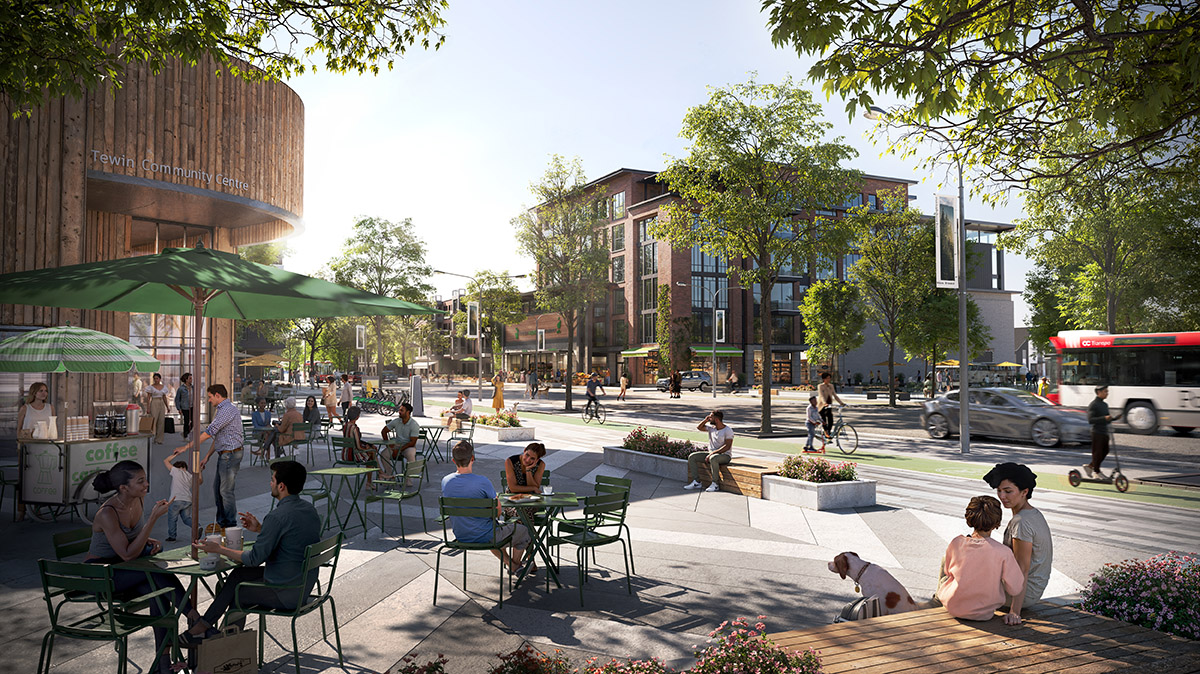
Header image: The proposed Tewin community on Ottawa’s outskirts, scrapped by City Council in October 2025, became a flashpoint where fiscal prudence, reconciliation politics, and urban‑planning realism collided.