
• By: Allen Brown

Is Car Insurance Cheaper in Ottawa vs. Toronto? Here Are the Facts

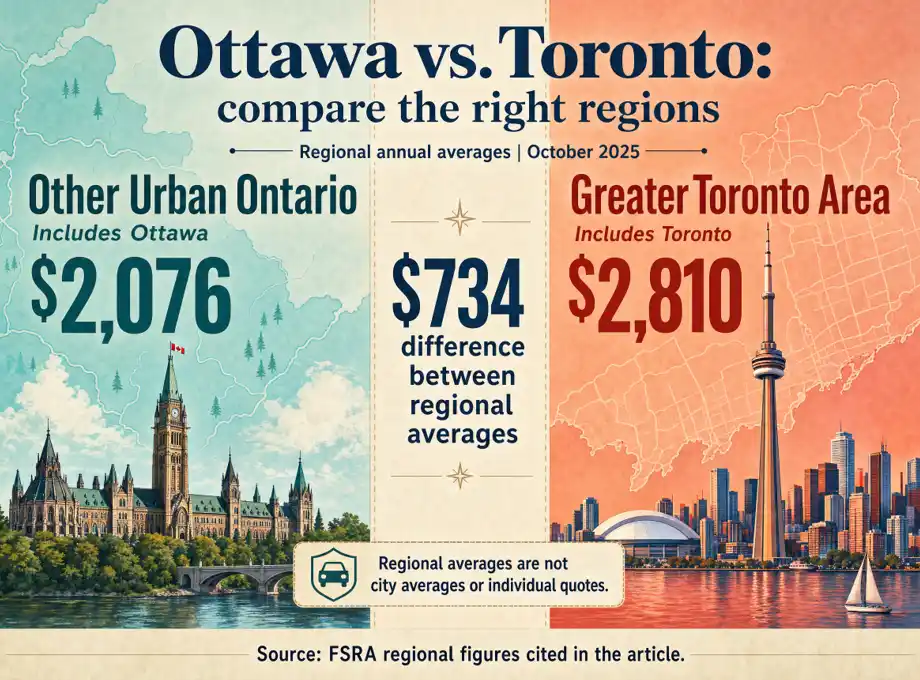
Yes, and the province’s own numbers say by how much. The Greater Toronto Area averaged $2,810 a year in October 2025, against $2,076 for the rest of urban Ontario. Toronto is in the Greater Toronto Area band, and Ottawa is counted with the rest of urban Ontario.

What the Regulator Measures

The province measures premiums by region. Neither Ottawa nor Toronto has its own official average.

Ontario’s Three Regional Premium Bands

The regulator publishes one provincial average and three regional averages. Each figure averages every private passenger vehicle insured over the previous twelve months. None of them is a quote for any individual driver.

As of October 2025, the provincial average was $2,164 a year. Within that, the Greater Toronto Area averaged $2,810 while Other Urban Ontario averaged $2,076, a difference of $734.

Rural Ontario averaged $1,740, so neither city is at the cheap end of the province.

The gap has been widening in dollars. Between October 2024 and October 2025, the GTA average rose $172, while Other Urban rose $158.

Why Published City Averages Disagree

City-level averages for Ottawa and Toronto come from the quotes people request on comparison sites, or from a sample driver run through a pricing model. Each set covers a different group of drivers than the regulator counts. Two such figures can appear on the same page from different datasets, and only a methodology note will say so.

All of those sets put Ottawa below Toronto, and the amounts vary by as much as half from one set to the next. A set built from quote requests measures whoever was shopping that month.

How Much of the Gap Moves With You

An insurer prices the policy on the address where the car is kept, so the territory changes when the address does. The driving record and the annual kilometres do not change with the address, and neither does the car.

Each insurer draws its own territory boundaries and files them for approval. Two insurers can therefore disagree about which addresses are expensive. A driver who moves and shops the policy at the same time is testing two variables at once.

Part of the gap between GTA territories and the rest of the province comes from a real difference in claims. Brampton, the most expensive place in Ontario to insure a car, is inside that band. Ontario’s Auditor General found in 2022 that the same driver with the same car would pay about $1,200 a year in London and about $3,350 in Brampton.

Local members there have campaigned for years against postal code discrimination. In the comparison that drove the 2018 legislative fight, Brampton drivers claimed 22.9 per cent more often than Ontario drivers overall, and their payouts were 26.3 per cent higher than the provincial average.

One Ontario driver saw his premium go up after Canada Post changed his postal code, and he had not moved at all. The boundary is administrative, so it can move even when the driver does not. Before signing a lease, give an insurer the new address and ask what the policy costs there.

The Argument Over Postal Code Rating

The rules for pricing car insurance in Ontario put every address inside a territory drawn from postal codes, and Ontario has spent nearly a decade arguing about where those lines fall.

Why the Regulator Kept Territory Rating

Ontario’s regulator reviewed territorial rating in August 2023 at the finance minister’s request and declined to ban it. In December 2023, it announced a test environment. Insurers may propose and test territory rate changes within the GTA for at least two years.

Asked in 2024 why the practice was not simply banned as unfair, the regulator’s chief executive defended it. He said where a driver lives is one of the biggest factors in that driver’s risk, and that removing geography from the calculation would move costs onto other drivers.

He also said the postal code method is outdated. The regulator’s predecessor built the territories out of postal codes, which is why a driver can move across the street and see a large increase.

The industry association has held both positions at once, defending geography as a genuine predictor of risk while calling the rules that govern it stale and overdue for modernization, and said the guidelines had not changed in more than 15 years.

When an insurer carves a new territory out of an existing one, the rates for the two adjoining territories cannot differ by more than 10 per cent at the outset, and that gap is allowed to widen later as claims data accumulates. Progressive Conservative and New Democrat members have both called postal code rating unfair, and a private member’s bill on auto insurance rate-setting was introduced in October 2018 and voted down.

Who Pays the Most Inside Toronto

The highest premiums inside Toronto fall on postal codes in Scarborough and North York. Several wards in those areas are designated Neighbourhood Improvement Areas, with higher poverty rates and less access to supports than the rest of the city. By January 2024, the government had still not introduced legislation of its own to end postal code rating.

A household with a second property sometimes asks whether the car can be registered at the cheaper address. That works only where the vehicle is genuinely kept there, since an insurer rates on the address where the car spends its nights, and a car registered somewhere it does not live is a misrepresentation the insurer can act on at claim time.

What car insurance covers is set by Ontario’s standard policy and does not change from one postal code to the next. Only the price does. A second address is, in any case, something only property owners have, and they are not the households paying the highest rates in Scarborough and North York.

So Is Car Insurance Cheaper in Ottawa?

Yes, on every measure the province publishes. Ottawa is in Other Urban Ontario, and Toronto is in the Greater Toronto Area. That band has averaged more than a third above the rest of urban Ontario at every reporting date since 2024.

The size of the difference for one driver depends on which territory the new address falls in and on which insurer drew that boundary. Ottawa has risk of its own. The cost of Ontario auto theft claims puts the city fourth in the province, up 363 per cent since 2017. Both bands rose at every reporting date from June 2024 to October 2025, so a move lowers what a driver pays without stopping the annual increase.