
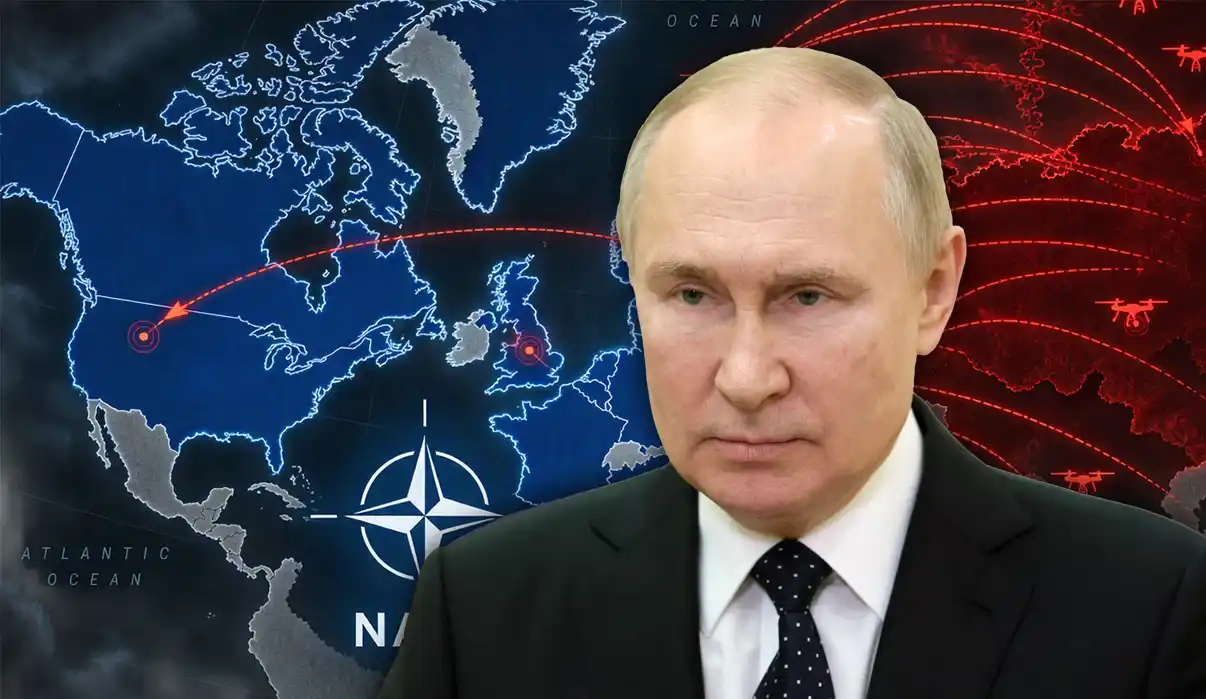
Putin’s Next Target May Be NATO’s Nerve
Russia does not have to finish its war in Ukraine before confronting NATO. Moscow could continue its campaign while undertaking a limited military or hybrid action designed not to conquer NATO territory, but to weaken the Alliance from within. Putin’s objective may be simpler and more dangerous: prove that Article 5 can be tested without producing a rapid, unified and decisive response.
Article 5 is NATO’s political and military centre of gravity. An armed attack against one Ally is considered an attack against all, but each member retains discretion over the action it considers necessary. Putin may believe he can exploit that flexibility by keeping an attack limited or ambiguous enough to divide Allied governments over attribution, proportionality and escalation.
The most plausible danger is not an immediate Russian armoured offensive across the Baltic frontier. It is a drone or missile strike presented as accidental, sabotage causing civilian casualties, a strategic cyberattack, infiltration by irregular forces or a shallow territorial incursion. Russia could deny responsibility, threaten nuclear escalation and offer negotiations before NATO had even agreed on what happened.
There is reason to take that possibility seriously. NATO says Russian drones and aircraft violated the airspace of several Allies in 2025, including Estonia, Latvia, Lithuania, Poland and Romania, prompting the Alliance to launch Eastern Sentry. NATO had already established Baltic Sentry following incidents involving critical undersea infrastructure in the Baltic Sea.
The most striking recent signal came from Washington. CIA Director John Ratcliffe travelled to Moscow in August, and multiple reports said he warned Russian officials against attacking NATO members, particularly the Baltic states. President Donald Trump subsequently downplayed the visit and said he did not believe Putin would attack NATO territory, but the reported warning should command attention.
Russia’s war in Ukraine and a test of NATO are not competing strategies. Pressure against NATO territory could force European governments to retain scarce air-defence systems and ammunition at home while political fear erodes support for Kyiv. Russia does not require another mass army to conduct sabotage, launch drones, mount cyberattacks or execute a localized incursion.
The decisive measurement would be NATO’s decision time: the interval between an incident, credible attribution and collective action. Moscow would seek to lengthen that interval through denial, disinformation, legal ambiguity and nuclear intimidation. If Allied governments spend days debating while Russia establishes facts on the ground, the Kremlin will have seized the initiative before NATO fires a shot.
Deterrence therefore requires more than declarations that Article 5 is sacred. NATO needs rehearsed political and military responses for sabotage, cyberattacks, missile strikes, irregular incursions and temporary territorial seizures. Political leaders and military commanders must exercise these decisions before a crisis, because a manufactured emergency is the worst time to begin defining collective defence.
Canada has more at stake than many Canadians realize. The Canadian-led multinational brigade in Latvia includes up to 3,500 soldiers from 14 NATO countries, with roughly 1,500 Canadian Armed Forces personnel reported as the brigade expands toward full capability. Canadian soldiers and commanders would therefore be near the centre of any serious Baltic confrontation.
The Alliance is also putting greater resources behind deterrence. European Allies and Canada increased defence expenditure by nearly 20 per cent in real terms in 2025, bringing their combined spending above US$570 billion. But money matters only if it produces deployable forces, ammunition, air defence, logistics and readiness.
For Canada, that means layered air defence, counter-drone systems, long-range fires, engineers, secure communications, pre-positioned ammunition and reliable reinforcement through contested ports and airfields. At home, it means accelerating NORAD modernization, Arctic surveillance, cyber defence and protection of critical infrastructure. Presence deters only when backed by the capability and authority to fight.
Supporting Ukraine and defending NATO are not competing missions. A Ukrainian defeat could free experienced Russian forces and place additional pressure on NATO’s eastern frontier. Sustained support for Kyiv therefore remains directly connected to the defence of the Alliance. The answer is not alarmism, but preparation. Putin must understand that ambiguity may affect the form of NATO’s response, but never its certainty.
If Canada and its Allies possess the capability, readiness and political will to act from the first hour, Putin’s test can fail before it begins.
Photo: Copilot