Alberta Chose Canada. Now Canada Must Choose to Build Something Together
The Alberta referendum, the lessons of Quebec, and why Canada’s future depends on rediscovering our shared national ambition.
I stayed up late watching the Alberta referendum results, thinking deeply about my country, how much I love it and how worried I am about its future.
Because I’ve been here before.
I was born and raised in Montreal. I remember the Quebec referendums of 1980 and 1995, particularly the anxiety of watching the results in 1995, when the country I loved came within a fraction of being divided.
Now, more than thirty years later, I found myself watching another debate about whether Canada should remain together. Only this time, it was Alberta.
Alberta isn’t some distant place to me. I’ve spent much of my business career working in Calgary and Edmonton, investing in and developing properties, building businesses and relationships. I have family members who live there. I know Alberta, and I appreciate the extraordinary contribution Albertans have made to Canada’s prosperity.
So when I hear people talking about separating Alberta from Canada, it troubles me deeply. Not because I don’t understand that Albertans have legitimate grievances. Many are longstanding and deserve serious attention. But because I believe so strongly in what we’ve accomplished together.
Why would we want to break apart something generations of Canadians have worked so hard to build?
Albertans Chose Canada, But They Also Demanded Change
On October 19, approximately 75 per cent of Albertans who voted rejected a proposal to begin the process of holding a binding referendum on separation.
That is a significant affirmation of Canadian unity. But it would be a mistake to interpret the result as an endorsement of the status quo.
Other questions on the ballot, involving immigration, provincial autonomy and constitutional reform, reflected a desire for changes in Alberta’s relationship with Ottawa. The message was not simply that Albertans wanted to remain Canadian. It was that many wanted to remain Canadian on different terms.
In a recent interview on The Brian Crombie Hour, I discussed the referendum with Stéphane Dion, the former federal Liberal leader, cabinet minister and architect of Canada’s Clarity Act.
Few Canadians understand the constitutional and political challenges of separatism better than Dion. Following Quebec’s extraordinarily close 1995 referendum, he became one of the most prominent defenders of Canadian unity.
Dion was pleased with the Alberta result but deeply critical of the referendum process. He questioned Premier Danielle Smith’s decision to facilitate a vote on separation and warned about the dangers of treating the possible breakup of the country as a negotiating instrument.
Andrew Coyne, writing in The Globe and Mail, was even more critical, describing the referendum as a debacle and arguing that Smith had created an unnecessary and divisive political confrontation.
There is an important distinction between respecting legitimate regional grievances and encouraging separatism as a means of extracting concessions.
Albertans have every right to challenge federal policies on energy, environmental regulation, immigration and economic development. But threatening to dismantle Confederation is an extraordinarily consequential way to pursue those objectives.
The referendum demonstrated that most Albertans who participated did not want to begin that process. Their preference to remain within Canada deserves to be taken seriously, just as their demands for change do.
The Lessons of Quebec
Dion reminded me that Canadian Confederation is not simply an arrangement from which a province can withdraw whenever it becomes dissatisfied.
The Supreme Court’s 1998 Reference re Secession of Quebec established that a clear majority supporting separation on a clear question would create a constitutional obligation to negotiate, not an automatic right to independence. The Clarity Act subsequently established a federal framework for assessing whether those conditions had been met.
Any negotiations would have to address Indigenous rights, constitutional obligations, borders, assets, liabilities and countless other issues.
The economic implications would be equally significant. An analysis cited in post-referendum commentary estimated that establishing an independent Alberta could cost as much as $170 billion over five years.
As someone who has spent much of his career in corporate finance and real estate development, I worry about the consequences of prolonged uncertainty. Businesses postpone investment decisions, lenders reassess risk, and employers reconsider expansion plans. Political uncertainty has an economic cost even when separation never occurs.
But I also understand Alberta’s frustrations.
The province has contributed enormously to Canada’s prosperity through energy, agriculture, entrepreneurship and investment. Albertans have watched pipelines delayed or cancelled, energy policies debated in Ottawa and their economic future subjected to decisions made thousands of kilometres away.
Some federal policies have been justified by legitimate environmental concerns. Others have imposed substantial costs on western Canada.
The challenge is to reconcile Canada’s environmental responsibilities with its economic opportunities, rather than treating them as permanently opposing objectives.
Dion and I disagreed on aspects of energy policy. He expressed serious concerns about expanding fossil fuel infrastructure, while I raised the argument that Canadian natural gas could potentially displace higher-emission energy sources internationally.
These are difficult questions requiring rigorous analysis, but they are precisely the kinds of disagreements Canadians should be capable of resolving together.
We also discussed Quebec’s continuing separatist movement and the importance of protecting its French language and culture.
Dion made an important observation: you can be a proud Quebecer and a proud Canadian simultaneously.
The same is true in Alberta. You can celebrate Alberta’s entrepreneurial culture, energy industry and western heritage while remaining equally proud to be Canadian.
One of Canada’s greatest accomplishments has been its ability to accommodate different regional, linguistic and cultural identities within a common national framework.
Canada Needs a Better National Story
The question of national identity was also central to another recent interview I conducted, with Halifax filmmaker and writer John Wesley Chisholm.
We discussed the power of storytelling in political leadership, including Prime Minister Mark Carney’s use of literature and philosophy, particularly his reference to Goethe’s Faust.
Great political leaders do more than announce policies, present statistics or criticize opponents. They explain who we are, where we have come from, what we believe and what we might become.
Winston Churchill, John F. Kennedy and Ronald Reagan understood this. Canada desperately needs to rediscover that kind of national story.
We spend enormous amounts of time discussing our differences, grievances and political disagreements. Far less time is devoted to celebrating what we’ve accomplished together or imagining what we might accomplish next.
Consider the extraordinary ambition of earlier generations.
In the nineteenth century, Canadians decided to build a railway across an enormous continent, overcoming extraordinary geographic, financial and engineering challenges. The Canadian Pacific Railway was more than a transportation project. It was a statement of national purpose, although its construction also involved profound injustices toward Indigenous peoples and Chinese workers.
In the twentieth century, we built the St. Lawrence Seaway, the Trans-Canada Highway, hydroelectric systems, nuclear power stations, pipelines, airports and communications networks.
Canadians helped develop insulin, the pacemaker, IMAX technology and the Canadarm. We created a public healthcare system founded on the principle that access to essential medical care should not depend simply on one’s ability to pay.
We helped establish the United Nations and NATO and contributed to the international institutions that shaped the postwar world.
These accomplishments were not inevitable. They required ambition, investment, cooperation and a willingness to think beyond immediate political disagreements.
Yet today, we often seem to have lost confidence in our ability to undertake projects of comparable scale. We debate, study, consult, commission reports and establish committees. Years pass, costs increase, and sometimes projects are abandoned because they have become too difficult, expensive or controversial.
Environmental protection, Indigenous consultation, responsible financing and sound economic analysis are essential. But these considerations should help us build better projects rather than become permanent excuses for building nothing.
What are we building together today that will make the next generation proud to be Canadian?
A New Generation of Nation-Building Projects
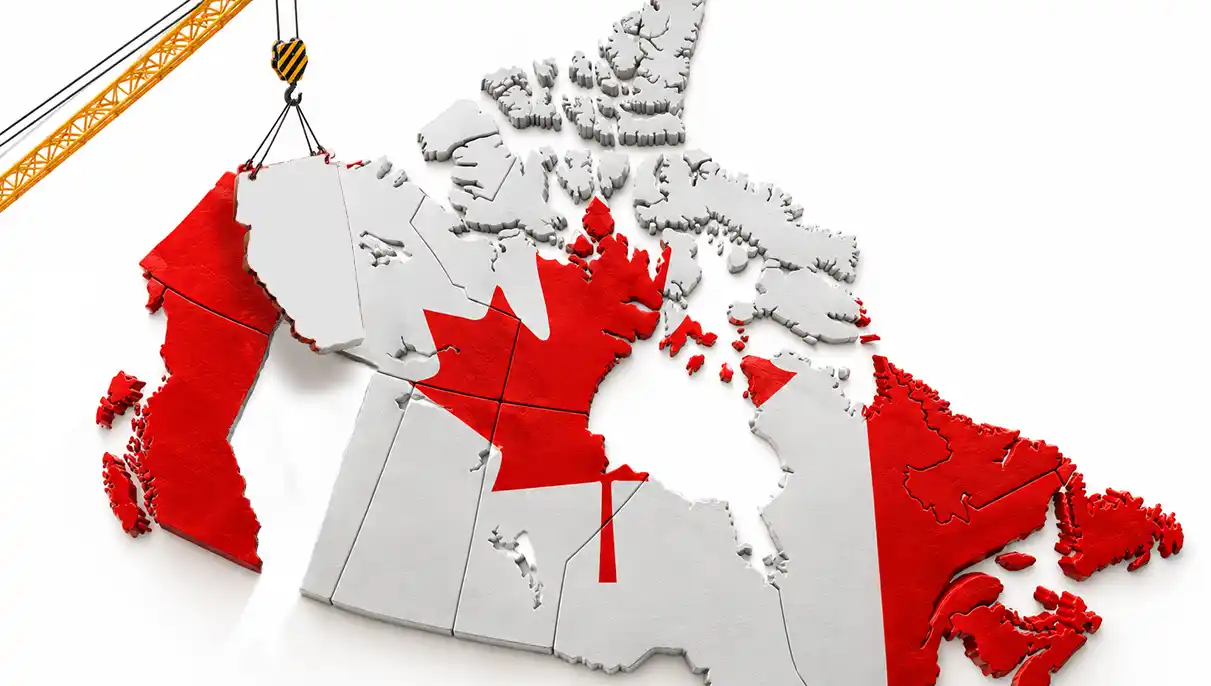
Canada has extraordinary opportunities to undertake another generation of national projects.
We could develop energy corridors connecting western Canadian oil and natural gas to eastern Canada and international markets, subject to responsible environmental and economic assessments.
We could strengthen interprovincial electricity connections, allowing Quebec hydroelectricity, Ontario nuclear power and western Canadian energy resources to complement one another.
We could develop high-speed rail connecting our major population centres, invest in critical minerals and advanced manufacturing, and expand Canada’s internationally recognized expertise in nuclear technology.
We could strengthen Arctic sovereignty through investments in northern infrastructure, transportation, defence and communications.
And we could build the housing, transit systems and communities that young Canadians need to establish families and participate in our country’s prosperity.
None of these projects would be easy. They would require cooperation among governments, Indigenous communities, businesses, investors and citizens.
But isn’t that precisely what nation-building is supposed to involve?
An energy corridor is more than a pipeline. It represents economic cooperation between regions. A railway is more than transportation. It connects communities and expands opportunity. Arctic infrastructure is more than defence spending. It strengthens sovereignty.
These projects become more meaningful when connected to a larger national purpose.
Prime Minister Carney’s recent appearances in Calgary and Edmonton offered an opportunity to begin rebuilding that sense of shared purpose. I was encouraged by his willingness to engage directly with Albertans and address the country’s economic and political challenges.
But national unity cannot depend on speeches alone. It requires policies, investments and compromises that demonstrate the practical advantages of Confederation.
What Does It Mean to Be Canadian?
Some time ago, inspired by the famous Molson commercial featuring Joe Canadian, I recorded my own version of “I Am Canadian”. It was an attempt to put into words what this country means to me.
Watching the Alberta referendum results brought me back to that commentary.
I believe in a country stretching from the rugged peaks of the Rockies to the Great Lakes, the red sands of Prince Edward Island, the shores of the Maritimes and the vast Arctic tundra.
I believe in a country blessed with extraordinary natural resources, freshwater reserves, forests, farmland, critical minerals, oil and gas.
But our greatest resource has always been our people: our ingenuity, creativity, entrepreneurship, compassion and willingness to accomplish things together that none of us could accomplish alone.
I believe in democracy, free and fair elections, human rights, religious freedom and the rule of law.
I believe in universal healthcare, strong public education, affordable housing and ensuring that seniors can retire with dignity.
I believe in reconciliation, acknowledging the injustices of our past and honouring the Indigenous peoples whose history on this land goes back thousands of years.
I believe in multiculturalism, where diversity is not simply tolerated but celebrated.
I believe in protecting our environment while responsibly developing the resources that contribute to our prosperity.
And I believe in remembering the sacrifices that made our freedoms possible.
My grandfather fought at Vimy Ridge during the First World War. My great-uncle flew in the Battle of Britain during the Second World War. My uncle served in Korea.
Like so many Canadian families, mine has a personal connection to the sacrifices of earlier generations.
The Canada we enjoy today did not simply happen. It was built, defended and sustained by generations who believed this country was worth the effort.
And now it is our turn.
But loving Canada does not mean ignoring its mistakes or agreeing with every decision made by our governments.
Patriotism means caring enough about your country to want it to become better. It means acknowledging failures while celebrating accomplishments, listening to those who disagree with us and recognizing that Canadians in different regions may have legitimate differences of perspective.
Because Canada is more than a collection of provinces, more than a geography and more than an economy.
Canada is an idea.
An idea that people of different backgrounds, languages, religions and histories can come together to build something greater than any one of us could accomplish alone.
In many ways, this is what I have spent much of my professional and academic life studying: the power of cooperation, relationships and community.
What I call the Power of Co.
The belief that people working together can accomplish more than they could individually.
And isn’t that fundamentally the Canadian experiment?
A country of enormous distances and extraordinary differences that has nevertheless created a shared national identity.
Alberta Chose Canada. Now Canada Must Choose Alberta.
The Alberta referendum should not be interpreted as the end of western alienation or the resolution of longstanding constitutional and economic disagreements. Nor should it be treated simply as a victory for Ottawa.
It should be understood as an opportunity.
Albertans have expressed a desire to remain part of Canada while also demanding changes in their relationship with the federal government.
Prime Minister Carney, Premier Smith and their counterparts across the country now have an opportunity to demonstrate that Canadian federalism can respond constructively to those concerns.
That means serious negotiations about energy, environmental regulation, infrastructure, immigration, economic development and provincial autonomy.
But national unity cannot be secured merely by negotiating fiscal arrangements or resolving constitutional disputes.
It must be sustained by a shared belief in the country’s future.
We need to recover the confidence that allowed earlier generations to build railways, seaways, highways and institutions that transformed Canada.
We need to rediscover the ambition to undertake projects that will benefit Canadians for generations.
And we need to tell a better story about who we are, what we share and what we can become.
Albertans have chosen Canada. Now Canada must demonstrate that it is listening to Alberta.
Our greatest strength has never been simply our geography, our resources or our wealth.
It is what we can accomplish together.
I believe in the True North, strong and free.
And I’m proud to be a Canadian.