
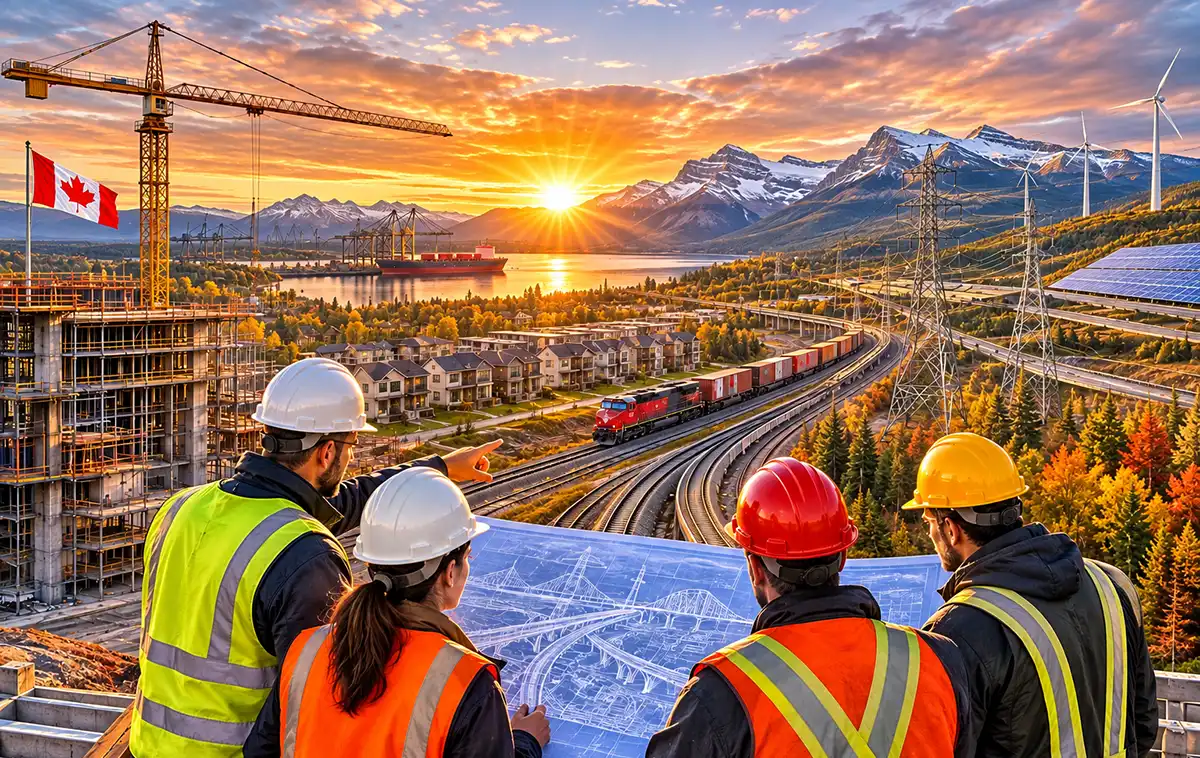
Canada’s Moment to Build: Why We Must Turn Economic Uncertainty into a New Era of Nation-Building

Canada is facing one of the most consequential economic turning points in its modern history.

The trade war with the United States, growing geopolitical instability, technological disruption, and the erosion of the international rules-based order have exposed uncomfortable weaknesses in our economy.

For decades, Canada has benefited enormously from its proximity to the world’s largest economy. Free trade agreements gave Canadian businesses privileged access to American markets, creating jobs, attracting investment, and supporting our prosperity.

But that relationship also encouraged a dangerous complacency.

We became comfortable exporting our natural resources and manufactured products south of the border without sufficiently investing in the infrastructure, technology, innovation, and productivity necessary to compete independently in global markets.

We relied increasingly on population growth and rising real estate values to drive economic expansion, while business investment and productivity growth lagged.

Now, as the United States becomes a less predictable economic partner, Canada faces a fundamental choice.

We can continue managing our existing economic relationships and hoping that the international environment returns to normal.

Or we can seize this moment to fundamentally strengthen our economy, diversify our trading relationships, and build the infrastructure necessary for a more prosperous and independent future.

I believe we must choose the latter.

A Budget That Raises Fundamental Questions

In a recent interview on The Brian Crombie Hour, I discussed the 2026 federal budget with Professor Daniel Béland of McGill University, a leading scholar of Canadian public policy and federalism.

Our conversation explored Prime Minister Mark Carney’s ambitious economic agenda, including major infrastructure investments, business tax incentives, increased defence spending, and a new approach to distinguishing government operating expenditures from capital investments.

The government is attempting to shift Canada’s economic strategy toward long-term investment and productivity growth.

That is an important objective. But Professor Béland raised legitimate concerns about the financial risks involved.

Federal borrowing requirements are projected to total approximately $765 billion over five years, while debt servicing costs could approach $78 billion annually by 2029–2030. These are substantial obligations that could constrain future governments, particularly if Canada experiences another economic shock.

Béland also questioned whether the distinction between operating expenditures and capital investments is always as clear as the government suggests. Education and healthcare, for example, can generate significant long-term economic returns, even though much of their spending is classified as operating expenditure.

Conversely, not every infrastructure project produces sufficient economic benefits to justify its cost.

This is a crucial distinction.

Borrowing money to build productive infrastructure is fundamentally different from borrowing to finance ongoing consumption. But calling something an investment does not automatically make it productive.

Canada needs ambitious investment, but it also needs transparent accounting, disciplined project selection, and measurable economic returns.

Rediscovering Canada’s Nation-Building Ambition

Canada has undertaken extraordinary nation-building projects before. The Canadian Pacific Railway connected a vast country and helped establish a national economy.

The St. Lawrence Seaway transformed our access to international markets.

Major hydroelectric developments in Quebec, Ontario, Manitoba, and British Columbia provided the energy necessary for industrial growth.

Pipelines, highways, airports, ports, and telecommunications networks opened our natural resources and connected our communities.

These projects required political leadership, enormous capital commitments, and cooperation among governments, businesses, and communities.

They were not simply infrastructure investments. They helped define Canada. Today, we need a comparable commitment to nation-building.

We need pipelines and energy corridors that allow Canadian resources to reach international markets rather than remaining overwhelmingly dependent on American customers.

We need expanded ports, modern freight railways, and high-speed passenger rail connecting major economic centres.

We need new hydroelectric generation, modern electricity grids, and interprovincial transmission capacity.

We need to responsibly develop our critical minerals, expand advanced manufacturing, and strengthen our ability to process and export higher-value products.

And increasingly, we need digital sovereignty.

Artificial intelligence, cybersecurity, cloud computing, data centres, and advanced telecommunications are becoming essential components of economic and national security. Canada cannot claim genuine economic independence if it remains excessively dependent on foreign countries for the technologies and infrastructure that will shape the next generation.

Sovereignty is about more than borders and flags. It is about having the economic capacity to make independent decisions.

Productivity Must Become a National Priority

Canada’s productivity problem is not new.

For years, economists and business leaders have warned that inadequate investment in machinery, technology, research, and innovation is undermining our competitiveness and living standards.

The federal budget attempts to address this challenge through substantial tax incentives for business investment, including accelerated deductions for qualifying capital expenditures.

The government’s proposed Productivity Mega Deduction is intended to reduce the tax burden on new investment and encourage businesses to modernize their operations.

This is a promising direction, but tax incentives alone will not solve Canada’s productivity challenges.

Businesses also need regulatory certainty, competitive energy costs, reliable infrastructure, access to skilled labour, and the ability to move goods and services efficiently across provincial and international borders.

Canada must reduce unnecessary regulatory delays, eliminate internal trade barriers, and create conditions that encourage businesses to invest for the long term.

We also need to move beyond an economic model that relies disproportionately on population growth and real estate appreciation.

Real prosperity comes from producing more value per worker.

It comes from innovation, capital investment, entrepreneurship, and the development of globally competitive industries.

Our objective should not simply be to grow the Canadian economy.

It should be to make Canadians more productive and prosperous.

Defence Spending as an Economic Opportunity

One of the most significant changes in Canada’s economic outlook is the renewed emphasis on defence spending.

For decades, Canada has underinvested in military capabilities relative to its international commitments. The current geopolitical environment has made defence modernization increasingly urgent.

But defence spending can also support a broader industrial strategy.

Canada already has considerable expertise in aerospace, advanced manufacturing, artificial intelligence, cybersecurity, communications, and engineering.

With thoughtful procurement policies and partnerships between government, universities, and industry, defence investment could help develop globally competitive Canadian technologies and businesses.

However, as Professor Béland emphasized, these industries must ultimately become competitive beyond government contracts.

The objective should be to create sustainable, export-oriented industries rather than permanent dependence on public subsidies.

Federalism Must Become an Asset, Not an Obstacle

Perhaps the greatest challenge to Canada’s nation-building ambitions is not financial or technological.

It is political.

Canada’s constitutional structure divides responsibility for natural resources, electricity, infrastructure, transportation, and economic development among federal and provincial governments.

As Professor Béland observed, relations between Ottawa and several provinces have improved under Prime Minister Carney, but significant differences remain.

Pipeline development, electricity transmission, infrastructure approvals, and interprovincial trade all require cooperation among governments with different priorities.

Quebec’s distinctive political and economic interests add another dimension to these negotiations.

Yet the projects Canada needs cannot be delivered if governments remain trapped in jurisdictional disputes and regional rivalries.

Pipelines do not stop at provincial borders.

Electricity networks cannot achieve their full potential in isolation. And international competitiveness cannot be built through thirteen separate economic strategies that fail to complement one another.

Canada needs a renewed commitment to cooperative federalism. That means respecting provincial jurisdiction while recognizing that certain economic challenges require coordinated national solutions.

It also means meaningful partnerships with Indigenous communities, whose participation is essential to many major infrastructure and resource developments.

This cannot simply be a Liberal agenda or a Conservative agenda. It must become a Canadian agenda.

The Importance of Democratic Middle Powers

Canada’s economic future also depends on strengthening relationships beyond North America.

The United States will remain our most important trading partner, and maintaining a strong economic relationship with our southern neighbour remains essential.

But excessive dependence on any single market creates vulnerability.

Canada should deepen its economic relationships with Europe, Japan, South Korea, Australia, and other democratic middle powers that share our interest in stable international trade, secure supply chains, technological cooperation, and the rule of law.

These countries face many of the same challenges: growing geopolitical uncertainty, economic pressure from larger powers, and the need to strengthen their industrial and technological capabilities.

By working together, democratic middle powers can help preserve an international economic system in which countries like Canada can prosper without becoming excessively dependent on any single great power.

Trade diversification, however, requires more than signing agreements.

It requires the transportation infrastructure, export capacity, competitive industries, and commercial relationships necessary to reach new markets.

The Real Test Is Execution

The federal budget represents an ambitious attempt to reposition the Canadian economy.

But ambition alone is not enough. Canada has a long history of announcing infrastructure projects that become delayed, overbudget, or trapped in regulatory and political disputes.

We cannot afford to repeat those mistakes. Every major investment should be evaluated against clear economic objectives.

Will it improve productivity?

Will it attract private capital?

Will it create sustainable employment?

Will it strengthen Canada’s export capacity?

Will it improve our economic and technological independence?

And will its long-term economic benefits justify the financial risks?

Government should help create the conditions for investment, but private capital must play a central role. Canadian pension funds, institutional investors, entrepreneurs, and businesses possess enormous financial resources and expertise.

Our challenge is to mobilize that capital toward productive investments in Canada rather than allowing it to flow disproportionately into foreign markets or unproductive assets.

We should measure success not by the billions of dollars announced in federal budgets, but by the infrastructure completed, businesses created, productivity improvements achieved, and living standards enhanced.

A Defining Moment for Canada

Canada has extraordinary advantages. We possess abundant natural resources, a highly educated population, sophisticated financial institutions, substantial private capital, and a reputation for political stability and the rule of law.

We have the ingredients necessary to become one of the world’s most prosperous, innovative, and economically independent countries. But potential is not achievement.

The greatest nation-building projects in Canadian history required generations of political leaders, entrepreneurs, workers, and communities to think beyond their immediate interests.

They required ambition and a willingness to take calculated risks.

Today, we face another such moment.

The international economic order is changing. Our relationship with the United States is becoming less predictable. Technological transformation is accelerating. And our longstanding productivity challenges can no longer be ignored.

The risks of excessive borrowing are real, as Professor Béland rightly emphasized.

But so are the risks of failing to invest in our economic future.

The answer is neither unlimited government spending nor fiscal austerity that prevents necessary investment.

It is disciplined ambition.

Invest boldly where the economic case is compelling. Demand accountability. Mobilize private capital. Remove barriers to investment. And build the infrastructure that future generations will depend upon.

For too long, Canada has been comfortable being the country next door to the United States.

Perhaps this is the moment when we finally decide to become the country we have always had the potential to be.