9/11: When the World Saw Evil in Full View

I remember watching the second aircraft strike the World Trade Center and realizing that the world had changed. As a member of the Canadian Armed Forces, September 11 reinvigorated my desire to serve. I knew evil when I saw it, and what we witnessed that morning was evil.

Nearly 3,000 people were murdered on September 11, 2001, including 24 Canadians. Office workers, firefighters, police officers, airline crews and ordinary travellers began that Tuesday expecting nothing more remarkable than another working day. Instead, terrorists hijacked four civilian aircraft, attacked the World Trade Center and Pentagon, while the passengers and crew of United Airlines Flight 93 fought back before their aircraft crashed in Pennsylvania.

We should remember the victims before anything else. We should remember the firefighters climbing the stairs of the towers while thousands fled downward, and the passengers of Flight 93 who understood what was happening and acted. Their courage reminds us that even in the face of extraordinary evil, ordinary people are capable of extraordinary acts.

Canada responded as well. When American airspace closed, communities across this country welcomed thousands of stranded passengers diverted to Canadian airports. In the years that followed, Canadians served in Afghanistan, and 158 members of the Canadian Armed Forces lost their lives during that mission. September 11 therefore belongs to Canadian history as well as American history. It taught my generation that the freedoms we inherited were neither universal nor guaranteed. Free societies survive because people are prepared to defend them, sometimes at enormous personal cost.

But 25 years later, I wonder whether we still understand what September 11 taught us. Its lesson was not simply that the West was vulnerable. It was that free societies must possess the moral confidence to recognize evil and the courage to confront it. That confidence appears less certain today. Recently, Canada’s national broadcaster became embroiled in controversy over whether journalists should describe the September 11 attacks as terrorism. The CBC ultimately reversed course, but the fact that such a debate occurred at all should concern us.

There is nothing intellectually sophisticated about refusing to call the deliberate murder of civilians terrorism. Al-Qaeda did not accidentally kill civilians while pursuing a legitimate military objective. Murdering civilians and terrorizing a society were the objectives. Across parts of Western academia, media and public life, however, we have become extraordinarily adept at contextualizing those who attack democratic societies while becoming increasingly uncomfortable making moral judgments about their actions. We search for historical grievances, power structures and competing narratives. Understanding context is important, but explanation must never become justification.

We have learned difficult lessons during the quarter-century since September 11. Afghanistan ended painfully, Iraq remains deeply controversial, and decisions made during the war on terrorism deserve continuing scrutiny. Democracies must examine their mistakes because accountability and self-correction are among their greatest strengths.

But we can debate what the West did after September 11 without debating what happened on September 11. Civilian aircraft were deliberately transformed into weapons, and thousands of innocent people were murdered to terrorize free societies. No subsequent policy failure changes the moral character of those attacks.

Nor did the threat disappear with al-Qaeda. ISIS later demonstrated an appalling capacity for murder, enslavement and terrorism, while Hamas showed on October 7 what happens when an organization deliberately targets civilians and takes hostages in pursuit of ideological objectives. These movements differ considerably, but deliberately terrorizing civilians remains evil regardless of the grievance invoked to justify it.

Moral clarity does not require moral simplicity. Democracies make mistakes and sometimes commit grave errors, and criticizing them is essential to a free society. But self-criticism becomes dangerous when it deteriorates into self-doubt so profound that we can no longer distinguish between imperfect democracies and those deliberately seeking to destroy them.

An entire generation of Canadians has now reached adulthood with no memory of watching the towers fall. That makes remembrance more important, not less. September 11 cannot become merely another historical anniversary whose ceremonies we observe while forgetting its meaning. We owe the dead more than a moment of silence. We owe them remembrance, but also the determination to preserve the free civilization their murderers sought to terrorize.

Freedom cannot defend itself, and 25 years after September 11, that remains its most important lesson.


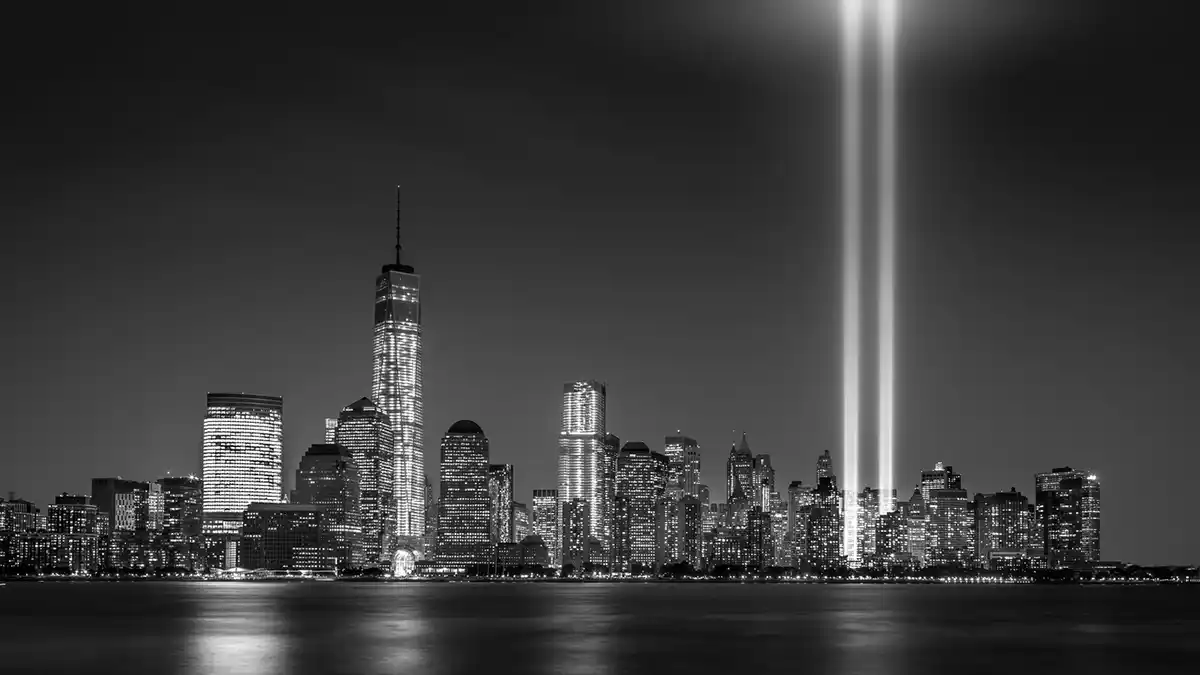
Header image: Two powerful beams of light project into the sky over lower Manhattan as part of The Tribute in Light official commemoration events of 9/11. The beams shine from dusk until dawn and are visible up to 60 miles from Lower Manhattan. (PHOTO: iStock)