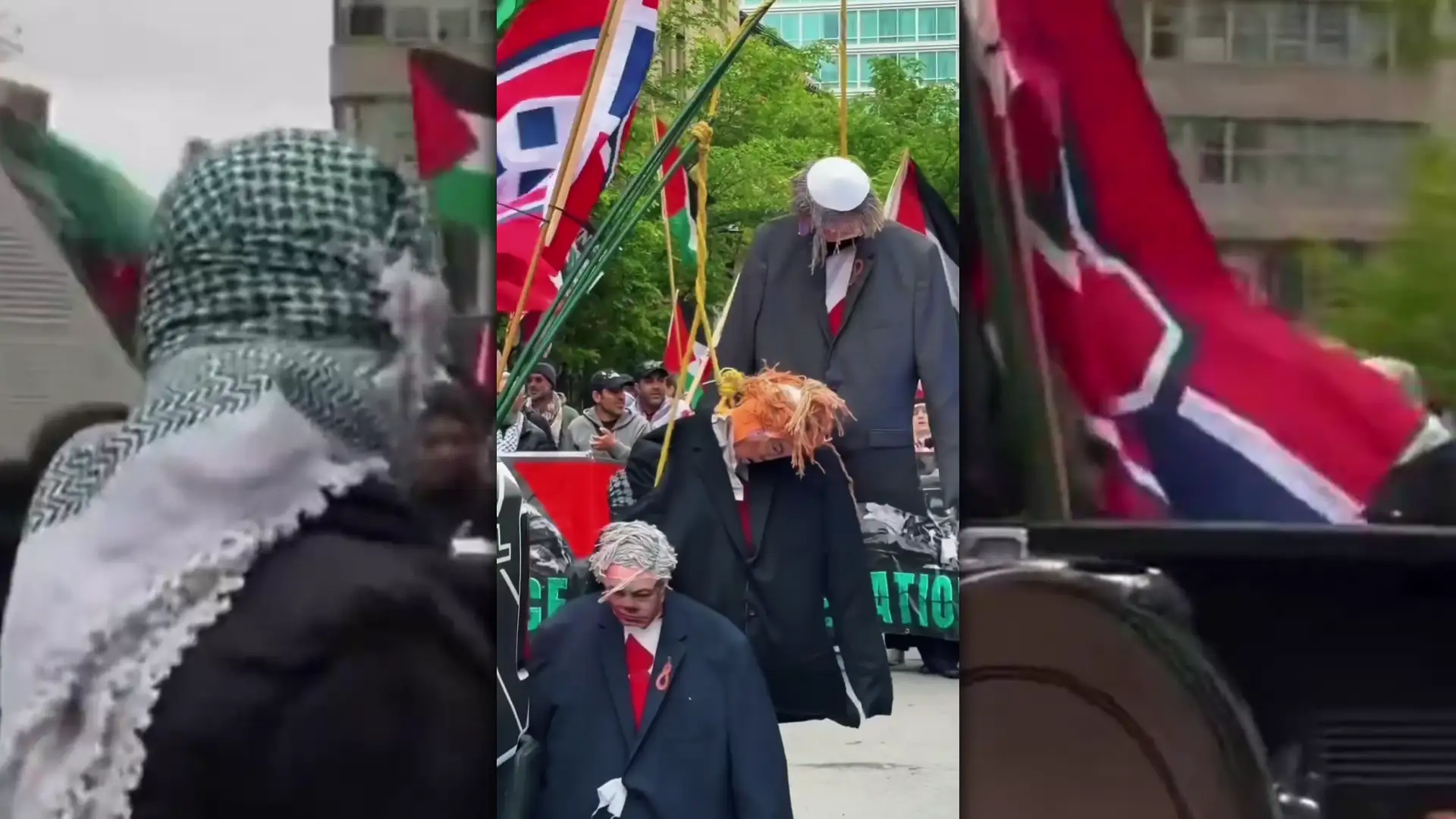
Are Lynched-Jew Effigies Enough to Get Our Laws Enforced Against Antisemites?

There was a time — not that long ago — when the sight of a Jew hanging from a noose in a public square would have shocked the conscience of every decent citizen. It would have provoked immediate condemnation from politicians, emergency meetings by civic authorities, police investigations, and editorials demanding accountability.

This week in Montreal, it barely produced a shrug.

At a demonstration organized by Montreal4Palestine, protesters paraded an effigy of a hanged Jew wearing a kippah through the streets of downtown Montreal. Images and videos circulated widely online. Some reports identified the effigy as representing Israeli minister Itamar Ben-Gvir. Others noted that, to any ordinary observer, the imagery unmistakably evoked the lynching of Jews.

And that is precisely the point.

When mobs choose symbols historically associated with the persecution and murder of Jews, they know exactly what they are doing. Public hangings and lynchings are not neutral political metaphors in Jewish history. They are among its darkest recurring realities — from medieval pogroms to Nazi terror to modern antisemitic violence. One does not need to hang a sign saying “all Jews” for the message to be understood.

What should terrify everyone is not merely that this occurred, but how quickly so many rushed to excuse it.

Scroll through social media reactions and the rationalizations come instantly: “It was only Ben-Gvir.” “It was political speech.” “People are overreacting.”

But civilized societies are not judged only by what they prohibit. They are judged by what they tolerate.

Would any other minority community be expected to calmly explain why an effigy resembling one of its members hanging from a noose might create fear? Would civic leaders debate whether the public display of a lynched Black man, Muslim, or gay person was merely “political commentary”? Of course not. Authorities would instantly understand the historical symbolism and social menace involved.

Yet when Jews are targeted, too many increasingly retreat into semantic games and moral evasions.

This is precisely why Criminal Code provisions already exist — and why they should have been immediately examined and enforced by police and prosecutors.

Section 319 of the Criminal Code prohibits the wilful promotion of hatred against an identifiable group. Jews unquestionably constitute such a protected group under Canadian law. Section 423 prohibits intimidation intended to provoke fear or compel conduct through threats or threatening acts. Section 430, the mischief provision, has repeatedly been applied in cases involving the obstruction or intimidation of communities in the enjoyment of public spaces and institutions. Depending on the full factual context and accompanying rhetoric, authorities could also have examined whether the conduct constituted incitement likely to lead to a breach of the peace.

None of this requires criminalizing legitimate criticism of Israel. Democracies survive political disagreement. What they cannot survive is the normalization of threatening ethnic symbolism masquerading as activism.

The issue here is not freedom of expression. Canada protects robust and even offensive political speech. But no democratic society treats all conduct as consequence-free merely because it occurs at a protest. The Criminal Code draws lines precisely because intimidation and hate propaganda undermine the security and equality of citizens.

And the consequences of refusing to enforce those lines are becoming impossible to ignore.

Canada recorded unprecedented levels of antisemitic incidents last year, according to Jewish advocacy organizations. Jewish schools require security guards. Synagogues face threats. Jewish students report intimidation on campuses. Businesses are vandalized. Demonstrations routinely feature slogans and imagery that would never be tolerated if directed at any other community.

Still, political leaders too often respond with carefully calibrated statements designed not to offend activist constituencies rather than to defend civic standards.

A hanging effigy in a city street is not dialogue. It is a menace. It is intimidation. It is an attempt to normalize imagery historically associated with terrorizing Jews.

The larger question now confronting us is painfully simple: if this is still not enough to trigger serious legal, political, and moral action against antisemitism, then what exactly is?

How much uglier must it become before authorities decide that the line has been crossed?

Because history teaches one lesson with brutal consistency: societies that normalize hatred against Jews never stop with the Jews. The corrosion eventually consumes the civic culture itself.

We now stand at that test. And silence, equivocation, and selective enforcement are no longer neutrality. They are complicit.

Image: Screenshot from an X post by @VivianBercovici, former Canadian ambassador to Israel.