Recommended Articles
LRT will lack transparency as long as the P3 exists

Harper Government’s Disdain For Science

The truckers roll into town rudderless



For more than half a century, Canada has debated high-speed rail as though it were a speculative fantasy, something eternally just beyond our reach, perpetually “under study,” always one report away from viability.
That framing is wrong. High-speed rail is not unproven. It is not exotic. And it is not primarily a question of population density or national temperament. It is a question of execution and Canada’s persistent unwillingness to be honest about what execution actually requires.
Nowhere is that clearer than in the Toronto–Ottawa–Montreal–Quebec City corridor, where roughly 44 per cent of the country’s population lives, works, studies, and travels. If high-speed rail cannot succeed here, it cannot succeed anywhere in Canada. And if it does succeed here, it becomes one of the most consequential nation-building projects since the St. Lawrence Seaway. The problem is not ambition. The problem is an illusion.
For decades, opponents and skeptics have repeated a familiar refrain: Canada is “too spread out,” “too car-dependent,” or “too small” to justify high-speed rail. That argument collapses under even modest scrutiny.
What matters is not national population density; it is corridor concentration. The Toronto–Ottawa–Montreal axis is long, linear, and heavily travelled; precisely the conditions under which high-speed rail thrives in France, Germany, Spain, and Japan. Many of those corridors began with similar levels of car ownership and skepticism. They succeeded not because they were European, but because they were engineered correctly and operated with discipline.
High-speed rail works when it is treated as a system, not a political symbol.
In my recent conversation with Michael Schabas, one of the few Canadians who has actually designed, bid on, and operated rail systems internationally, a simple point came through repeatedly: Canada does not fail because high-speed rail is impossible. Canada fails because it keeps misunderstanding how it works.
Take routing. Legacy rail alignments, such as Highway 7 corridors with tight curves, are fundamentally incompatible with true high-speed operations. Speeds collapse below 60 km/h in places — rendering the entire value proposition meaningless. High-speed rail requires alignments designed for sustained 300–320 km/h travel, often skirting shield terrain through forests rather than hugging existing roads.
Then there is technology. Electric trains are not optional; they are required. Weight limits, axle loads, energy efficiency, and operating economics all point in the same direction. So do double-decker trains, which reduce cost per seat by 20–25 per cent and are now standard in successful European systems.
And finally, stations. Canada has a habit of treating downtown stations as sacred objects. In reality, the most successful high-speed systems balance edge-of-city stations where suburban populations actually live with selective downtown access. Only a minority of passengers want to go straight downtown; many are transferring, commuting, or heading elsewhere entirely.
Symbolism should never trump throughput.
For residents of Ottawa, this moment matters enormously. There is real promise in proposals to bring high-speed rail closer to the city core, potentially re-using the historic downtown station. But if tunnelling is already required, planners should think bigger: extending under the river to Gatineau and creating a shared rail spine that could one day support a Manotick–Ottawa–Hull–Gatineau metro service.
That would not just connect cities. It would reshape labour markets, housing options, and daily life across the National Capital Region.
Even more transformative is what lies east and west. A properly aligned high-speed line could place Belleville, Quinte, and Kingston within 45 to 75 minutes of Toronto, Ottawa, and Montreal, distances that fundamentally change where people can live, build businesses, and raise families. A single hourly stop in each direction is enough to support tens of thousands of new homes without undermining through-passenger economics. This is how high-speed systems work elsewhere. There is no reason Canada cannot learn the same lessons.
Critics often fixate on capital cost while ignoring operating reality. Properly designed high-speed rail corridors generate substantial operating surpluses, often billions annually, because the cost per seat-kilometre is significantly lower than that of airlines, and demand expands once travel becomes faster, more reliable, and more frequent. Average fares on successful European lines are often lower than what Canadians pay today on VIA Rail.
Airlines do not disappear; they adapt. High-speed rail absorbs short-haul demand and feeds longer-distance connections. The result is a more efficient transportation ecosystem, not a zero-sum battle. The real risk is not financial infeasibility. It is building the wrong system.
Canada’s track record on major infrastructure has earned public skepticism, and rightly so. Cost overruns, schedule slippage, and muddled accountability have become normalized.
That is precisely why this project must be judged differently. The burden is on Alto and its partners not merely to promise benefits, but to demonstrate clearly, transparently, and rigorously that route selection, service planning, fare strategy, and governance have been optimized before construction begins.
High-speed rail does not forgive improvisation. It rewards clarity.
This is not an argument for high-speed rail at any cost. It is an argument for doing it properly or not doing it at all.
Canada does not lack engineers, capital, or precedent. What we have lacked is the discipline to stop pretending that every corridor is unique, every lesson foreign, and every failure inevitable.
High-speed rail is not a leap of faith. It is a test of competence. If we pass it, we reshape mobility, productivity, housing, and national cohesion for generations.
If we fail, it will not be because the idea was too ambitious but because we once again chose comfort over clarity.
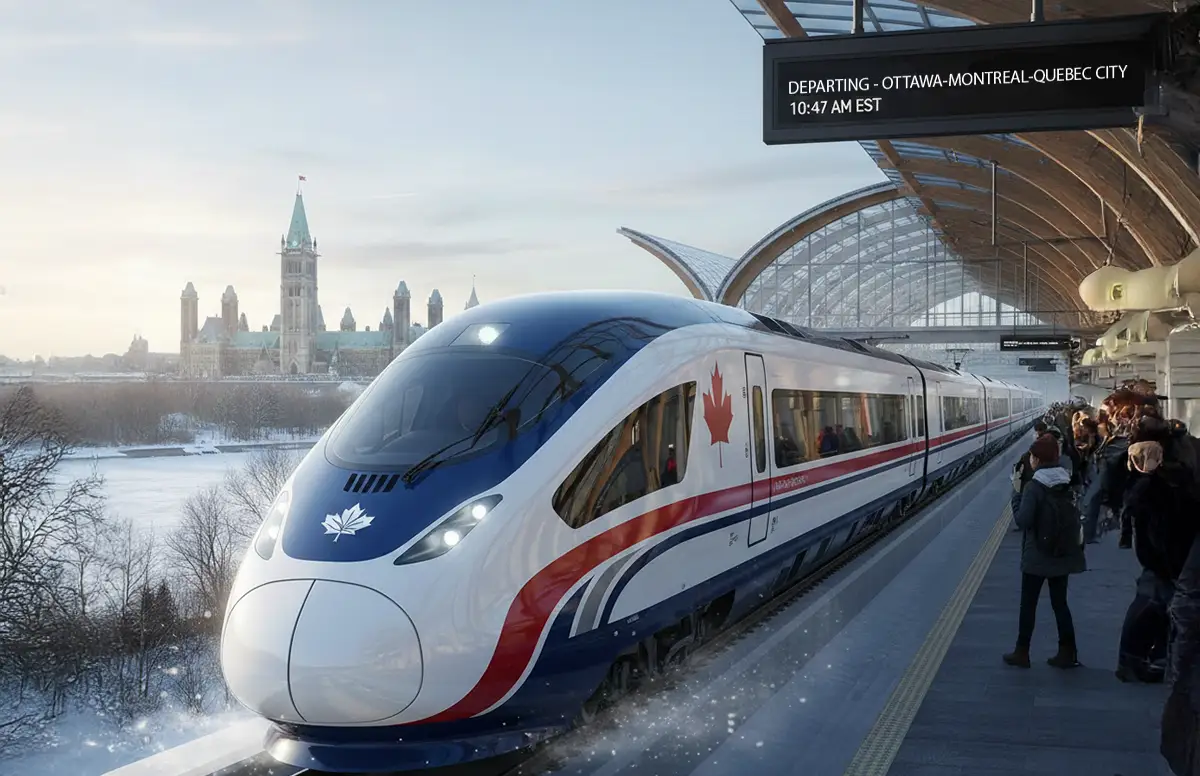
Header image: Generated by AI