Beyond the Front-Runners: Why Ottawa’s Long-Shot Mayoral Candidates Ran

Ten of Ottawa’s 14 mayoral candidates shared less than three per cent of the vote. Their campaigns reveal what motivates people to enter municipal politics—and how difficult it can be to get heard.


By Justin Campbell

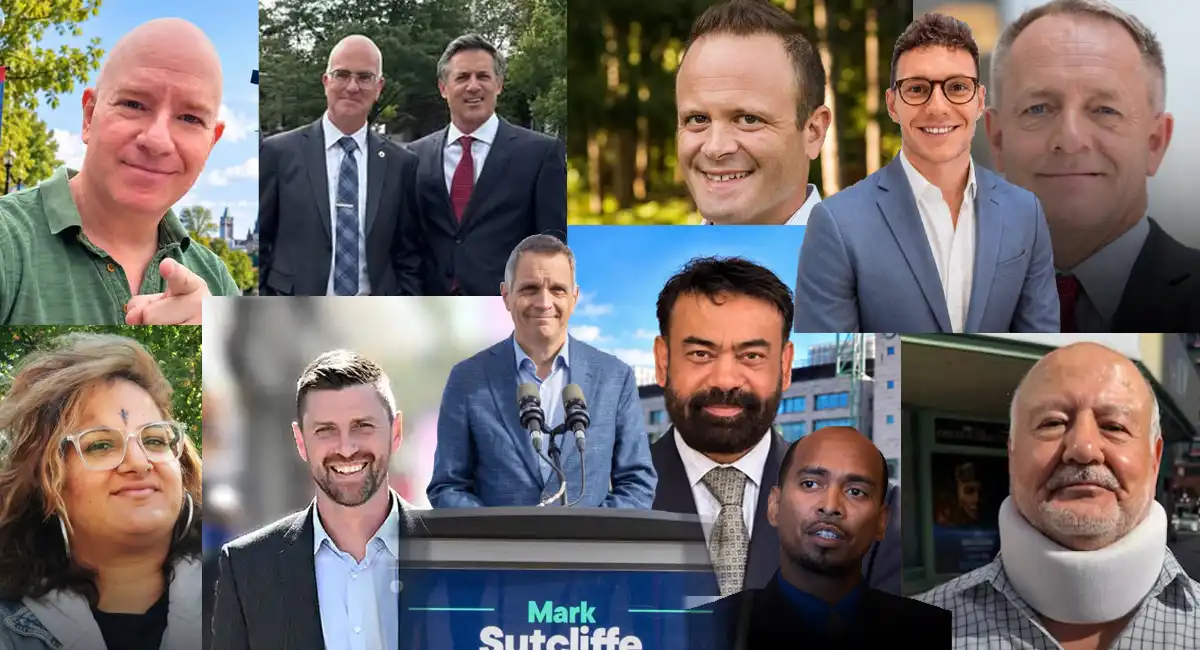
Fourteen candidates were certified to run for mayor of Ottawa in last Monday’s (October 26) municipal election. When the votes were counted, only four received more than five per cent of the vote. Incumbent Mark Sutcliffe, three-term city councillor Jeff Leiper, retired economist Neil Saravanamuttoo and homebuilder Alex Lawson dominated election coverage, campaign signs, door-knocking and public debates.

Sutcliffe was re-elected with 44.65 per cent of the vote, followed by Leiper with 33.90 per cent, Saravanamuttoo with 11.04 per cent and Lawson with 7.56 per cent. The remaining ten candidates received a combined 8,884 votes, representing just 2.85 per cent of the valid mayoral vote. The City Clerk declared the results official on October 30.

The numbers tell one story about the election. The experiences of the candidates who finished well behind the front-runners tell another: why people with limited resources, little political experience or a particular issue they want to advance decide to run for mayor, even when their chances of winning are remote.

The election also raises a broader question about participation in municipal democracy. Turnout was 36.21 per cent, down from 43.8 per cent in 2022. While the presence of long-shot candidates cannot explain that decline, their experiences offer a window into the challenges of entering a political contest and finding an audience for ideas outside the mainstream campaign.

Running for mayor in a city the size of Ottawa requires a network of experienced people familiar with how to campaign, teams of volunteers who believe in the candidate and a clear understanding of the mayor’s role, according to The Logic journalist David Reevely and communications consultant Barry McLoughlin.

To register, a candidate needs 25 endorsements from eligible electors, a $200 filing fee and some knowledge of how to navigate the registration forms at the City of Ottawa Elections Office, located at 1221 Cyrville Road, Unit B. The nomination period ran from May 1 to August 21, with the final deadline at 2 p.m.

For some candidates, the practical demands of campaigning began before they had even made their first pitch to voters. Ali Shayvard, for example, was employed by the city as a relief instructor for Para Transpo and said he was required to take an unpaid leave of absence to campaign. His financial responsibilities meant he had to wait until the last day of registration to afford the time off.

For ordinary citizens without city hall or political experience, such as first-time candidates Shayvard and Josh Rachlis, the knowledge of what is required to run for mayor was an in-the-moment learning process. Shayvard received 0.33 per cent of the vote, while Rachlis received 0.22 per cent.

“When you’re running … you have to learn all the background stuff,” Shayvard explained. “You need to learn all the accounting stuff. You need to learn exactly what you need to do for your donations, what you need to do for your websites.”

“Because I’m running on the last day, I don’t have that opportunity,” Shayvard said, explaining that registering earlier would have given him more time to research questions and seek guidance from the elections office.

The experience illustrates one of the less visible barriers to running for public office: the time, financial flexibility and administrative knowledge needed to organize a campaign before the actual campaigning begins.

Rachlis, who ran his campaign entirely on his own, said he learned to focus his efforts on attracting media attention as a way to gain a voice as an alternative option.

“I knew that no matter what I run for, my odds of winning aren’t great because I am just one person,” Rachlis said. “I don’t have a whole team, so how can I make a bigger impact and make a difference for the city by introducing myself and my ideas and my platform?”

One approach was to ensure he received CBC coverage when he registered as a mayoral candidate, as well as prioritizing candidate questionnaires sent out by various media outlets.

“Being interviewed at the registration office might be the only time you get media coverage, so it’s something to consider,” Rachlis explained. “How can you optimize your campaign to get some coverage and bring attention to your values and your ideas?”

According to Reevely, candidates who poll higher generally have the resources to register earlier and assemble a campaign team. He likened the effort to establishing a small business, something first-time candidates may not appreciate.

“You must have a plan, and typically … people who will help you, which means recruiting them, and that means starting early,” Reevely explained. “All of that usually gets done before you file nomination papers … that is invisible if you’re a novice to this. I think what tends to separate the people who stand a chance from people who don’t is understanding that it is like you’re starting a small business or nonprofit.”

Candidates such as Lawson and Saravanamuttoo, who were also outsiders to city hall but received 7.56 and 11.04 per cent of the vote respectively, networked with people who could guide their campaigns and position them as serious candidates, Reevely said. They entered the race with platforms and a clearer understanding of their audiences.

“Lawson got people who could teach him how to run for mayor, and Saravanamuttoo, who learned how to run for mayor from the last campaign – that is a big distinction” from the candidates at the low end of the vote count, Reevely explained.

The importance of visibility was also reflected in a separate analysis of media coverage during the campaign. Communications firm Liaison Strategies tracked earned media appearances in five Ontario mayoral races between August 3 and October 2. In Ottawa, its analysis found that Sutcliffe accounted for 38.2 per cent of appearances, followed by Lawson at 22 per cent, Leiper at 21.8 per cent and Saravanamuttoo at 17.9 per cent. The study focused on those four candidates, rather than all 14, but illustrates how attention during the campaign was concentrated among the leading contenders.

McLoughlin, a communications consultant who has worked on municipal campaigns in Ottawa for 30 years, identified four characteristics he believes can undermine candidates and their campaigns.

One is a lack of campaign knowledge. “They’re getting into something that they can’t even comprehend,” McLoughlin said. “The complexity, the sheer energy, the amount of resources, the teams, the organization … you must understand all those aspects, and many do not.”

The second issue is ambition. “Ego has gotten way ahead of their understanding” of what a mayor does, he said.

Third is motivation. “Candidates, even the ones below the radar line, have to ask, what is my authentic reason for wanting to be mayor? What change do I want to make? There are issues,” McLoughlin said, “and they have views on them, (but) were they ever tested? Tell me how that would work. How would that be paid for?”

McLoughlin’s point is that having strong opinions about municipal issues is not the same as having a workable plan to address them. Candidates must be able to explain what they want to change, how they would do it and how their proposals would be funded.

Finally, there is political attitude. If a candidate is running on a non-negotiable issue or platform, McLoughlin argued, they can come across as too extreme and limited. “I think there are purists, people that feel that they have something genuine to add that others don’t… (they feel) we shouldn’t even have a world where people are debating each other at council,” he said.

Leiper, who came second to Sutcliffe with 33.90 per cent of the vote, suggested that name recognition, resources and civic knowledge, as well as a motivation to serve the community rather than naked ambition to reach the mayor’s office, help a candidate earn media coverage and become competitive.

“If you can’t demonstrate that you have” those attributes, “then … the media is not going to pay attention to you. Then the polling won’t really go in your favour.”

Leiper had a defined position on the direction of the city. “The city’s on the wrong track, and we can get back on the right track,” he said. “I believe that I can make decisions that get us on the right track.” He came second to incumbent Sutcliffe after running a campaign that showed him frequently interacting with the public at meet-and-greets, debates and other functions, as documented on social media.

Originally intending to retire from politics, Leiper changed his mind because he felt the city was going in the wrong direction. “There are a lot of levers that the mayor has to accomplish significant change in the city not available to a city councillor, and I honestly believe that as mayor, I can use those levers in a way that better serves the public interest,” he said.

But a low vote total does not necessarily mean a candidate contributed nothing to the campaign. Some of the lower-polling candidates were motivated by specific policy concerns or by a desire to bring issues they felt were being overlooked into the public conversation.

Rachlis, Westaway and Bakshi, for example, did not present the same broad, fully developed mayoral platforms as the four leading candidates. Their campaigns were more narrowly focused, but each had ideas and concerns they wanted voters to consider.

Rachlis, during an August debate, made specific suggestions ranging from encouraging walkability through mixed-use planning to protecting green space and making neighbourhoods more environmentally sustainable.

At an August 26 forum hosted by the People’s Official Plan Coalition, Rachlis discussed mixed-use neighbourhoods, the development of existing parking areas and incentives for greener driveways and parking lots. The same forum included seven mayoral candidates, among them Shayvard, Westaway, Saravanamuttoo and Leiper. Its coverage by Capital Current demonstrates that candidates outside the leading four had opportunities to present policy ideas in public forums, even if those opportunities did not translate into substantial election support.

Rachlis emphasized that winning was not the point. Instead, he approached the campaign as a way to give voice to his environmental concerns. Of the 14 candidates, he came in 13th, ahead of only Zed Chebib, who finished last, with 0.13 per cent. Rachlis received 0.22 per cent of the vote.

“When there’s things about the province or the country or the city that I feel like I could contribute to, running an election is one way to get my ideas in there,” Rachlis said.

“I’m strengthening democracy. I’m giving people more of a choice,” he said.

Westaway’s campaign, including his website, focused almost exclusively on the agricultural land use of the Greenbelt, rather than on the municipal issues that dominated much of the election discussion, such as transit and affordability. Like Rachlis, he campaigned alone. His motivation for running was to have a platform to speak about the Greenbelt rather than to become mayor, which he considered unlikely.

“I’m not going to be your next mayor; it’s just not happening,” Westaway said. “Why pretend?”

“I just want to be heard,” he continued. “I just think it’s for the best, and I admit, it’s a selfish reason too, because it’s my self-promotion.”

After the election, however, Westaway said he was pleased with the experience and intended to continue building support for his platform ahead of the next municipal campaign.

“I was very pleased with this campaign, (which) was my first mayoral run, and I had lots of fun. I am sure I’ll be back in four years and, in the meantime, I’ll try to build up a social media following so I can have a bigger impact next time,” he said. He acknowledged that removing Greenbelt farms was unlikely, but added that “if I can get them to plant trees along the roads it will be a victory.”

Bakshi, a public servant who, like Shayvard, said she had to wait until the end of the registration period before she was able to campaign, wanted the city to “stop digging” and cultivate social unity and political engagement among residents. Rather than presenting a conventional, detailed mayoral platform, she described her campaign as an opportunity to speak directly with residents and learn about their concerns.

“I’m at the ground level talking to people,” she explained. “This is where my research is. I don’t have a report. I don’t have an association that I’m going to. I’m talking to real people and being very candid and honest.”

Her time on maternity leave allowed her to survey public concerns, prompting her to consider running for mayor.

“I’ve always been trying to figure out how to solve some of the gaps I see in my community,” Bakshi said.

Like Rachlis and Westaway, Bakshi lacked a campaign team or experienced guidance. Instead, she responded to candidate questionnaires sent by media outlets and various interest groups. As the campaign ramped up in October, she joined other candidates at meet-and-greets, where they mingled with residents. Bakshi also reached out to the office of OC Transpo general manager Rick Leary, requesting an urgent meeting before the election to discuss the transit budget.

She received 0.40 per cent of the vote, finishing sixth overall and receiving more votes than all but one of the other ten lower-polling candidates: Amjad Ali Syed, who received 0.42 per cent.

After the election, Bakshi said she felt her campaign had made an impact.

“Many people felt they were represented and shared that it is important to be fair to one another … the impact is big, and so many companies are reaching out to me because of the campaign,” she said.

Shayvard chose to run for mayor in part to demonstrate that a visible minority could seek the office following the election of Zohran Mamdani as mayor of New York City. He also wanted to address infrastructure and transit issues that he felt had worsened under Sutcliffe.

Citing his experience of other world capitals, he said, “The infrastructure, everything is top notch. And to me, we’re Canada’s capital. I’m not (suggesting we lay) gold bricks at every single intersection. But can we at least have proper roads? Because our roads have never been this bad.”

Of the candidates interviewed, Shayvard was the only one who said he managed to visit all 24 wards and speak with residents. He relied on a small team of family and friends to help build a website, develop a platform and erect campaign signs. He also articulated a mandate to address transit, roads and housing affordability.

“I went to all the wards, and I listened to all their problems,” Shayvard said. “Anytime you want to apply for a job, you have (to know) the main issue,” and how much priority it deserves. “I would say OC Transpo is at least 50 per cent” of the issues in each ward he canvassed.

Sutcliffe, Leiper, Lawson and Saravanamuttoo all had platforms with established mandates on their respective websites. Sutcliffe, who won 44.65 per cent of the vote, presented a substantial amount of material at a press conference, including a 70-page platform book.

“We’re going to make Ottawa better than it was before,” he said at the press conference.

The difference between the leading candidates and those who received only a small fraction of the vote was not simply a matter of who had ideas and who did not. It was also a question of organization, experience, resources, public recognition and the ability to communicate a credible plan to voters.

While the election results confirmed that the serious contest was primarily between Sutcliffe and Leiper, Rachlis, Bakshi, Westaway and Shayvard all described the campaign as a learning experience that introduced them to a broader community and gave them a better understanding of the political process.

“The campaign … helped me understand how campaigning works and what it takes to get your message out,” Shayvard said. “When I run again, I’ll be much better prepared because I’ve been through the process.”

Shayvard said he felt unable to get his ideas out during the campaign, having been invited only to smaller debates and meet-and-greets.

“I think many people following the election through news and social media may not even have known that someone from OC Transpo was running for mayor,” he continued. “It’s difficult for ideas to have an impact when people don’t get the chance to hear them.”

Bakshi voiced her intention to rally Shayvard, Westaway and Rachlis as a political group that she referred to as the “four musketeers.”

“I said, if we don’t (win), at least we should be able to create a group so that we can … talk with the mayor’s office,” Bakshi said.

Westaway agreed. “I do like the idea of having an informal municipal party, that it would be easy to reach out to new candidates who … sign up,” he said. “We’re speaking as a group, and I think that’s great.”

Whether the proposed group develops into an organized civic voice remains to be seen. But the idea points to one possible outcome of a campaign that produced few votes: candidates who did not win may still find ways to bring their concerns to City Hall.

The label “fringe candidate” can obscure the different motivations behind these campaigns. Some candidates may have underestimated the demands of running a large municipal campaign. Others understood they were unlikely to win but saw an election as an opportunity to raise an issue, test an idea, meet residents or challenge the established political conversation.

Ottawa’s election has produced a clear result and a new four-year mandate for its mayor and council. But the candidates who finished far behind the front-runners also participated in the democratic process. Their campaigns raise a question worth considering after the ballots have been counted: how can a city make room for new voices and unconventional ideas while still demanding the preparation, accountability and practical understanding required to govern?