Canada and China Re‑Engage: Trifocal Global Foundation and Cassels Brock Lead High‑Level Economic Bridge Summit in Toronto
Canada’s relationship with China is entering a new, more deliberate phase. After a prolonged period of strained relations between Ottawa and Beijing — a period many business leaders and foreign‑policy analysts say left Canada sidelined in the world’s fastest‑growing region — Prime Minister Mark Carney moved quickly to repair the damage and re‑establish structured engagement with China. His government has emphasized a return to professional diplomacy, economic diversification, and high‑level cooperation, creating the conditions for forums like this one to take place.
China, under President Xi Jinping, has likewise signalled a renewed interest in stable, rules‑based engagement, particularly in areas tied to investment, innovation, and cultural exchange.
It was in this context that the Canada‑China Economic Bridge Forum convened on April 16, 2026, in Toronto. Hosted by the Trifocal Global Foundation in partnership with Cassels Brock & Blackwell LLP, the summit brought together 100 senior leaders from business, law, policy, and innovation to map out a professional framework for long‑term bilateral cooperation. Jasmine Wang (Green Elephant Investments) added the investor lens, noting that cross‑border success depends on capital alignment and a long‑term vision.
A Summit on Re-engagement— and a Key Canadian Voice at the Centre
Trust shaped much of the day’s discussions, and few Canadians have done more to build that trust than Marc Kealey, President of the Trifocal Global Foundation. Over years of work across Asia, Kealey has become one of Canada’s most influential voices on structured, transparent engagement with China. His message at the forum was direct: “The Canada‑China Economic Bridge Forum provides a high‑level platform for building the high‑trust, sincere strategic partnerships necessary for long‑term bilateral cooperation.”
The summit opened with Kealey and David Qi, CEO of the Trifocal Global Foundation, reflecting on their 2025 mission to Fujian — a trip rooted in cultural diplomacy and institutional relationship‑building that set the stage for the more ambitious economic objectives now underway.
A Leading Legal Voice in Canada–Asia Business
Tera Li Parizeau, a Partner at Cassels Brock & Blackwell LLP and widely regarded as one of Canada’s leading authorities on cross‑border investment and regulatory strategy, joined Kealey in outlining how those early diplomatic efforts created the conditions for deeper cooperation in 2026. Her practice spans international corporate structuring, foreign direct investment, and market‑entry compliance, and she has advised major Asia‑Pacific companies navigating Canada’s regulatory environment. Parizeau’s reputation for precision, clarity, and practical guidance has made her a go‑to advisor for multinational firms entering the Canadian market. Her contribution to the forum underscored why she is seen as a national expert on Canada–Asia business law and a key figure in shaping the legal frameworks that support international economic cooperation.
Highlights from the Summit: Innovation, Housing, and Cross‑Border Leadership
The summit featured many notable moments, but two contributions stood out for their clarity, expertise, and forward‑looking vision.
Reena Chaudhary, Co‑Founder of i2i, delivered one of the day’s most compelling interventions. A respected Canadian entrepreneur with deep experience in digital transformation and cross‑border innovation, Chaudhary has built her career at the intersection of technology, strategy, and global market expansion. Her remarks focused on the operational realities facing companies that want to scale internationally — from cultural intelligence to leadership readiness — and grounded the broader discussions in the practical challenges of building globally competitive firms.

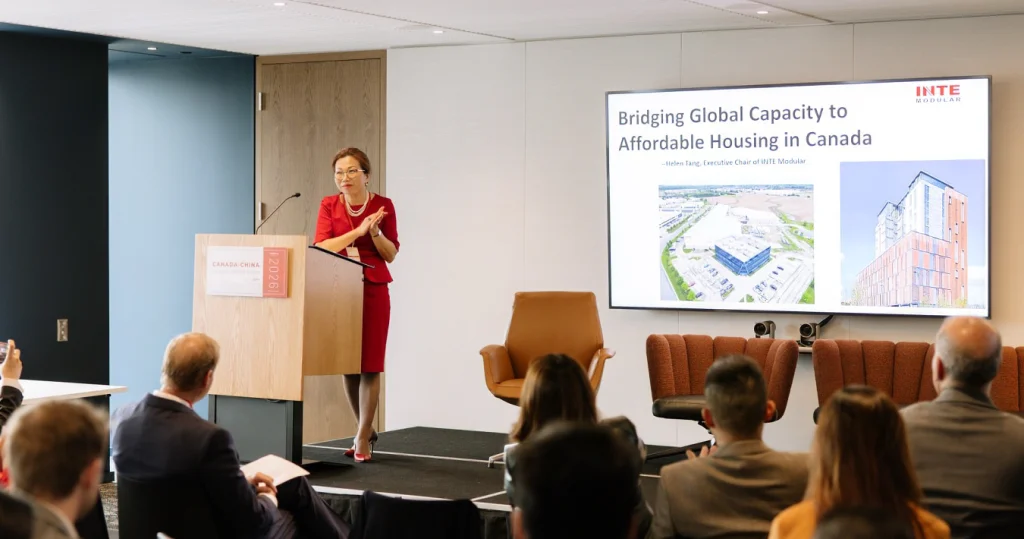
Above: Dr. Helen Tang at the Canada‑China Economic Bridge Forum held on April 16, 2026, in Toronto.
Dr. Helen Tang, Executive Chair of INTE Modular, provided another defining highlight. Tang is widely recognized as one of Canada’s leading voices in modular construction and advanced manufacturing. Her work has helped position modular building as a credible, scalable solution to Canada’s housing supply crisis. At the summit, she outlined how modular manufacturing — supported by cross‑border collaboration in materials, design, and production — can dramatically reduce construction timelines and improve affordability. Her presentation was one of the most forward‑looking sessions of the day and underscored the potential for Canada–China cooperation in solving shared housing challenges.
A Return Mission to Fujian — and a New Cross‑Border Business Platform
Building on last year’s progress, the Foundation announced its 2026 return mission to Fujian, aimed at expanding commercial, cultural, and investment ties.
Kealey also introduced Next Step Global (NSG), a new business reality television program inspired by Shark Tank and The Apprentice. Designed to help companies in Asia and North America navigate cross‑border scaling, NSG will air to an audience of 1.4 billion viewers in China — a massive platform for international entrepreneurial exchange.

Panel 1: Unlocking Market Opportunities Across Borders
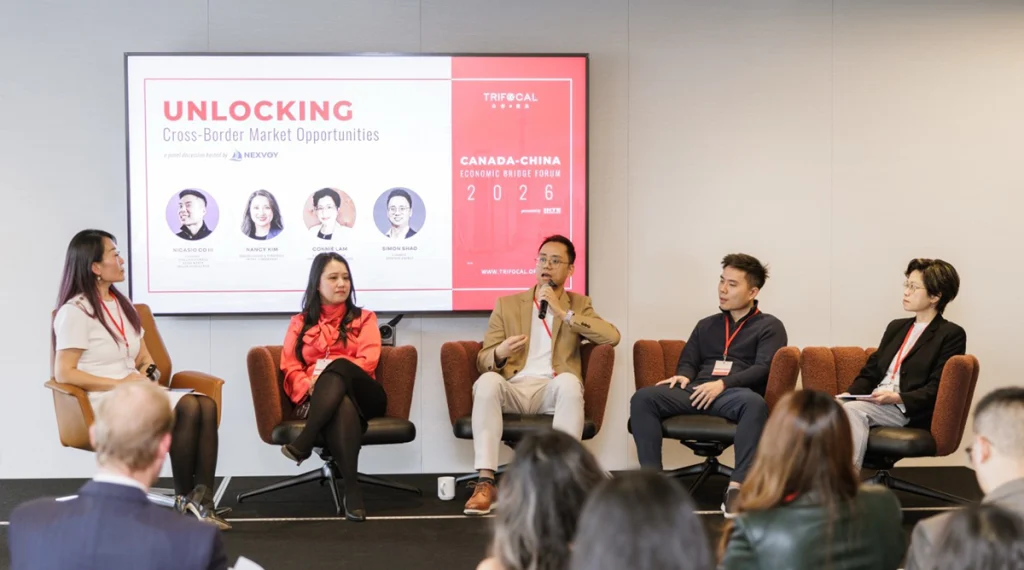
The first panel, “Unlocking Market Opportunities,” hosted by Vera Tsui of Nexvoy Initiative Canada, examined the practical realities of bilateral trade.
Panelists included:
• Nicasio Co III, Founder, Ecom North
• Nancy Kim, Strategic Retail Expert
• Simon Shao, Founder, Maxperr Energy
• Connie Lam, Assistant Manager, InvestHK
The discussion underscored the importance of strategic hubs like Hong Kong, which continue to serve as vital conduits for technology, logistics, and investment between East and West. Speakers emphasized the need for localized intelligence — Canadian firms entering Asia and Chinese firms entering North America both face steep learning curves without it.

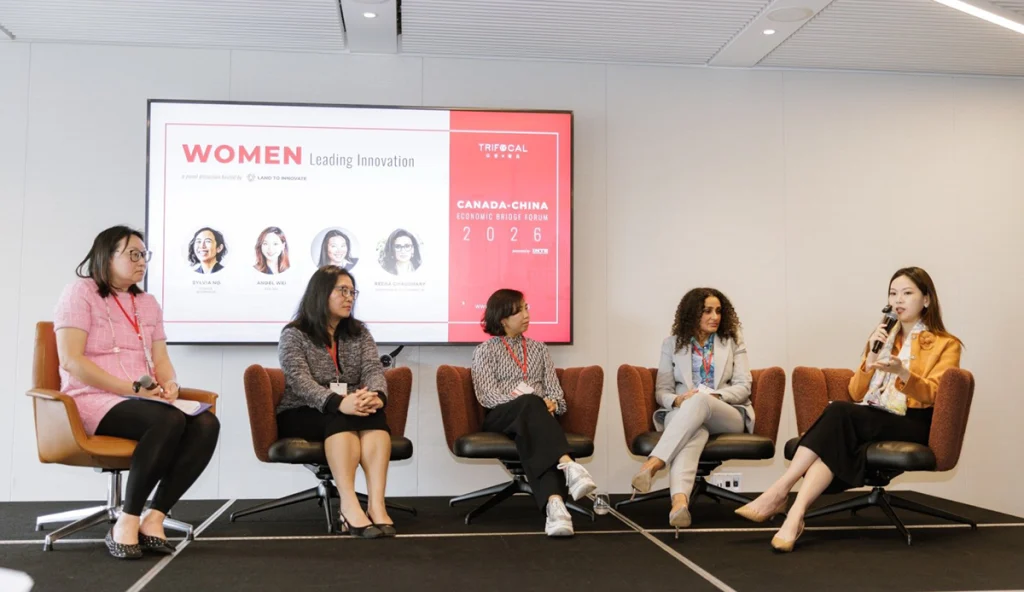
Panel 2: Women Leading Innovation in a Transforming Global Economy
The second panel, “Women Leading Innovation,” hosted by Tianna Feng, Executive Director of Land to Innovate, highlighted the leadership of women driving transformation across healthcare, retail, and technology.
Panelists included:
• Yvonne Chan, CEO & Founder, Santé Circle Health
• Reena Chaudhary, Co‑Founder, i2i
• Angel Wei, CEO, SCA
• Sylvia Ng, Founder, ReturnBear
Their discussion focused on organizational readiness, cultural intelligence, and the human side of AI adoption — areas where diverse leadership teams are proving especially effective.
Keynotes: Cultural Intelligence, Housing Innovation, and Urban Futures
The forum’s keynote speakers provided broader context for the day’s discussions:
• Victor Gao, Co‑Founder & Managing Director of iMpact, spoke on cultural intelligence in international negotiations.
• Helen Tang, Executive Chair of INTE Modular, expanded on modular manufacturing as a scalable solution to Canada’s housing challenges.
• Reza Pourvaziry, Chair of the Urban Economy Forum, introduced the Frontrunner Cities initiative.
• Dan Donovan, Publisher & Managing Editor of Ottawa Life Magazine, discussed the media’s role in bridging cultural misconceptions and supporting stable international relations.
The conversations in Toronto pointed to a clear trajectory: Canada and China are entering a phase of engagement defined by structured, commercially focused cooperation. The summit demonstrated that senior leaders in business, law, and innovation are prepared to work within that framework and move projects from concept to execution. Trifocal Global Foundation has positioned itself as a practical convenor for this renewed engagement, creating a mechanism where opportunities can be identified early, vetted quickly, and advanced with the right partners at the table.
What followed throughout the day reinforced that direction. Companies on both sides of the Pacific are reassessing supply chains, looking for predictable partners, and seeking out markets where regulatory clarity supports long‑term planning. The discussions in Toronto reflected that shift.
Rather than broad declarations, the summit produced the kind of early alignment that serious commercial initiatives depend on — shared priorities, defined channels of communication, and a clearer sense of where collaboration can deliver measurable value. For Canadian and Chinese firms exploring expansion, investment, or technology partnerships, that structure matters. It shortens timelines, reduces uncertainty, and creates a more reliable path from opportunity to execution.
The Toronto forum showed that those conditions are taking shape again, and that the people capable of driving meaningful cross‑border cooperation are already engaged in the work.
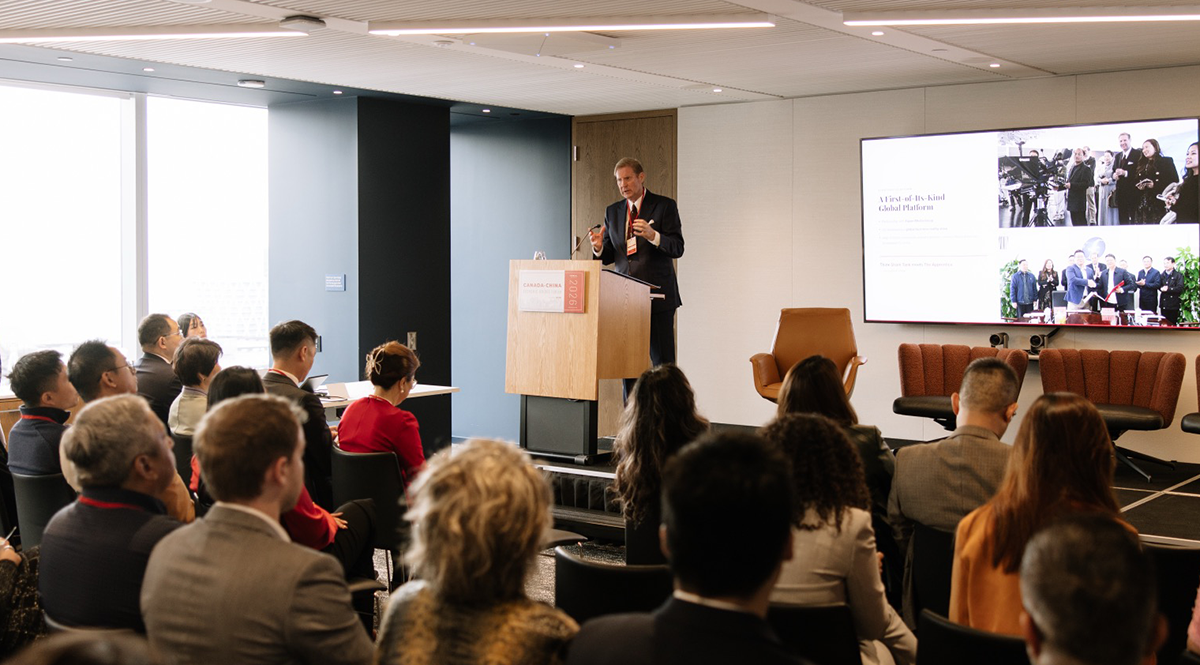
Header image: Marc Kealey, President of the Trifocal Global Foundation, addresses attendees of the Canada‑China Economic Bridge Forum.
Photos: Courtesy Canada‑China Economic Bridge Forum