
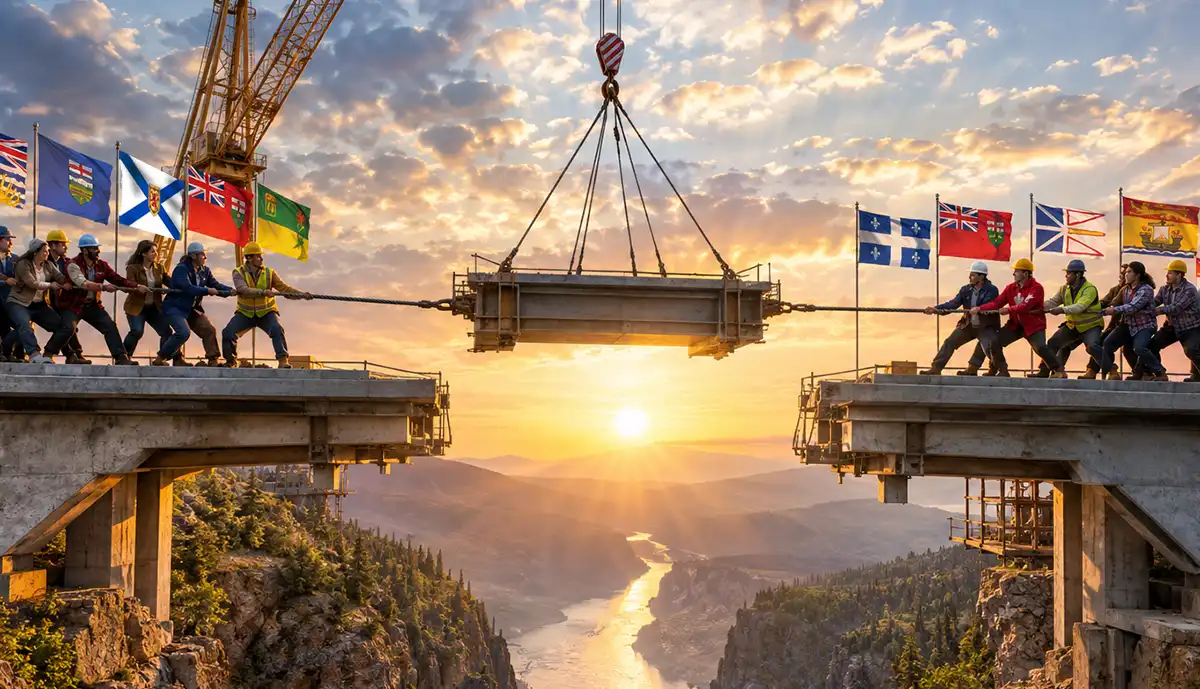
Canada Needs to Build, Not Break Apart

At the very moment Canada needs a new era of nation-building, separatist pressures and political divisions threaten our ability to seize an extraordinary economic opportunity.


I attended the Toronto Global Economic Forum this week, where economists, investors, business leaders and policymakers discussed the extraordinary changes reshaping the global economy. Artificial intelligence, government debt, rising borrowing costs, energy security and the transformation of international trade dominated the formal presentations.

But some of the most troubling conversations took place outside the conference rooms.

Over coffee and between sessions, I spoke with people increasingly concerned about Canada’s political future. Their central worry was not simply whether Alberta or Quebec might someday separate from Canada. It was whether renewed separatist pressures could paralyze federal–provincial cooperation at precisely the moment when the country most urgently needs to act.

Canada faces an extraordinary economic opportunity at the very moment when political divisions threaten our ability to seize it.

The World Is Changing Faster Than Canada

One of the clearest messages from the forum was that the era of inexpensive capital may be ending.

For much of the past two decades, governments and businesses operated in an environment of historically low interest rates. Governments accumulated enormous debts, companies financed expansion with inexpensive borrowing, and investors became accustomed to rising asset values.

That environment is changing.

One speaker summarized the emerging challenges through three words: debt, data and doubt.

Governments need unprecedented amounts of financing. Artificial intelligence companies are investing extraordinary sums in data centres, computing infrastructure and electricity. Meanwhile, investors are becoming more skeptical about whether the resulting debt and valuations can be justified.

Global investment requirements are increasing just as financing conditions are becoming more demanding.

One speaker observed that equity markets have been behaving like teenagers on drugs, while bond markets are behaving like adults. Behind the colourful analogy was a serious warning: bond investors are increasingly distinguishing between borrowers with sustainable cash flows and those dependent on optimistic assumptions and continuing access to inexpensive capital.

Several participants also questioned whether artificial intelligence is experiencing an investment bubble comparable to the railway boom of the nineteenth century or the dot-com boom of the late 1990s.

Railways transformed national economies, but many railway companies went bankrupt. The internet revolutionized commerce and communications, but countless dot-com companies disappeared.

Artificial intelligence may prove equally transformative without every AI company, data centre or large language model becoming a successful investment.

Indeed, some speakers argued that the most durable beneficiaries of the AI revolution may ultimately be the providers of electricity, power grids, energy and critical minerals.

Those are precisely the areas where Canada possesses enormous advantages.

America Is No Longer Playing by the Old Rules

Another particularly important presentation came from a senior international trade lawyer from Washington.

Her message was stark: many Canadians do not appreciate how fundamentally American attitudes toward international trade have changed.

For decades, the United States regarded economic integration with allies as both good economic policy and good national security policy. Trade was expected to create prosperity, strengthen alliances and reduce international conflict.

COVID exposed the weaknesses in that approach.

The United States discovered that it could not always guarantee access to personal protective equipment, pharmaceuticals and other essential products. Policymakers increasingly concluded that national security required greater control over strategically important supply chains.

The result has been a shift toward tariffs, domestic industrial incentives and policies designed to encourage production within the United States.

The lawyer argued that this transformation began under the Biden administration and would likely endure beyond the current administration. Her most important observation was that being an American friend or ally no longer guarantees preferential trade treatment.

For Canada, that is a fundamental warning.

We have built much of our economic strategy around preferential access to the American market. But if Washington increasingly places domestic production and national security ahead of traditional trading relationships, Canada must strengthen its own economic resilience.

We need to become indispensable to North American supply chains while expanding our ability to trade with the rest of the world. That means developing our energy resources, critical minerals, electricity infrastructure, ports, railways and industrial capacity. And it means doing so quickly.

Canada’s Greatest Obstacle May Be Political

This brings me to the conversations that concerned me most at the forum. At a time when Canada needs unprecedented cooperation among governments, separatist pressures in Alberta and Quebec threaten to complicate that cooperation.

In Alberta, Premier Danielle Smith faces a politically sensitive environment in which separatist sentiment, although far from universally shared, has become an increasingly visible force.

Several people I spoke with expressed concern about divisions within the United Conservative Party and the potential for separatist activists to influence internal party politics. They worried that leadership disputes, an intensified sovereignty debate or the possibility of an early provincial election could consume the government’s attention.

The implications extend well beyond provincial politics.

Alberta and Ottawa need to cooperate on energy development, pipeline infrastructure and access to international markets. These projects require sustained political attention, regulatory coordination and agreements that investors can rely upon.

If cooperation with Ottawa becomes politically difficult within Alberta’s governing party, major projects could be delayed regardless of their economic merits. That would hurt Alberta as much as the rest of Canada.

Alberta’s prosperity depends in part on its ability to develop its resources and reach international markets. Canada’s prosperity depends in part on Alberta’s enormous energy and industrial capabilities.

The two interests should reinforce one another, not compete.

Quebec presents a different but equally important challenge.

The Parti Québécois continues to advocate sovereignty and another referendum. The prospect of renewed constitutional confrontation raises legitimate concerns about federal–provincial cooperation.

Quebec’s hydroelectric resources, critical minerals, manufacturing capabilities and transportation infrastructure are central to Canada’s economic future.

Canada needs stronger electricity connections between provinces, improved transportation corridors and expanded access to international markets. These objectives will be more difficult to achieve if federal–provincial relations become dominated by constitutional disputes.

The concern is not that every disagreement with Ottawa represents separatism. Provincial governments have legitimate interests and constitutional responsibilities that must be respected.

The danger arises when political confrontation becomes more rewarding than practical cooperation.

National Unity Is an Economic Issue

We tend to discuss Canadian national unity as a constitutional question.

Will Quebec hold another referendum? How strong is separatist sentiment in Alberta? What powers should Ottawa and the provinces exercise?

Those questions matter. But there is another dimension that deserves much more attention.

National unity is an economic competitiveness issue.

Investors need confidence that major projects can be approved, financed and constructed within reasonable time frames.

They need predictable regulations, enforceable agreements and governments capable of making decisions.

If Canada’s most important infrastructure projects become entangled in political disputes, capital will move elsewhere.

And in today’s world, that capital is becoming increasingly expensive and increasingly competitive.

The United States is aggressively pursuing domestic investment. Europe is restructuring its energy and industrial systems. Countries around the world are competing to secure critical minerals, electricity supplies and strategic infrastructure.

Canada cannot afford to spend another decade debating projects that other countries are already building.

We Have Built a Country Before

Canada’s history offers an important lesson. Some of our greatest national accomplishments emerged from periods of extraordinary political and economic difficulty.

The transcontinental railways connected distant regions and helped establish a national economy. The St. Lawrence Seaway, opened in 1959, connected the industrial heartland of North America with global markets. Our national highway system, hydroelectric developments, nuclear industry and transportation networks created economic opportunities that individual provinces could not have achieved as effectively on their own.

These projects were expensive, controversial and politically difficult. But they reflected a willingness to pursue national objectives that extended beyond immediate electoral considerations.

Canada now needs a comparable commitment to nation-building.

We should be expanding east–west energy and electricity infrastructure, improving our ports and transportation corridors, accelerating critical-mineral development, strengthening our nuclear industry and removing unnecessary barriers to interprovincial commerce. We should also be examining whether our regulatory and taxation systems encourage the private investment required to make these projects economically viable.

None of this means Ottawa should dictate provincial priorities. Nor does it mean legitimate regional grievances should be dismissed.

On the contrary, successful nation-building requires cooperation, negotiation and a willingness to ensure that economic benefits are broadly shared.

The best argument for Confederation is not simply that Canadians should remain united.

It is demonstrating that Canadians are more prosperous when they work together.

Alberta should see tangible benefits from expanded energy access. Quebec should benefit from stronger electricity and industrial connections. Ontario should be able to strengthen its manufacturing economy. Western and Atlantic provinces should benefit from improved transportation infrastructure and access to global markets.

National unity becomes more durable when it produces practical economic results.

The Challenge for Prime Minister Carney

Prime Minister Mark Carney has emphasized the importance of major national projects, economic competitiveness and reducing Canada’s vulnerability to international trade disruptions.

Those are appropriate priorities for the economic environment we face. But identifying worthwhile projects is only the beginning.

The real challenge is securing the cooperation necessary to deliver them. That will require federal leadership capable of working with provincial governments across political and ideological differences, respecting Indigenous rights and interests, and attracting substantial private-sector investment.

It will also require provincial leaders to recognize that their long-term economic interests may depend on agreements with Ottawa, even when confrontation offers short-term political advantages.

Neither Ottawa nor the provinces can accomplish this agenda alone.

And no province can fully realize its economic potential by withdrawing from the national relationships that help support it.

Build Bridges That Outlast the Booms

One phrase from the Toronto Global Economic Forum has stayed with me:

We need to build bridges that outlast the booms.

The railway boom came and went. The dot-com boom came and went. The current AI boom will eventually mature, and some of today’s celebrated companies will undoubtedly disappoint investors.

But the infrastructure that supports a productive economy can endure for generations. Railways. Ports. Electricity grids. Energy corridors. Universities. Transportation systems. And just as importantly, the relationships among regions and communities that make those investments possible.

Canada needs to build both kinds of bridges. Physical bridges that connect our economy. And political bridges that connect Canadians.

Between Alberta and Quebec. Between Western and Central Canada. Between urban and rural communities. Between governments and the private sector.

The global economy is entering a period of extraordinary change. Capital is becoming more expensive. Trade relationships are becoming less predictable. Countries are competing fiercely for strategic industries, natural resources and infrastructure investment.

Canada has the resources, geography, talent and institutional foundations to prosper in this environment.

What we cannot afford is to squander those advantages through political paralysis and renewed constitutional confrontation.

The greatest threat to Canada’s economic future may not be American tariffs, rising interest rates or an artificial intelligence investment bubble.

It may be our own inability to come together and do the things we know need to be done.

Canada does not need another decade of constitutional confrontation.

It needs another generation of nation-building.

We don’t need to break this country apart. We need to build it together.

Photo: AI