
From ‘1929’ to 2026: What History Teaches Us About Market Euphoria
When Certainty Becomes the Risk
Over the holidays, I received Andrew Ross Sorkin’s 1929 as a Christmas gift — and I haven’t been able to put it down.
Not because market crashes are inherently fascinating, but because once you’ve lived through a few economic cycles, you start to recognize the pattern. The names change. The assets change. Technology evolves. But the psychology remains stubbornly the same.
Every major market rupture begins not with panic, but with confidence — the conviction that this time is different. That innovation has matured. That leverage is manageable. That risk has finally been engineered out of the system.
In the late 1920s, that belief was everywhere.
Productivity was rising. Credit was abundant. Financial innovation was accelerating. Ordinary investors were buying stocks on margin with as little as ten percent down. Markets were described as modern, scientific, even self‑correcting. Many believed risk had been conquered.
At the centre of that world stood Charles E. Mitchell, head of National City Bank — then the largest bank in the world and one of the most influential institutions on Wall Street. Mitchell wasn’t reckless. He was thoughtful, articulate, and deeply convinced that modern finance had evolved beyond the fragilities of the past.
What makes his story haunting is that Mitchell understood — at least in theory — the difference between money and meaning. He once said:
“A man can get a temporary thrill from making money, but if all he has to show for his life’s work is a financial balance he cannot derive a great deal of satisfaction… A man must be able to say, ‘My work has been of such a character that I have benefited my fellowmen.’”
Wise words — and deeply ironic.
Because when the market cracked in October 1929, it wasn’t due to fake innovation or misplaced ambition. It was because leverage had outrun reality. Prices had detached from earnings. Confidence had hardened into certainty.
The collapse that followed was brutal. The Dow lost nearly ninety percent of its value. Banks failed. Credit evaporated. Millions lost jobs, savings, and faith in institutions. The pain that followed wasn’t caused by optimism — but by the absence of humility.
Seventy years later, the same story returned with new language.
In the late 1990s, it was the Internet. Clicks replaced profits. Eyeballs replaced earnings. We were told traditional valuation metrics no longer applied — that scale mattered more than cash flow, speed more than sustainability.
For a while, that story worked. Until it didn’t.
Between 2000 and 2002, the NASDAQ fell nearly 80 percent. Thousands of companies vanished. What survived wasn’t hype, but businesses capable of adapting once capital became scarce and scrutiny returned.
More recently, I’ve seen echoes of that same pattern much closer to home.
Over the past several years on my radio program, I’ve spoken with dozens of developers, planners, politicians, and financiers about the Greater Toronto Area real estate market. One observation kept resurfacing:
For years, developers weren’t selling homes. They were selling math.
The pitch wasn’t about livability or long-term community building. It was about leverage, internal rates of return, and the belief that condos could be flipped before they were finished. Small private investors — many highly leveraged — flooded into the market, confident they could sell or rent at a profit based on floor plans rather than finished buildings.
And so we built accordingly.
Towers grew taller. Units grew smaller — “dog crates,” as more than one planner described them. Buildings optimized for investors, not families.
For a while, the math worked.
Then interest rates rose. End‑user demand softened. Gravity returned.
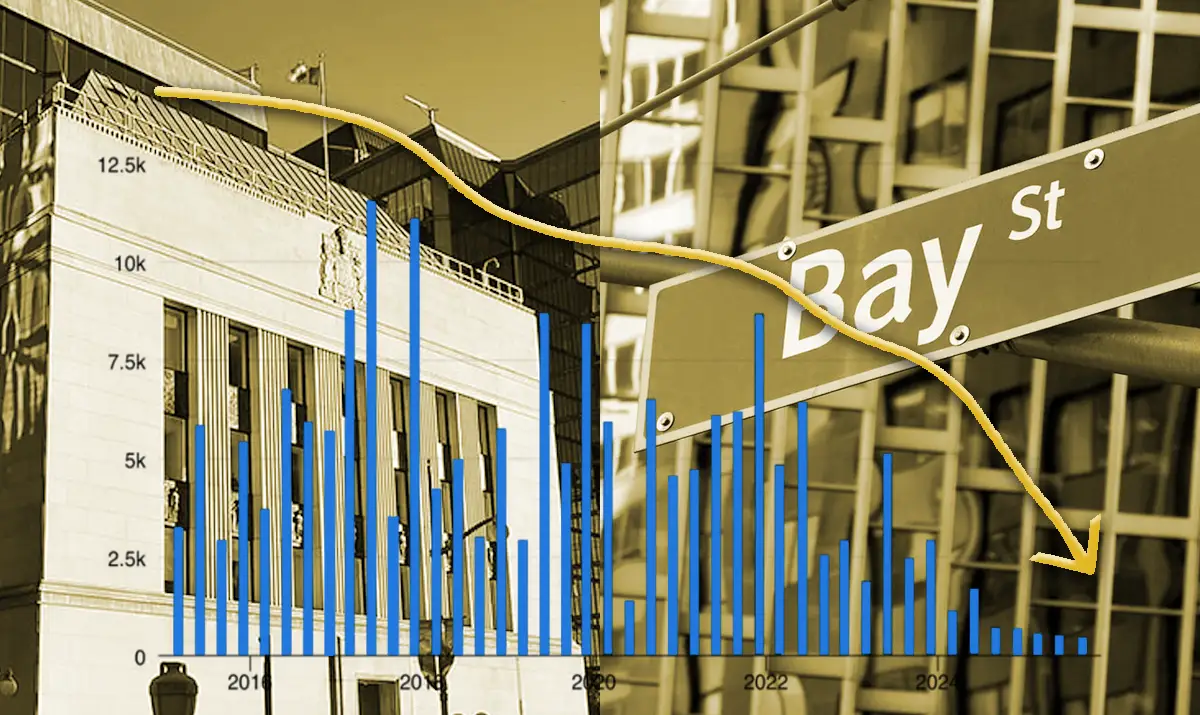
By mid‑2025, Toronto condo prices were down roughly 10 to 15 percent from their 2022 peak. Pre‑construction sales collapsed. Inventory climbed as completions surged into a weakening market. Investor ownership — estimated at more than half of new condo purchases during the boom — shifted from momentum to fragility as negative cash flow and refinancing risk spread.
What surprised many wasn’t that the market corrected. It was how abruptly belief flipped.
Some developers and lenders adjusted early — redesigning projects, renegotiating land prices, tightening assumptions. Others hesitated, reluctant to mark assets to market or confront uncomfortable realities.
History is unforgiving on this point: denial is not a strategy.
What made this cycle feel familiar wasn’t greed, but conviction — the same conviction that fuelled 1929 and resurfaced during the tech crash. The belief that leverage, innovation, and financial sophistication had finally tamed risk, and that underlying value would simply take care of itself.
Which brings us to today.
Artificial intelligence is real, transformative, and powerful. It will reshape productivity, medicine, communications, and work itself. But as we head into 2026, it’s worth asking a careful question: are we witnessing genuine innovation — or expectations outrunning reality once again?
A striking share of recent stock‑market gains is concentrated in a small number of AI‑linked firms. That doesn’t mean those companies aren’t real. They are. But concentration itself is a signal — a sign of where expectations are piling up and where narratives are doing heavy lifting.
History suggests crashes don’t happen because innovation is fake. They happen because expectations outrun execution — because capital crowds in before governance, earnings, and durable business models fully catch up.
In the final pages of 1929, Sorkin offers a quiet but unsettling conclusion. The enduring lesson of that era isn’t about rates, regulation, or bankers. It’s about human nature.
No matter how many warnings are issued or laws are written, people will always find new reasons to believe good times will last forever. Optimism turns into certainty. Hope hardens into conviction. And eventually, humanity loses its head — again.
The antidote to irrational exuberance is not regulation alone, nor cynicism, but humility.
Humility to know no system is foolproof.
No market fully rational.
No generation exempt.
History does not punish hope.
It punishes blindness.
As we enter a new year filled with extraordinary technologies, powerful markets, and compelling stories, the challenge before us is not to abandon optimism — but to temper it with memory, judgment, and restraint.
That lesson, at least, has never changed.
Tune in to Brian Crombie, host of The Brian Crombie Hour, at www.briancrombie.com or on all major podcast platforms.
Header image: Bay Street, iStock. “New Condo Sales in the GTA have Plummeted: Sales of Condo Units in New High-Rise Projects in the Greater Toronto Area, Units Per Quarter” via Altus Group, RBC Economics. Bay Street, iStock