

How Unique Casino Live Games Work for Beginners

Live casino games run on a straightforward principle: a human dealer operates the game inside a certified studio, a camera streams every action in real time and you interact through an on-screen interface from any device. No software algorithm decides the outcome. The dealer draws real cards, spins a real wheel or rolls real dice — and you watch it happen as it occurs. For beginners, that transparency is one of the most reassuring aspects of the format.

What separates unique live casino games from standard offerings is structural. Unique formats introduce rule variations, modified betting architectures or special features that do not appear on a conventional blackjack or roulette table. Understanding the base setup first makes those variations far easier to navigate.

Basic Setup Behind Every Live Casino Game

Three components run simultaneously in every live casino session: the dealer, the stream and the interface. The dealer manages the physical game inside a studio equipped with professional lighting, multiple camera angles and RFID-enabled card sensors that register results automatically. £5 deposit casino UK and other licensed platform providers connect that studio feed directly to players through a compressed video stream with latency typically under two seconds. The on-screen interface overlays the stream, giving players access to bet controls, game history, chat functions and the current round timer — all without interrupting the video feed.

Studio infrastructure is more standardized than most beginners expect. Evolution Gaming operates studios in Latvia, Georgia, Malta and Canada, among other locations, all certified under the same technical and procedural standards. Pragmatic Play Live and Playtech Live maintain comparable infrastructure. As of 2026 these three providers collectively supply live dealer content to over 700 licensed operators worldwide. That scale means a beginner joining any reputable platform is almost certainly connecting to a tested, regulated environment.

What a Beginner Actually Sees and Does

Joining a live table for the first time involves a specific sequence of actions. The interface is designed to guide new players through each phase, but knowing what to expect before sitting down removes any hesitation. The round structure is identical whether the game is a standard format or a unique variant with additional rules.

A beginner’s first live session follows this sequence from login to result:

1. Select the live casino section from the main lobby and filter by game type or bet limit
2. Click on a table to preview the video feed, current dealer and minimum stake before joining
3. Enter the table — the stream loads within seconds and the interface appears over the video
4. Wait for the betting window to open — a visible countdown timer shows how many seconds remain
5. Place a bet by clicking chip denominations on the available betting zones displayed on screen
6. Watch the dealer complete the round in real time — cards drawn, wheel spun or dice revealed
7. Receive the result automatically — winnings are credited to the account balance instantly

According to a 2024 player onboarding report by Gambling Insider, 71% of new live casino players successfully completed their first round without consulting a help section, citing visible bet controls and clear round timers as the primary reasons. The interface does most of the orientation work automatically.

Terms Every Beginner Should Know Before Playing

Live casino games use a specific vocabulary that appears consistently across all formats and providers. Recognizing these terms before the first session prevents confusion during live rounds, where betting windows are limited to 15–30 seconds. The following concepts appear across virtually every live table game:

• Betting window — the fixed time period during which bets can be placed or adjusted before a round begins
• RTP (Return to Player) — the percentage of total wagered money a game returns to players over time, expressed as a figure like 98.71%
• Side bet — an optional additional wager placed alongside the main bet, offering different payout structures
• House edge — the mathematical advantage the casino holds over the player, directly inverse to the RTP
• Live chat — a real-time text function that allows players to communicate with the dealer or other participants
• Game history — a panel showing previous round results, used by players to track patterns or verify past outcomes
• Multi-camera view — the ability to switch between camera angles during the stream for closer detail on cards or the wheel

What Makes a Live Game Format Unique

A live game qualifies as unique when its core mechanics differ from the standard rule set of the game category it belongs to. Visual design and table themes are not sufficient. The distinction must appear in the rules, the betting structure or the features available during each round.

Rule Variations That Change How a Game Plays

Rule variations are the most direct source of differentiation between standard and unique live formats. In Power Blackjack, for example, players can double, triple or quadruple down on any two cards — a mechanic unavailable in classic blackjack. Free Bet Blackjack allows the house to fund splits and doubles at no cost to the player. These rule changes alter the strategic options available and directly impact the game’s RTP, which in both cases reaches above 98%. A single rule modification can shift the house edge by 0.3% to 0.8%, which is significant across extended play.

Special Features and Side Options in Unique Formats

Beyond rule changes, unique live games often include structured bonus features tied to specific outcomes. Dragon Bonus in Speed Baccarat Pro pays up to 30:1 on natural winning hands. Bust It in Power Blackjack triggers when the dealer busts with three or more cards, with payouts scaling based on card count. These features are optional — beginners are never required to use them. A casino blogger who tested eight unique live formats across four platforms in late 2026 wrote: “The side features in the better-designed titles feel like additions rather than distractions. You can ignore them entirely and the base game still runs fine.” That independence between the base game and optional features is a consistent design principle in well-constructed unique formats.

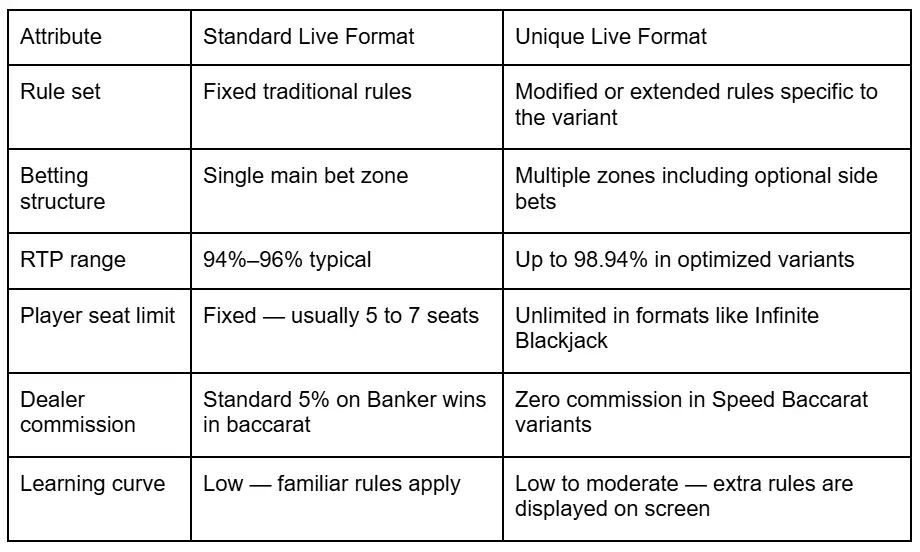
The following table compares the key attributes of standard versus unique live game formats to help beginners identify the differences at a glance:

How to Recognize a Beginner Friendly Live Table

Not every live table is equally accessible to new players. Certain design elements signal that a table was built with clarity and ease of entry in mind. Recognizing these before joining saves time and reduces uncertainty during the first few rounds. The following attributes consistently appear in well-designed beginner-accessible live tables:

• On-screen rule summary — a collapsible panel displaying game rules without leaving the table
• Visible RTP figure — displayed in the game information panel before and during the session
• Low minimum bet — tables starting at £0.10 to £1.00 allow extended play without high exposure
• Slow round speed — some tables offer extended betting windows of up to 45 seconds
• Demo or free play mode — available on select platforms for practice before real-money play
• Clear bet confirmation — a visual or audible cue confirming a bet was registered before the window closes

Live casino game formats have expanded significantly since 2020. As of 2025 Evolution Gaming’s live lobby alone offers over 100 distinct table variants, compared to fewer than 30 in 2019. For beginners, starting with a unique format that carries a high RTP and visible rule guides is not a disadvantage — it is a structured entry point into one of the most transparent game environments in online casino play.

Every component discussed here — the stream, the interface, the rule set and the optional features — operates simultaneously within a single session window. Once a beginner has completed two or three rounds, the sequence becomes automatic. The format is designed to be learned through participation, not preparation.