Recommended Articles

Film Review: Night School
Book Review: Canada 150 Women

Book Review: London’s Afternoon Teas


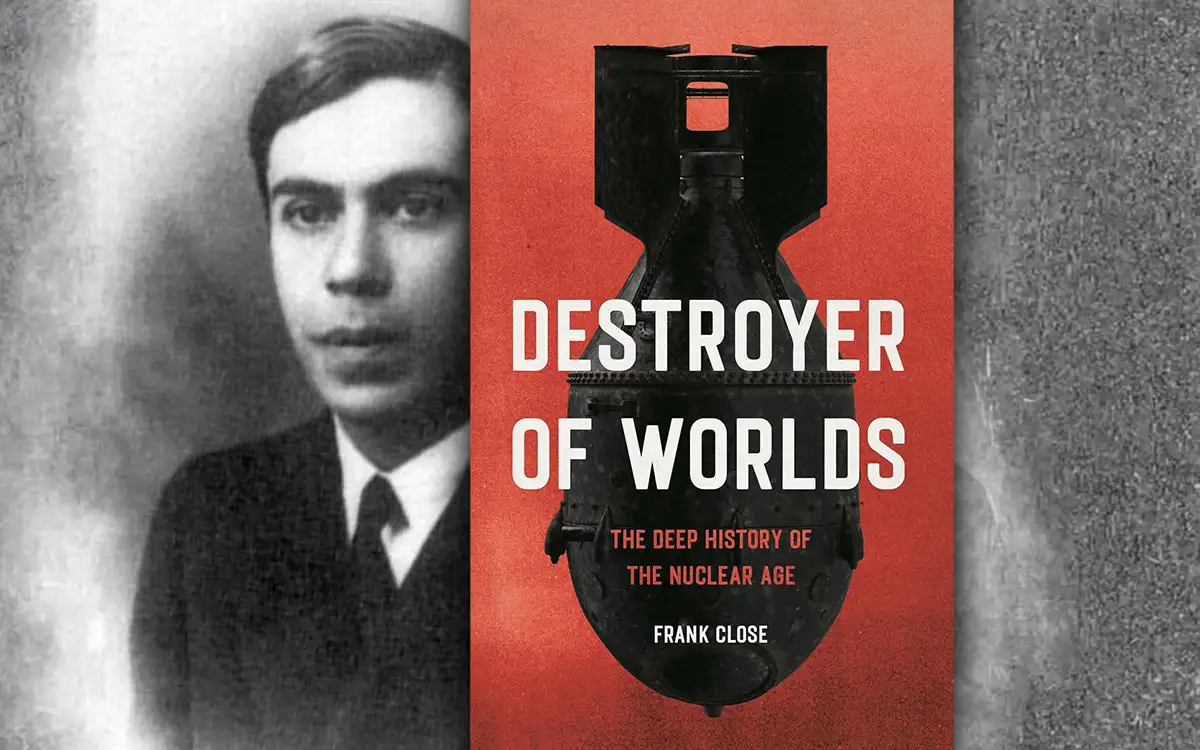
Frank Close’s history of the nuclear age shows how the development of the atomic bomb was shaped by the era’s unstable politics.
Ettore Majorana was a brilliant Italian physicist who vanished without a trace on March 28th, 1938. The mystery of his disappearance has fascinated and confounded the scientific community ever since, mostly because the clues left behind do not lead to definitive conclusions as to his actual fate. Most strikingly, his body was never found. He was among the world’s greatest physicists, some going so far as to suggest that, intellectually, he was in the same league as Galileo or Newton. In the days preceding his disappearance, he emptied his bank account and wrote a few cryptic letters, one to his family and another to his colleagues in the Department of Nuclear Physics at the University of Naples. The letters suggest he was planning to disappear. The question was and remains the nature of the disappearance. Was his plan somehow to slip away undetected from Italy and Europe generally and begin life anew in some other place? There was at least one reported sighting of him in 1955 in a restaurant in Argentina, wearing a hat and dark glasses in an apparent bid to conceal his identity. An alternative theory is that he joined an Italian monastery. The monastic life might have indeed suited his enigmatic personality. Publicity averse but ever keen to understand the nature of reality, one can imagine Majorana contemplating the universe in the quiet confines of a monastery. Or, as is more commonly believed, was Majorana’s plan to take his own life? That possibility seems more in keeping with his apparent state of mind at that time. He was, in addition to being brilliant, withdrawn, lonely and depressed. “Do not wear black,” he insisted in the letter written to his family in the days before he disappeared. If the family must mourn my being gone, he goes on to write, do so but for no longer than three days.
As the English physicist and writer Frank Close documents in his fascinating new book Destroyer of Worlds: The Deep History of the Nuclear Age, Ettore Majorana was perhaps the most brilliant among a group of five young and brilliant Italian physicists led by Enrico Fermi. When Fermi recruited Majorana, the hope was to establish a physics community in Italy that could both keep up with and contribute to the galloping pace of advances in physics at the time. Fermi was prepared to accommodate himself to Mussolini’s fascist dictatorship, which had been in power since late October 1922. He became a member of the party despite declaring his indifference to politics. His aim was instead to be left in peace so that he and his colleagues could get on with the serious business of research. The notion that the fraught spheres of science and politics could be kept separate in this way was a luxury in which Fermi would, soon enough, no longer be able to indulge. It seems likely that the brooding Majorana was less sanguine than his friend and colleague about the state of politics in both Italy and Germany. It was in 1933 that he was invited to Leipzig, Germany to work with Werner Heisenberg, the great German theoretical physicist. The Nazis took power around the time of his arrival. Anti-Jewish and anti-immigrant sentiment was on the rise. Some of those who knew Majorana insisted that his disposition took a turn towards the dark at around this time. Could it be that the respective political trajectories of both his home country, Italy, and Germany plunged him into a deep sea of despair from which he was never able to escape? Although we will never know, it is a plausible and sobering possibility.
The Destroyer of Worlds is not a book about Ettore Majorana, or at least not him alone. Close writes about but does not exhaustively explore the mystery of the great physicist’s disappearance. Close’s aim is to instead take the reader on a guided tour of a period of transformative advances in our understanding of the sub-atomic world and that of quantum mechanics. Majorana, like his friend and colleague Fermi, was one among a constellation of scientists – mostly chemists and physicists – who contributed to the emerging understanding of the atom and its constituent parts, the nucleus the key among them. The book is thus not a story of a single towering intellect ushering in a revolutionary understanding of the sub-atomic world. On the contrary, as Close makes abundantly clear, no one chemist or physicist was responsible for generating the quickly accumulating insights into the atom and its nucleus or the emerging field of quantum mechanics. Scientists would do their research, conduct experiments and then perhaps publish a paper. New insights circulated but slowly, almost ploddingly, by today’s standards. Still, scientists would build on the insights and discoveries of other scientists, no matter their country of origin or their gender. A spirit of openness largely prevailed, at least until the late 1930s.
It was Ernest Rutherford, the great New Zealand scientist who did pioneering work at McGill University at the turn of the twentieth century before returning to Cambridge in 1907, who famously declared that anyone who talks about the splitting of the atom leading to a new source of energy and power is ‘talking moonshine.’ He made this remark in 1933, not so far in time from 1945, the year the Americans deployed the atomic bomb not once but twice, the first on Hiroshima on August 6th and the second on Nagasaki on August 9th. Rutherford was hardly alone in his delayed understanding of what new and dangerous possibilities might be unleashed by a deeper understanding of the quantum world. On the contrary, this disconnect is in keeping with one of the themes that runs like a current through Destroyer of Worlds. The sense shared among the great chemists and physicists of the day was of exploring the outer frontiers of science. To what end or ends, however, was less clear. The quantum world was so foreign and dizzyingly complex that even Albert Einstein was skeptical that it could be properly understood. Thus, there was a gap between the time of that shared sense of exploration and cooperation and the terrifying recognition of what was ultimately at stake: the ability to harness and then unleash a new type of not only energy but power on the world. Indeed, in the span of a few years, the world was transformed in a way few anticipated not so long before. Close expertly and with great clarity and insight details how that gap was quickly closed.
The gradual coming into focus of the sub-atomic world was as much a chemistry affair as a physics affair. Surely one of the starting points in this emerging focus revolved around a basic proposition: there were elements in the universe more fundamental than the atom. The atom instead has many parts. To begin with, the atom is comprised of protons and electrons. There is a nucleus, in which the protons reside. The electrons exist outside of the nucleus. So far, so good. Unexplained paradoxes and phenomena pointed to gaps in our knowledge of all of the atom’s constituent parts. There were others still to be discovered: the neutron, neutrino, and positron, to take but three examples. Likewise, chemists started to fill in the gaps in the periodic table, the establishment of which was made only in 1869 by the Russian scientist Dmitri Mendeleev. In these and many other ways, as Close carefully and wonderfully demonstrates, the build up of our understanding was steady but inexorable.
Moreover, the atom was not, as previously believed, immutable. Rather, the transmutation of the atom is what is happening during the process of radiation. Majorana understood before most others the nature of the dynamic relationship between the nuclei’s various parts. One essential question helps to illuminate the changing understanding: how to explain the stability of heavy nuclei, such as that of uranium? The answer was not obvious, in part because protons repel each other, being electrically charged, thereby creating instability in the nuclei. Stability is thus established when a proton emits a positron and thereby is converted to a neutron. This is what is now known as beta decay.
As Close then goes on to demonstrate, it was Lise Meitner and her nephew Otto Frisch – she an Austrian Jew and he a German Jew – who together made a critical discovery about uranium. Subjecting the uranium nuclei to a steady barrage of neutron strikes serves to split the nuclei in two. This is what is referred to as nuclear fission. Once the truth of this discovery was reaffirmed by other scientists, questions immediately followed, perhaps none more crucial than the following: “was more than one neutron released for every neutron that caused the fission in the first place?” A tantalizing but soon terrifying possibility emerged if the answer to that question was yes, as it turned out to be. The release of more than one neutron meant that, in theory at least, “a self-sustaining chain reaction could occur.”
Close describes 1933 as the dawn of nuclear physics. It was also the year that the sordid and unstable world of European politics started to more forcefully and explicitly impinge on the world of science.
In particular, the threats posed by Fascism generally and Nazism specifically started to reverberate among the chemists and physicists most closely associated with this new and daunting discipline of quantum mechanics. This convergence between science and politics is why the story Close relates can prompt the reader to imagine counterfactual scenarios. Think of it this way: the Nazi’s rise to power initiated a different sort of chain reaction, this one people- and community-centred, the absence of which might have ultimately led to a different and more catastrophic outcome of World War Two. There were many scientists crucial to the emerging understanding of quantum mechanics and later to the development of the atomic bomb who also happened to be Jewish and German or, like Lise Meitner, Jewish but from elsewhere and living in Berlin. The Nazis had no use for their expertise and instead began a ruthless campaign of removing Jews from universities as well as any other institutions of learning. Many Jewish scientists saw the looming apocalypse coming and fled Germany for safer confines. Others had to be nudged. Neils Bohr, the Nobel Prize-winning Danish physicist, encouraged Otto Frisch to flee Germany in 1933, before it was too late. A few years later, he informed Enrico Fermi that he was to be awarded the Nobel Prize for physics. Fermi’s wife was Jewish. When you travel to Stockholm to receive your Nobel, he advised Fermi, use the opportunity to escape fascist Italy (and ally of Germany) and save your wife from certain death. Fermi heeded Bohr’s advice. Weeks after traveling to Stockholm, Fermi and his wife sailed to the US, where he immediately resumed his teaching and research career at Columbia University. Fermi, initially skeptical that an atomic bomb was feasible, was among the first to experiment with uranium in a bid towards initiating a self-sustaining chain reaction. Had he not fled Italy, Fermi might have conducted the same research in Italy.
Close also tells the story of how Leo Szilard, the German Jew who had fled his native country upon the Nazis assuming power in 1933, asked Albert Einstein to sign a letter to America’s President Roosevelt. Szilard drafted the letter in 1939. Einstein obliged. The letter was delivered to Roosevelt on October 11, 1939. It was both a warning and a plea. The Nazis had started another war. Their genocidal aims were self-evident. And now nuclear science was on the verge of unleashing a world-altering technology on the world. The Nazis would be unstoppable should they be the first to develop an atomic bomb. As American president, you cannot let that happen. The ever meticulous Close is careful to insist that the letter alone was not the impetus for the Manhattan Project, the American-led program that fuelled the accelerated development of the atomic bomb. Nevertheless, there is no doubt it alerted Roosevelt’s administration to what was at stake.
Perhaps this race to develop weapons of mass destruction is what Ettore Majorana foresaw and could not countenance. Close dismisses this idea, insisting his disappearance in 1938 was too far removed from the breakthroughs that made the building of an atomic weapon more likely. Still, I wonder. As Close remarks, those who knew Majorana well describe his gaze as so severe and penetrating that it was as though he could see what others could not yet see. It does not seem a stretch that he might have understood the implications if scientists were soon more effectively able to manipulate the sub-atomic world. The atomic bomb would represent a type of power so awesome that much of humanity could be destroyed with just a few. Yet the race to develop them would occur at a time of great tension and looming war. Humanity was not equipped to successfully manage such power. To Majorana, if not yet to his colleagues, it might have seemed that the world was on the eve of destruction.
Title: Destroyer of Worlds: The Deep History of the Nuclear Age
Author: Frank Close
Publisher: Basic Books
Publication date: June 2025
ISBN: 1541605896