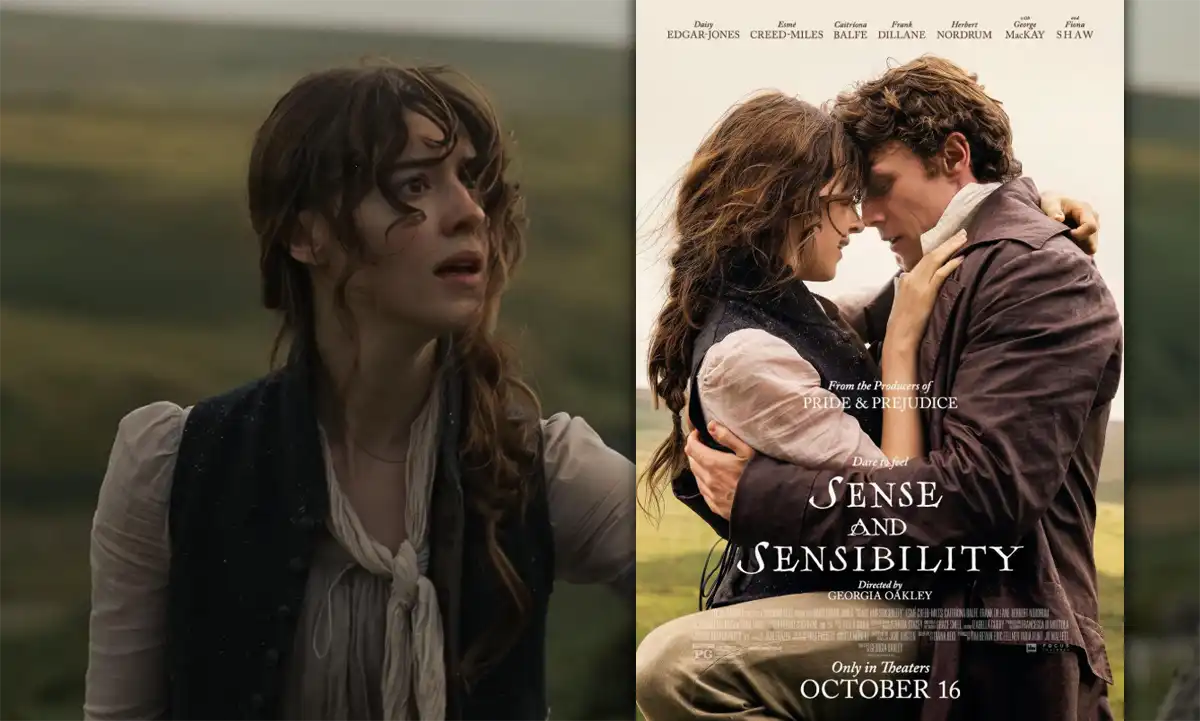
Sense and Sensibility Movie Review: A Beautifully Crafted Return to Jane Austen

Review by J. A. Forrester


Synopsis: Sisters Elinor and Marianne Dashwood must leave their Sussex estate to live with a distant relative, while facing both romantic and financial struggles.
Director: Georgia Oakley
Stars: Daisy Edgar-Jones, Esme Creed-Miles, Caitriona Balfe


In the spring of 2020, we were to take a tour of Hardy & Austen country through the southern counties of coastal England (Dorset and Hampshire), but the Pandemic cancelled those plans. In the interval, I’ve continued researching the life and times of Jane Austen. She did not conform to the quiet home-bound figure promoted by her family following her death at 41 years of age in 1817.

Modern biographers have uncovered a lively, witty, outgoing, satirical author who shared her opinions freely and did not conform to the social standards of the Georgian period, and the limited options available for young women. This may explain why her elder sister Cassandra burned the majority of her 3,000 letters, and her Austen brothers wrote her “official biography.”

Sense and Sensibility was Austen’s first novel published on 30 October 1811 in the format we read today. The original title was Elinor and Marianne, and it consisted of a series of letters between the Dashwood sisters. The final publication was extensively revised and restructured into a conventional narrative, and Jane then paid for a London printer, thereby retaining the copyright for herself.

All four of her novels published before her death were anonymous, so she was unable to experience the success of her writing and the respect it has gained over time.

Jane would be amazed to find her image engraved on British10 pound notes; the first woman author to be so honoured. The Governor of the Bank of England in 2017, on the 200 th anniversary of Austen’s death, was Mark Carney.

Sense and Sensibility has never been out of print, and it was adapted for both cinema and television many times, a process which surprisingly only began in 1971, when BBC television undertook the first dramatization, if you don’t count a 1927 BBC radio drama.

My favourite version was the 1995 Ang Lee-directed feature film, which provided not only a starring role for Emma Thompson as Elinor but also an Oscar for Best Adapted Screenplay in March 1996.

The current production of Sense and Sensibility, directed by Georgia Oakley, is a worthy successor to the 1995 film and celebrates the bond between sisters Elinor and Marianne rather than romantic pairings.

For those unfamiliar with the story: the Dashwood family are living in “reduced circumstances”, as the Strickland sisters, Susanna Moodie and Catharine Parr Traill, would have it. As was the case in Georgian England, the eldest male heir took over their country estate and banished them to a rural cottage in coastal Devon, supplied at the last minute by a distant relation.

The only hope for elevating the family back into “society” is by marriage to another member of the landed gentry, but there are fewer prospects in the remote location.

Their stepbrother and his hostile wife make sure that the Dashwood sisters are not encouraged to return to Hampshire. They also renege on a deathbed promise to Mr. Dashwood that they would financially support his daughters.

To their rescue come neighbours and distant relatives who invite Elinor & Marianne to balls and social events, which provide the opportunity to mingle and meet prospective partners.

I know that this plot is classically romantic, however, it’s the subtlety of the written text, filtered through an exceptional screenplay, performed by an excellent cast, directed by a strong woman director, shot by a very good cinematographer and edited with skill that creates a pleasurable film to watch.

It is worthwhile to see this 21st Century production of Sense and Sensibility on a large theatre screen, as it is visually stunning.

There are a couple of scenes near the end of the film, including a tableau against a stone wall near the cottage, reminiscent of 19th-century artists, particularly John Constable.