International Women’s Day Is Not a Celebration — It’s a Warning
International Women’s Day is often framed as a celebration. We celebrate the progress women have made. We celebrate leadership, achievement, and equality. We highlight the barriers that have been broken and the glass ceilings that have been shattered.
But after a recent conversation on The Brian Crombie Hour with historian Professor Jacqueline Murray, University Professor Emerita at the University of Guelph and Fellow of the Royal Society of Canada, I came away with a very different feeling.
International Women’s Day should also be a warning. Because history shows that rights gained can also be rights lost. And the story of women’s rights begins much earlier than most people realize.
The Question Beneath Western Civilization
Professor Murray reminded me that for centuries Western civilization wrestled with a fundamental question that today sounds shocking: Are women fully human in the same sense as men?
The debate traces back to the very foundations of Western religious and philosophical thought. The biblical book of Genesis contains two creation stories. In one, man and woman are created together, equal partners in creation. But in the second, Eve is created from Adam’s rib.
That second story shaped centuries of theological interpretation. Women were seen not as equal partners, but as derivative beings — created second and therefore subordinate.
This interpretation did not remain confined to religion. It flowed into law, politics, and culture.
Even the Enlightenment — the intellectual movement that gave birth to modern democracy — largely excluded women. The Declaration of the Rights of Man in revolutionary France made the exclusion explicit. The American Declaration of Independence spoke of the equality of “men.”
Democracy expanded liberty. But initially, it expanded it for men. Women would spend the next two centuries fighting to be included in the category of “person.”
Canada’s Own Battle for Recognition
Canada’s famous Persons Case of 1927 illustrates just how recent this struggle is. At the time, women were legally excluded from being appointed to the Canadian Senate because they were not considered “persons” under the law.

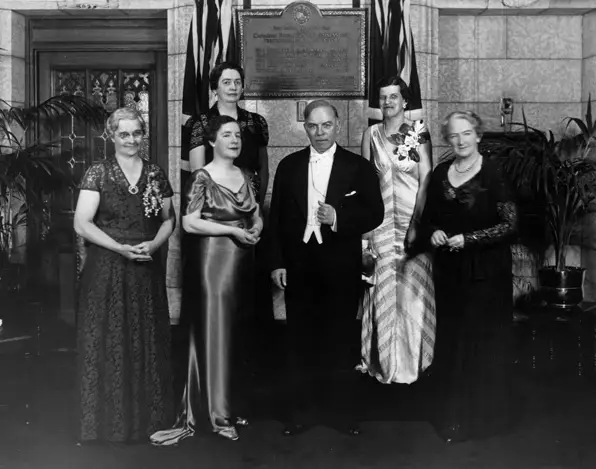
The Famous Five—Emily Murphy, Nellie McClung, Irene Parlby, Louise McKinney, and Henrietta Muir Edwards—alongside the Honourable W.L. Mackenzie King. (Photo: thecanadianwomenssuffrage.weebly.com/)
Five women, now remembered as the Famous Five, challenged that interpretation. The case ultimately reached the Judicial Committee of the Privy Council in London, which ruled that women were indeed persons.
The decision was revolutionary. Not because it granted a specific job, but because it forced the legal system to recognize women as fully equal participants in the public life of the nation.
Even then, the journey was far from complete. Canada’s constitutional protections for gender equality were only firmly entrenched with the Charter of Rights and Freedoms in 1982, strengthened further in 1989. In the United States, the Equal Rights Amendment has still never been ratified.
In historical terms, women’s equality is not ancient history. It is recent. And that matters.
The Illusion of Permanent Progress
One of Professor Murray’s concerns is complacency. Many younger women understandably assume that the rights they enjoy today are permanent. They grew up in societies where women vote, lead, and participate fully in public life.
But history offers a sobering lesson. Rights are never permanent.
In recent years the United States has witnessed the reversal of longstanding abortion protections and renewed political battles over women’s autonomy. Around the world, openly anti‑feminist movements have gained influence. Some of these movements frame women’s rights not as progress but as a threat to traditional social order.
That rhetoric is not new. It echoes arguments that have appeared repeatedly throughout history whenever women have pushed for equality.
And history suggests something uncomfortable: Every generation must decide whether it will defend the rights it inherited, or slowly allow them to erode.
Women’s Rights Are a Democracy Issue
What is often missed in these debates is that women’s rights are not simply a social issue. They are a democratic issue.
Democracy rests on the principle that citizens possess equal dignity and equal standing under the law. Once that principle becomes negotiable for one group, it becomes negotiable for everyone.
Authoritarian systems throughout history have often begun by restricting the rights of specific groups — minorities, dissidents, or women — before gradually eroding democratic institutions more broadly.
Equality is not an accessory to democracy. It is one of its structural foundations.
That is why attacks on women’s rights often accompany wider democratic backsliding, and why defending those rights is inseparable from defending democracy itself.
Progress Is Real But It Is Fragile
None of this diminishes the extraordinary progress of the past century. Women now lead governments, corporations, universities, and scientific institutions. Laws across much of the democratic world now formally recognize equality between men and women.
But as Professor Murray reminded me, historical gains should never be mistaken for permanent victories. Every generation inherits rights that earlier generations fought to secure. And every generation must decide whether it will defend them.
A Personal Reflection
For me, this question has become more personal recently. I have a new granddaughter. When I look at her, I imagine the world she will grow up in, the opportunities she will have, the freedoms she will expect, and the life she will build.
Those opportunities exist because previous generations fought to expand the boundaries of equality. Women demanded to vote. To study. To work. To lead. They insisted that society recognize something that should have been obvious all along: that women are not secondary participants in human civilization.
They are half of it.
International Women’s Day is therefore not simply a moment of celebration. It is also a moment of responsibility. Because the freedoms my granddaughter will inherit depend on whether our generation understands something essential.
Rights do not maintain themselves. They survive only when people remember why they were fought for in the first place.
History tells us that equality was never inevitable. The question now is whether we are wise enough to keep it.