Pop Culture and Understanding 9-11: Finding Meaning in Carnage

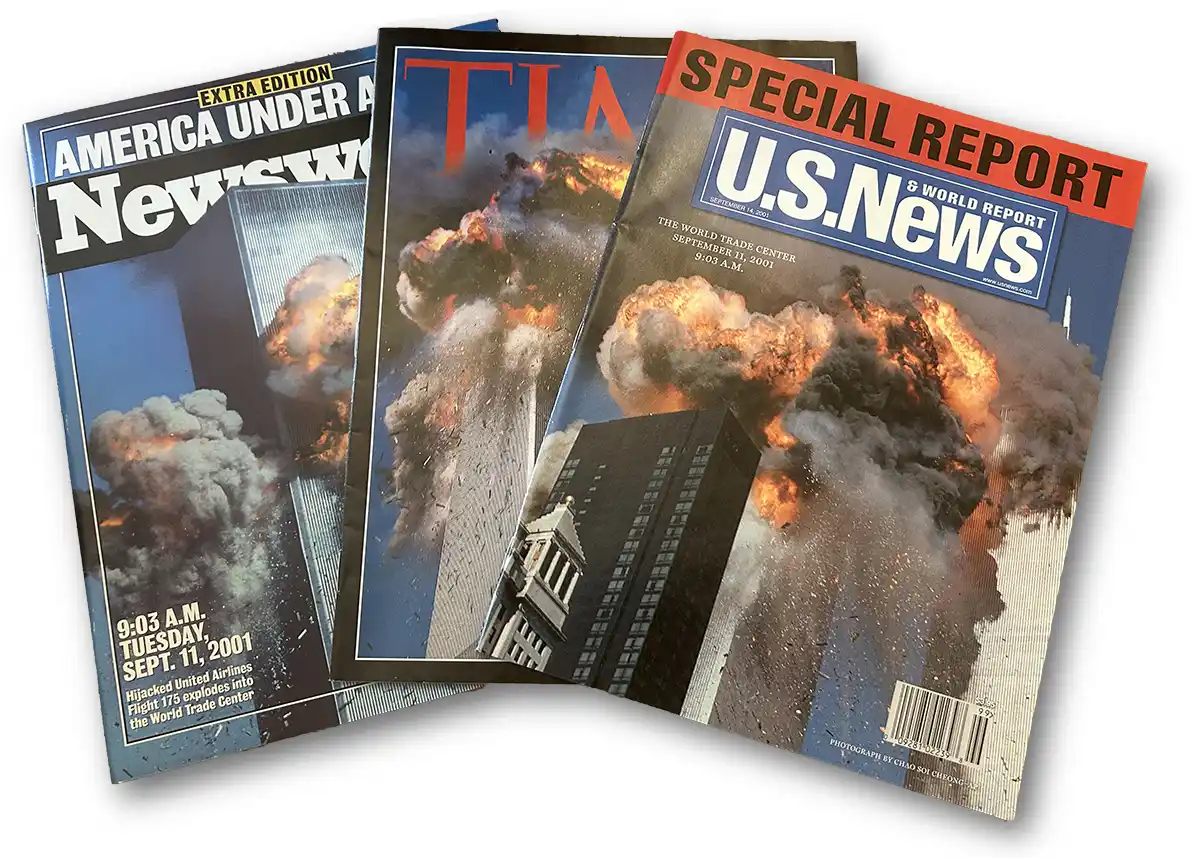
From their construction in the early 1970s to their destruction on September 11, 2001, the Twin Towers of the World Trade Centre at the southern tip of Manhattan were synonymous with New York City (NYC). Rarely did the opening shots of a movie or television show set in NYC not open with a panoramic shot from the Statue of Liberty across Battery Park to the 110-story pillars piercing the sky. The visual instantly established a vibe and mood accentuated by sunny or nighttime lighting. The towers were more than cathedrals of commerce; they were physical manifestations of American daring, elan and power. They were also home to the nearly 50,000 people who worked in those offices. 2,977 people died in all the 9-11 attacks, including first responders and airline passengers.

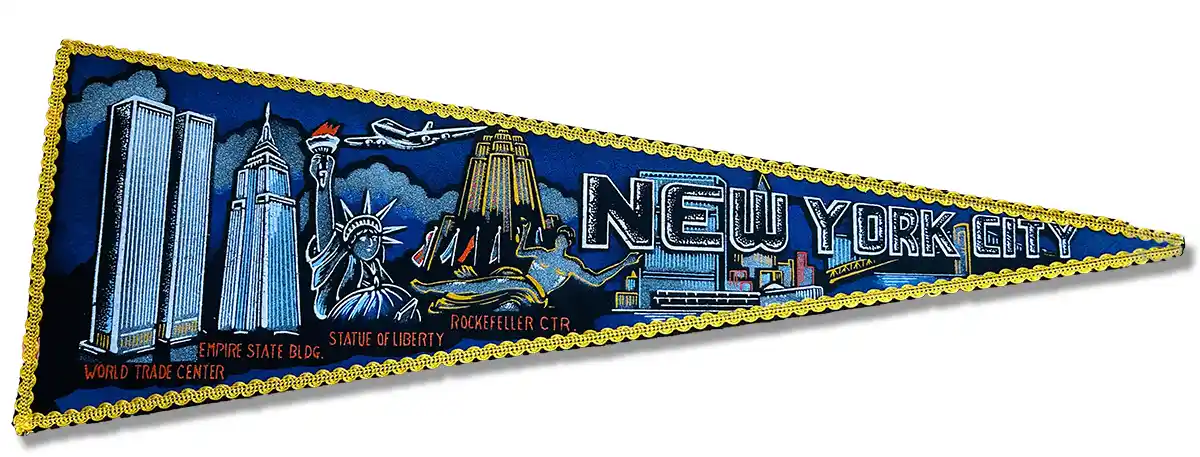
ABOVE: When I bought this in the 80s, I didn’t give a second thought to the jet. Looks different now!


Similarly, is there a comic book superhero or fictional character more associated with New York City than the Amazing Spider-Man, and his secret alter-ego, student photographer Peter Parker? From the humble working-class streets of Queens to the fictional Empire State University to the skyscrapers of Midtown, Spider-Man is the quintessential ‘Noo Yawkah’. Superman patrolled the skies of the shining city of Metropolis, while Batman battled the criminal elements on the dirty, dangerous streets of Gotham City; a dystopian version of NYC.

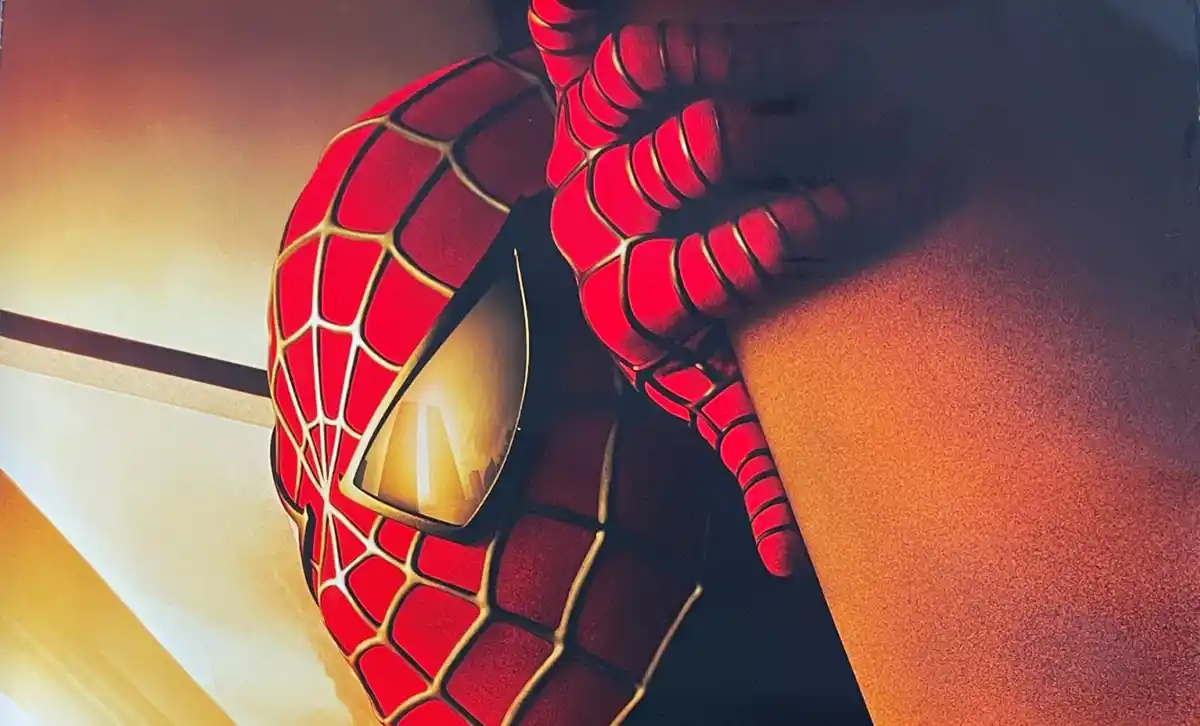
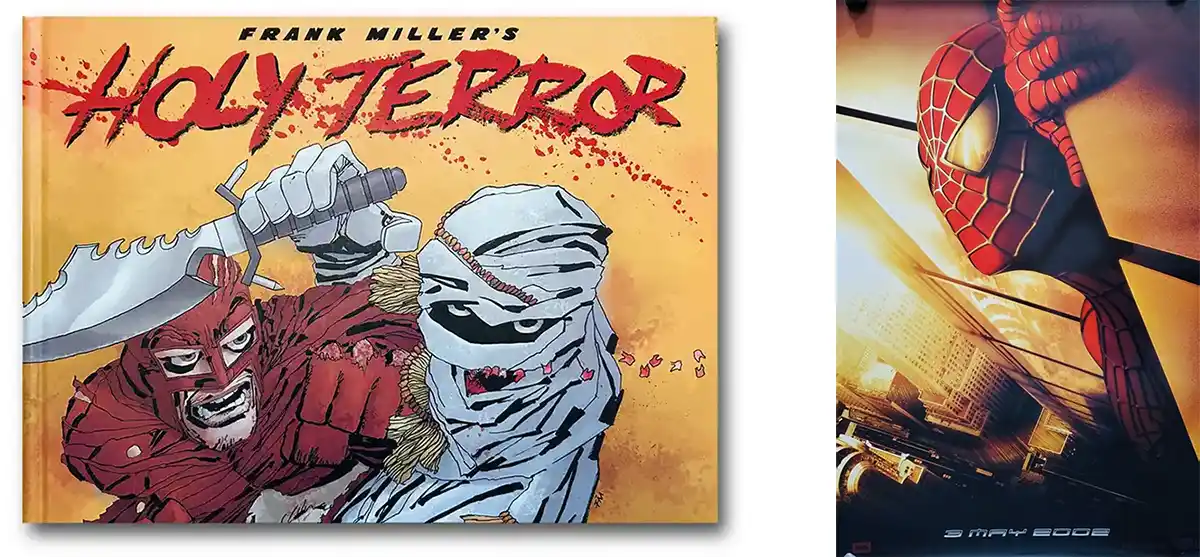
In early September 2001, the trailer for the new Spider-Man movie was released. The closing action shot was Spidey snaring a helicopter full of criminals in webbing strung between the Twin Towers. The movie poster shows the WTC reflected in the eye shade of his mask. Days later, with the towers having been destroyed in a terrorist attack, both the trailer and the poster were pulled, some segments of the movie had to be re-shot, and release was delayed. Sound business decisions but this also represents the importance of pop culture in our shared North American, and indeed Western culture.

The 9-11 attacks destroyed physical manifestations of our open society: airliners filled with people from all walks of life, and in destroying the towers and institutions of government like the Pentagon, while murdering clerks, first responders and hedge fund titans alike. All were equally vulnerable in their mass deaths. In doing so, the terrorists stole our collective freedoms, a key element being freedom of expression. I use “our” deliberately. Our relationship with Americans was much different 25 years ago than it is today. The border was a line on a map, not a metaphorical wall. Canadians were one with Americans in their sense of loss and outrage.

Relatively few people read Foreign Affairs or The Economist, or even The New Yorker magazine. Fewer still if they’re young. But they consume other types of media from very diverse sources. While economic and political analysis can tell you what happened and perhaps uncover the “why”, it lacks emotional punch, and usually cultural awareness. Pop culture provides that alternate lens through which we can understand and process the extreme loss of life, and our loss of certainty about our safety, mobility, broad social trust and the concept of God itself. How did 9-11 happen? Why did it happen? Why did God let it happen? We largely know the answer to the first. And while we can intellectually analyze the roots of the violent ideology and extreme hatred that drove the terrorists, we cannot fathom the tipping point where belief becomes action. The third remains without resolution.

In the end, there is no meaning in the violence itself of that day. Meaning emerges from our rituals, the testimony of survivors and loved ones of those lost, and the small and large acts of community that followed the attacks. In our secular society, rituals can play out in unlikely places: comic books, music, movies, books, Broadway plays, television comedies, and sporting arenas.

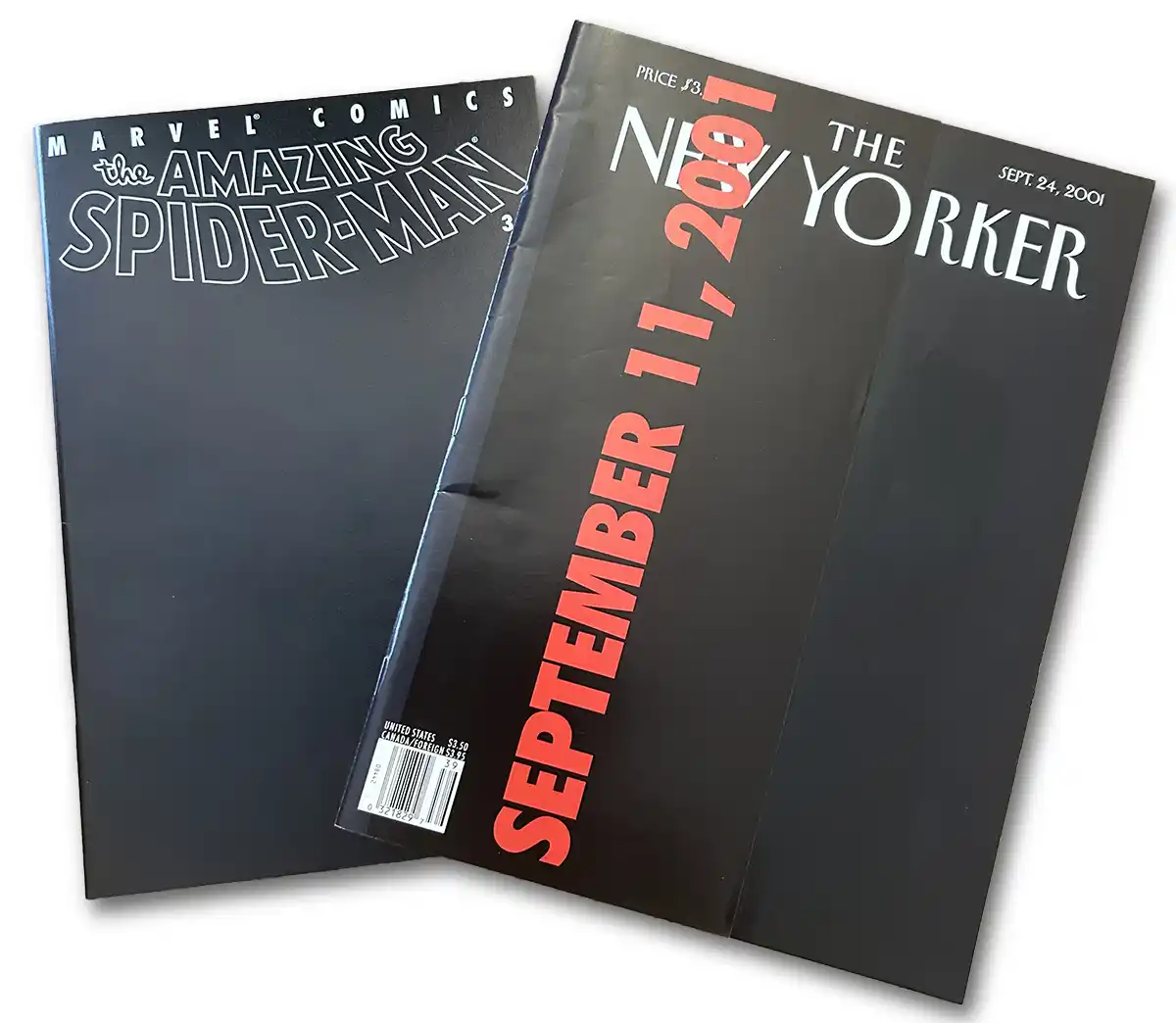
Processing tragedy follows a predictable path, akin to the five stages of grief: shock, disbelief, disorientation, grief, and often, revenge and anger. If the chord of this arc is anchored at one endpoint by grief and loss, followed by defiance, hope, closure and redemption, we may say the opposite endpoint is blind rage. Two radically different publications reflected these early stages with jet black covers. The New Yorker presented the towers as fading into black; their familiar profile barely perceptible. Alongside the requisite theatre, movie and restaurant reviews, the New Yorker presented a series of personal essays. One essayist termed the damage “civilizational”. That our increasingly open societies rely “increasingly on trust – the unsentimental expectation that people, individually and collectively, will behave more or less in their rational self-interest. The terrorists made use of that trust. They rode the flow of the world’s aerial circulatory system like lethal viruses… The tactics of the terrorists were as brilliant as they were depraved.”

The second black cover was the next Spider-Man issue: when arriving at Ground Zero to find only smoking rubble, our hero is asked by a frantic couple, “Where were you? How could you let this happen?” He had no answer but thought, “How do you say we didn’t know. We couldn’t know. We couldn’t imagine.” Reflecting the solidarity of American society, he was joined in recovery efforts by arch-enemies, Doc Ock, the Kingpin, Dr. Doom (with tears in his eyes) and Magneto. His final thoughts echoed the evolving narrative that, “we have endured worse before, we will bear this burden… This has not weakened us. It has only made us stronger.” Resolve expressed in terms a twelve-year-old can understand.

The question was asked: Will we ever laugh again? The response came tentatively. David Letterman’s The Late Show returned a week later. Letterman dispensed with his Top Ten list and instead spoke emotionally of his city. A few days after, Jon Stewart’s halting delivery on The Daily Show attempted to be light but instead was heavily weighted with the remains of that day.

One comedian jumped the gun. Speaking at a roast of Playboy founder Hugh Hefner in New York just two weeks after 9-11, a Gilbert Gottfried joke angered the crowd: “I have a flight to California. I can’t get a direct flight – they said they have to stop at the Empire State Building”. One attendee shouted, “Too soon!”

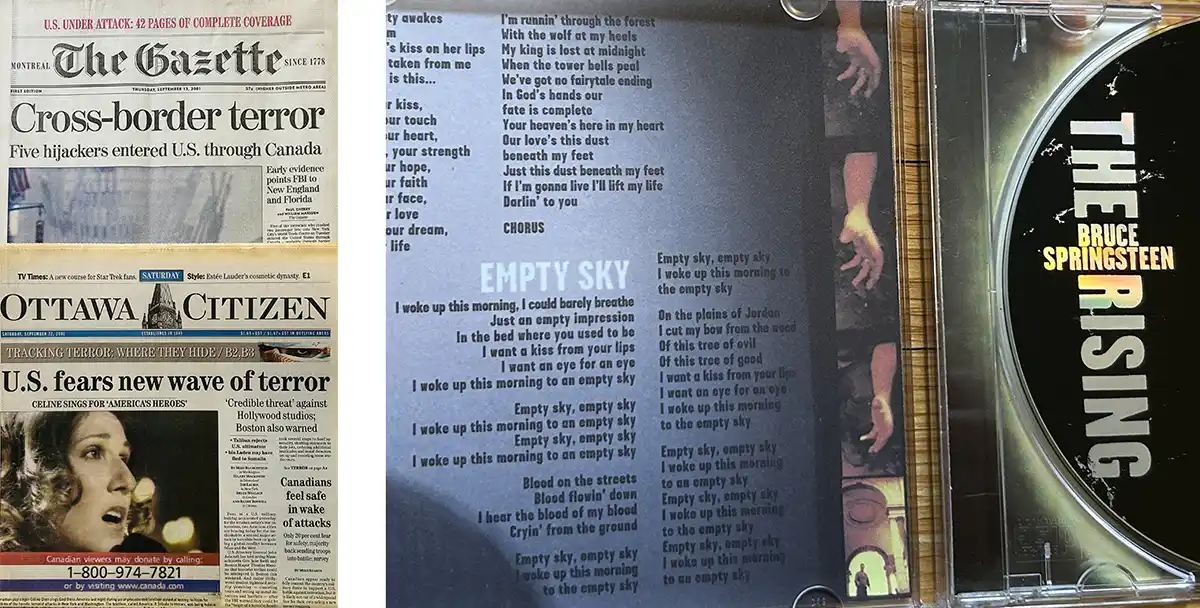
Ten days after 9-11, fires still raged in the bowels of the fallen towers. A telethon brought together Bruce Springsteen, U2, Neil Young and Tom Hanks among others, to raise funds to assist families of the victims. There was a dedicated 1-800 number for Canadian donors and Céline Dion sang “God Bless America”. Springsteen debuted a song written before the attacks but which captured the mood, the sadness and despair. In City of Ruins, he sang,

Now there’s tears on the pillow
Darling, where you slept
And you took my heart when you left
Without your sweet kiss my soul is lost, my friend
How do I begin again?
My city’s in ruins

The song would become the final track of The Rising album released in 2002. Songs alluded to: firefighters disappearing, “up the stairs, into the fire”; hope “waiting on a sunny day, gonna chase the clouds away”; despair “I woke up this morning to the empty sky”; cultural divides “’Neath Allah’s blessed rain, we remain worlds apart”; loss “I close my eyes, you’re missing, I see the sun rise, you’re missing”; and eventually redemption “ sky of longing and emptiness (a dream of life), Sky of fullness, sky of blessed life”. The album is overtly spiritual and reflects Springsteen’s Roman Catholic upbringing, bringing belief into the public square.

Two months after 9-11, country music star Alan Jackson provided one of the clearest musical expressions of the immediate disbelief and emotional reaction to the attack. As occurs so often with musicians, Jackson awoke an October morning at 4 a.m. with a chorus running through his brain. He jumped out of bed, and wrote it down so he wouldn’t forget it as he fell back asleep. The beautiful song, “Where Were You” (when the world stopped turning), went to number one on the Billboard country chart and stayed there for five weeks. He would later say that he didn’t want a song of revenge; he wanted to remember how he felt that day. The chorus closes with a rephrasing of a line from Paul’s First Letter to the Corinthians: “Faith, hope and love are some good things He gave us. And the greatest is love.”

The arc quickly nudged into defiance and resolve though as New York Mayor Rudy Giuliani granted permission to laugh again. In late September on Saturday Night Live, flanked by police and firefighters, Giuliani stated that “we will not yield to terrorism. We will not live in fear”. Paul Simon performed his ode to NYC, The Boxer. The central figure in the song is laid low by the city – metaphorically in the ring – but stays standing. Against a backdrop of police and firefighters, Canadian-born SNL producer Lorne Michaels walks on stage and asks, “Can we be funny?” Giuliani’s deadpan response brought an ovation from the live audience and dropped jaws across North America. “Why start now? Live from New York, it’s Saturday Night!”

https://www.tiktok.com/@viciousheadbutt/video/7413502571911925022

Sport, presidential politics and post-attack patriotism converged into a single frame in October as President George W Bush strode to the pitcher’s mound before Game 3 of the 2001 World Series and delivered the ceremonial pitch. Yankee Stadium was packed, and despite the security, the President was not hiding in a bunker (unlike, say Osama Bin Laden in a cave in Afghanistan); the symbolism was clear. Grief and loss remained, but New York was back, and the United States of America was unbowed. Bush threw a perfect strike over the plate.

Throughout the Fall, comedians and mainstream television moved beyond overt expressions of sorrow, grief and loss to more nuanced criticism of the government for lack of preparedness and intelligence failures. Al Queda was not to be feared. It was to be eliminated. Revenge – understandably – became a priority. Within months, US forces would be in Afghanistan. The first Canadian soldiers would join them in December with full deployment in the spring of 2002. Canadian Kiefer Sutherland would star in 24, a television thriller set in a fictional though realistic Counter Terrorist Unit, which premiered in November. The show would run for nine seasons.

Michael Moore’s 2004 documentary Fahrenheit 9-11 laid bare conspiracy theories about the Bush family’s close ties to the ruling Saudi royal family and whether this contributed to the blind spot in the US government to state-sponsored terrorism and indeed, actual complicity of the Saudis in the attacks. The film was sharply critical of George W Bush, and questioned US attacks in Afghanistan, and the rationale and legitimacy of the invasion of Iraq which followed in 2003. More American soldiers would die in Iraq than citizens died on September 11, 2001.

Perhaps Canada’s greatest contribution to this genre is the runaway smash Broadway hit Come From Away. Set in the coffee shops, airport and homes of Gander, Newfoundland, the musical traces the bewilderment of passengers (mostly Americans) as they disembark on a windy tarmac in a place they’ve never heard of. The kindness of residents wins over their initial wariness, and deep friendships develop. The script also highlights cultural differences, such as the gay couple who kept their relationship hidden. The funniest line is uttered by a Black New Yorker, who, when asked to go grab some barbeques, responds that back home, he would be shot for doing so. Special ceremonies will be held in Gander later this week on September 11th.

The arc of pop culture’s contribution to our understanding of 9-11 continued through the release of action movie treatments such as The World Trade Center, Flight 93, Falling Man and television’s Rescue Me, which features a damaged firefighter with PTSD and survivor’s guilt in the years after the attacks. In 2011, comic book writer and artist of The Dark Knight Rises fame, Frank Miller, published a graphic novel entitled Holy Terror, the words spelt in splattered blood. Miller had planned to use the Batman character along with Catwoman. But as the novel’s darkness increased, he felt he had to invent a new hero – the Fixer and partner, cat-burglar Natalie Stack. Both took America’s fight into an NYC mosque, the supposed headquarters for Al Queda. The novel was criticized for anti-Islam tropes and Miller himself said he was consumed by rage in its production. He hoped he would never be so angry again.

The new Spider-Man trailer was released on December 15, 2001. As in life, the Twin Towers were gone. Five days later, the final fires at Ground Zero were extinguished.


Dan McCarthy is currently writing a book entitled, “After the Towers Fell: Canada’s First 100 Days Post 9-11”. He was Executive Assistant to Justice Minister Anne McLellan in the fall of 2001.