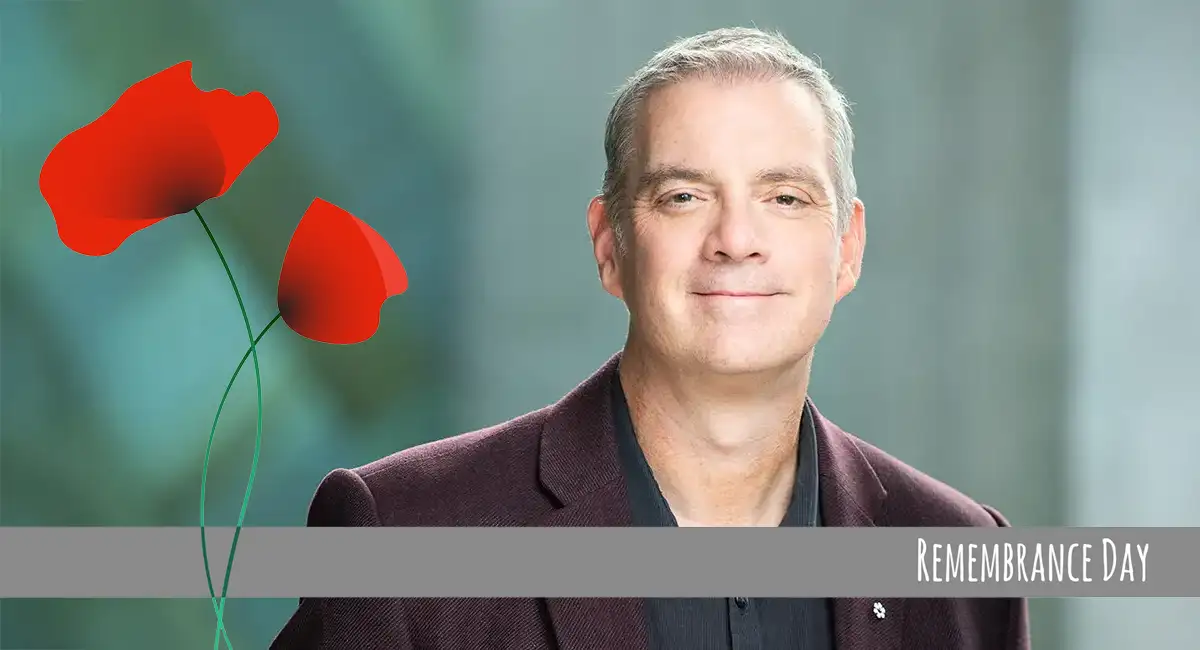
Remembering Tim Cook – Ottawa’s Stalwart Historian

This Remembrance Day, we mourn the loss of yet another fallen hero who has left an indelible mark on Canada’s military history


On November 11, Canadians across the country will mark Remembrance Day, in memory of the fallen soldiers who sacrificed their lives for freedom and peace. This year also marks 104 years of the Remembrance Day poppy, a visible symbol of remembrance of those who served. It is also the emblem of the Royal Canadian Legion, which raises funds for war veterans through its Poppy Campaign and distributes several million poppies each year to be worn by Canadians from the last Friday of October to Remembrance Day.

In a 2021 opinion piece in The Globe and Mail, the late Dr. Tim Cook, Chief Historian and director of Research at Canadian War Museum remarked, “The poppy has always been tethered to those Canadians who served and sacrificed, to acts of violence and heroism, and as a symbol of commemoration and observation. It is a flower infused with tears for loved ones long gone and sadness for humanity’s flaws that lead to war. While the poppy is worn in many parts of the world, its story, spooled out over 100 years, is very much connected to Canada’s history, of generations past and present.”

This Remembrance Day will be even more solemn as Ottawa mourns the loss of Dr. Tim Cook, who passed away on October 25 at the age of 54. Widely regarded as Canada’s preeminent military historian, the award-winning author of 19 books on Canada’s military history had a prolonged 13-year battle with Hodgkin’s disease. He is survived by his wife and three daughters.

In a statement issued by the Canadian War Museum, Caroline Dromaguet, President and CEO, Canadian War Museum and Canadian Museum of History said, “The Canadian War Museum is deeply saddened to announce the passing of our dear friend and colleague Chief Historian and Director of Research, Dr. Tim Cook. As Canada’s preeminent military historian, Tim Cook’s contributions to the Museum since 2002 have been enormous. He was instrumental in shaping the Canadian War Museum we know today. Tim was one of Canada’s most prolific, best known, and influential historians and authors. He published 19 books and dozens of scholarly articles and contributed hundreds of conference presentations, public addresses, and media interviews. He was a passionate ambassador for both the museum and Canadian military history. He has forever left his own mark on history.”

Early Life and Career

Tim Cook was born in Kingston, Ontario, and grew up in Ottawa. His interest in history was piqued early thanks to his parents, Terry Cook, a noted archivist and Sharon Anne Cook, a history professor and author. After obtaining a BA Honours degree in History from Trent University in Peterborough, he won a scholarship from the Royal Military College of Canada, where he pursued a Master’s degree in History. He then went on to do his Ph.D in History at the University of New South Wales.

Despite his paternal grandfather, Gordon Cook, being in RAF Bomber Command during World War II, it did not kickstart Cook’s career as a military historian. Rather, it was his first article published nearly 30 years ago in Canadian Military History, the journal of the Laurier Centre for the Study of Canada, that cemented his writing career. In a recent note by Cook to the journal, he said, “Canadian Military History has supported me throughout my career. The editor published my first article in 1996, “The Blind Leading the Blind,” on the Battle of St. Eloi. Before it was accepted, I remember thinking that if the article is published, I might try to make a career in military history. It was published; and I did.”

The rest, as they say, is history, with Cook going on to write numerous books, in addition to several articles and book reviews for the journal during the course of his prolific writing career. Cook also contributed to other publications, including the Journal of Military History, the International History Review, Legion Magazine, The Canadian Encyclopedia and Canada’s History Magazine (where he also served as a board member). His opinion pieces and interviews have been published in Maclean’s, The Globe and Mail, National Post, and Toronto Star.

Cook was also an Adjunct Research Professor at Carleton University, a member of The Historic Sites and Monuments Board of Canada, and served as editor of Studies in Canadian Military History, a book series published by the University of British Columbia (UBC) Press in partnership with the Canadian War Museum.

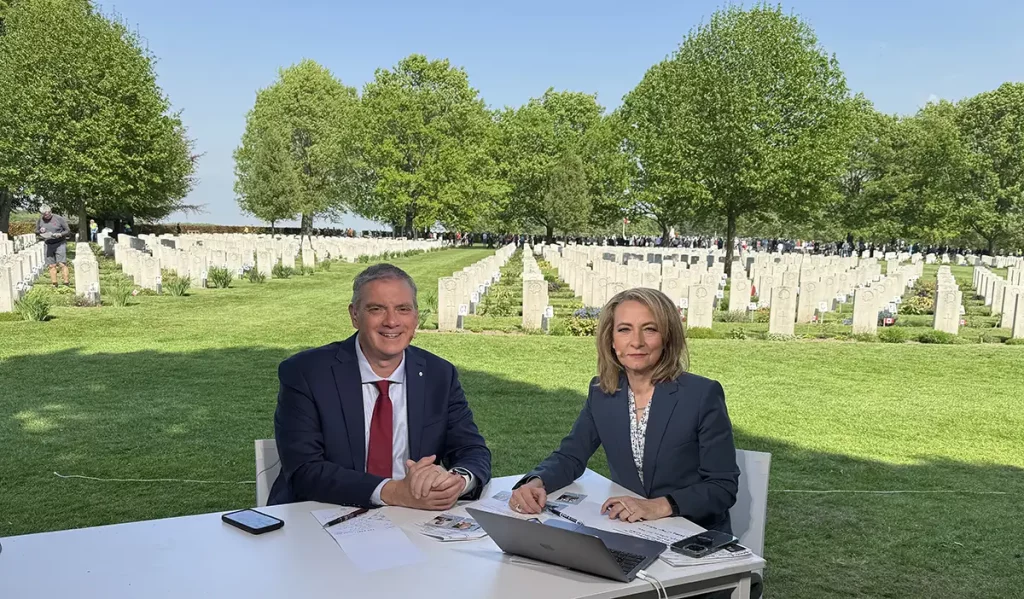
ABOVE: Dr. Tim Cook with CBC News chief correspondent Adrienne Arsenault broadcasting from the Groesbeek Canadian War Cemetery in the Netherlands, May 2025. (Photo: Courtesy CBC News and Penguin Random House Canada)

He was a frequent commentator in the media, regularly appearing on CBC Radio’s The Current, As It Happens, and Ideas, as well as TVO’s The Agenda and CTV’s Canada AM and Your Morning. Since 2017, he was also an on-air contributor for CBC TV’s national coverage of Remembrance Day ceremonies from Ottawa.

Contribution to the Canadian War Museum

Cook joined the Canadian War Museum in 2002, where he served as the First World War historian, curating the museum’s permanent gallery on the First World War, as well as a dozen temporary, travelling, and digital exhibitions. From 2022 until his passing, he served as Chief Historian and Director of Research, overseeing the work of historians at the museum and the Military History Research Centre. He was also part of the leadership team at the Canadian Museum of History for the past two years.

During his tenure at the Canadian War Museum, he played a crucial role in curating major exhibitions including ‘Victory 1918 – The Last 100 Days’, ‘Communities at War’, ‘War and Medicine’ and ‘Forever Changed: Stories from the Second World War’. These exhibits, often centred around personal stories from the battlefield, provided visitors with an immersive understanding of war’s impact and invited individual reflection. He also led the development of Gallery 2, ‘For Crown and Country’, and led the ‘In Their Own Voices’ oral history project that captured personal stories of veterans and their loved ones. He conceived and led multiple major updates to the museum’s galleries, research, publications, lectures, and international outreach. Through his recent initiatives, he helped lay the foundations for future research at the museum.

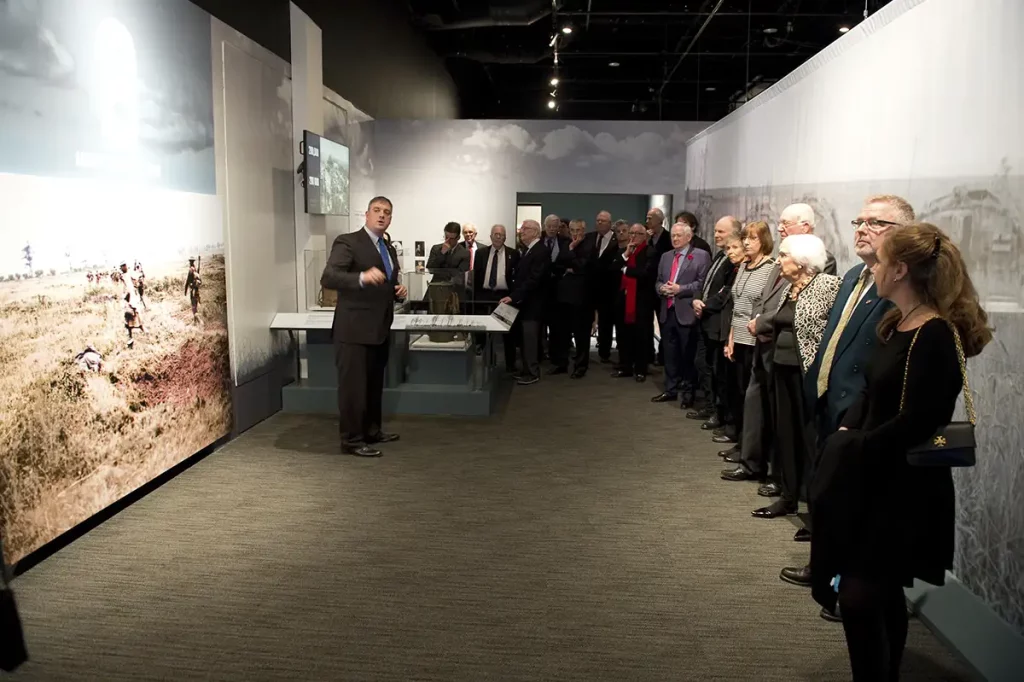
ABOVE: Tim Cook at the opening of the exhibition “The Last Hundred Days” at the Canadian War Museum in October 2018. (Photo: Courtesy Canadian War Museum)

In terms of how Cook was a passionate ambassador for the museum, Jim Whitham, Director General, Canadian War Museum and Vice-President, Research, Collections and Exhibitions, Canadian Museum of History, who worked closely with Cook for the past 23 years says that Cook championed the mandate of the museum to preserve and present Canadian military history; directing research, curating exhibitions, delivering lectures, mentoring staff and aspiring historians and actively engaging with the public who visited the museum to see his work and exhibitions. Cook always tried to shine a spotlight on his team, ensuring they took the credit, although he was always around to support them.

“Tim was an exceptional historian, a fantastic storyteller, and a passionate advocate for Canadian military history. In addition to his remarkable qualities as a historian, Tim was an even better person, friend, and mentor to many. He always found time for anyone who sought his help or advice, and he had a unique ability to make everyone feel welcome. I will forever miss his guidance, positive attitude, humour and how he made everyone smile,” remarked Whitham.

An Author Who Encapsulated the True Meaning of Remembrance Day

Aiming to connect Canadians of all ages with the legacy of the two world wars and the crucial role Canada played in them, Cook’s writing combined academic analysis and factual details of the wars with poignant personal stories gleaned from numerous interviews with war veterans, letters and memoirs from soldiers during the war and extensive and meticulous research from museum archives.

Through every book he wrote, Cook made military history more accessible with vivid, riveting narratives that brought scenes from the battlefield to life, shedding light on the human cost of war and the legacy of service of those who sacrificed their lives for preserving civilization. Not only did his books help to bridge the gap between academicians and the general public, but his insightful works also helped shape our collective understanding and memory of war, truly honouring those who served and fostering a broader appreciation for Canada’s military as well as the thousands of civilians who supported wartime military efforts.

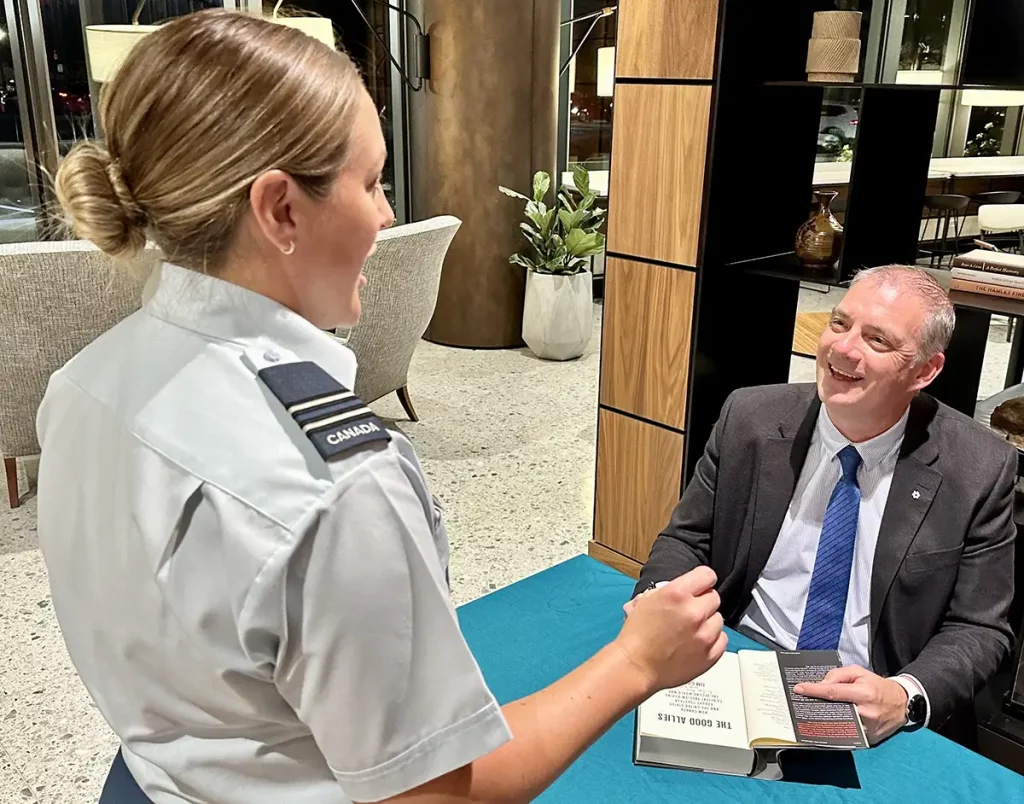
ABOVE: Dr. Tim Cook at a Washington, DC book signing, October 2024. (Photo: by Jennifer Stadnyk. Courtesy Penguin Random House Canada)

His books both informed and transformed the public’s perception of wartime contributions, challenging conventional narratives and exploring the emotional and psychological aspects of war, thereby allowing readers to connect on a deeper level with Canada’s war heroes. In a 2023 interview with The Canadian Press, Cook said the two world wars are particularly important in understanding the development of Canada and how they shaped society.

For his contributions to Canadian history, he was recognized with the Queen Elizabeth II Diamond Jubilee Medal, the Minister of Veterans Affairs Commendation, and the Governor General’s History Award. He was a Fellow of the Royal Society of Canada and a Member of the Order of Canada.

The fact that his books won multiple prestigious awards speaks to the impact that he made, inspiring both Canadians and a global audience. He was a four-time winner of the City of Ottawa Book Award, two-time winner of the J.W. Dafoe prize for Literary Non-fiction and two-time winner of the C.P. Stacey award for most distinguished book in Canadian military history. He was also the recipient of the Charles A. Taylor prize for Literary Non-Fiction, and his book The Good Allies: How Canada and the United States Fought Together to Defeat Fascism during the Second World War was one of five shortlisted for the 2025 Lionel Gelber Prize for the world’s best non-fiction works about foreign policy.

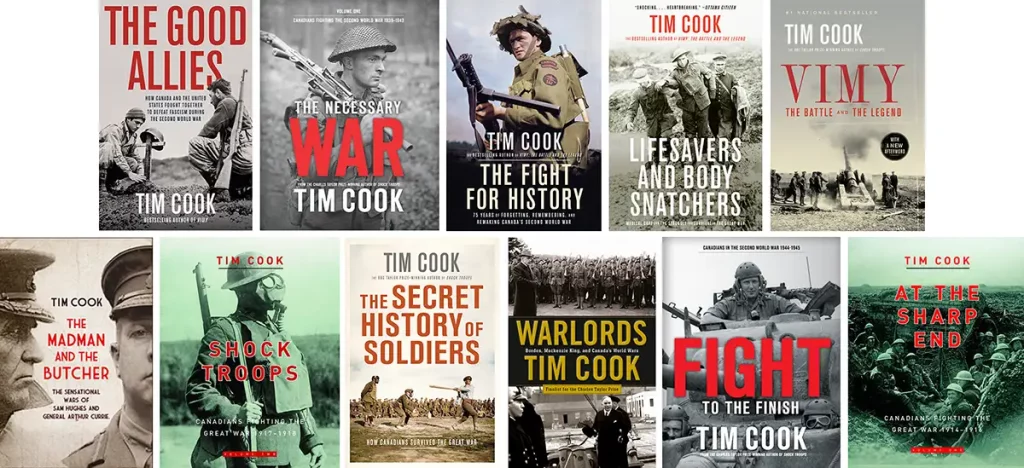
A few of his noteworthy books include The Good Allies: How Canada and the United States Fought Together to Defeat Fascism during the Second World War, which explores the complex relationship between the US and Canada during the Second World War, drawing important parallels on the current political tensions between the two allies. In a meeting between Canada’s Mélanie Joly, then Minister of Foreign Affairs, and U.S. Secretary of State Marco Rubio on January 29, 2025, in Washington D.C., Joly gifted Rubio a copy of The Good Allies, adding a note, “Marco, an example of what we can achieve when we work together.”

Cook’s book, The Necessary War: Canadians Fighting the Second World War, 1939-1943, Volume One (2014), explores the successes and failures of Canada’s early war effort within the larger context of the international story, drawing on veteran interviews, letters from soldiers, and archival research. In The Fight for History: 75 Years of Forgetting, Remembering and Remaking Canada’s Second World War, Cook highlights the important role Canada played in the war, especially in light of how many of the international institutions born out of the Second World War are under attack today.

In Life Savers and Body Snatchers: Medical Care and the Struggle for Survival in the Great War, he unearths previously unpublished evidence of the role Canadian doctors played in a British program of harvesting organs from slain First World War soldiers, while simultaneously highlighting the role that Canadian doctors played in saving lives and how groundbreaking wartime medical practices helped saved many more lives in World War II.

Vimy: The Battle and the Legend is a fresh take on the Battle of Vimy Ridge, delving into the huge role that Vimy plays in Canada’s history and how it has been remembered over 100 years.

His forthcoming book, The Unquiet Western Front, is scheduled for publication in 2026 by Allen Lane Canada, an imprint of Penguin Random House Canada, which has published most of his books.

“There is little we can say to add to Tim’s legacy. His numerous awards and the lasting impact his work has had on a generation of readers speak volumes more than any of us can. But no award captures what Tim meant to us. Over the course of many years and many books, Tim came to be known to all of us as much for his warmth and generosity of spirit as he was for his talent as a writer, and as eager to talk about family as he was to talk about history. He will be bitterly missed by all who worked with him and admired him,” said Nick Garrison, Publishing Director of Allen Lane Canada, in a statement issued by Penguin Random House Canada.

A Storied Legacy

Even as he battled an aggressive form of cancer, Dr. Tim Cook remained steadfast in his mission. He continued to write—book after book—while fulfilling his full-time role at the Canadian War Museum. He pressed on through pain with quiet resolve, driven by a singular purpose: to honour the sacrifices of Canadian soldiers and veterans of the First and Second World Wars. Through his prolific writing, compelling exhibitions, and powerful public talks, he deepened our national understanding of war, memory, and the human cost of conflict.

His passing is a profound loss for Canada. Yet his legacy endures—in the pages of his books, in the minds of the historians he mentored, and in the hearts of countless Canadians moved by his work. Though he is gone, Dr. Tim Cook will be remembered not only as one of our most cherished military historians but also as a generous steward of remembrance who gave back by lifting others forward.

The Canadian War Museum has a book of condolences available in the lobby for those who wish to leave a personal message. A more formal opportunity to celebrate Tim Cook’s contributions will be shared through museum channels soon.

For more information about Remembrance Day events at the Canadian War Museum, visit warmuseum.ca/remember.