The Future Belongs to the Countries That Build
Driving from Vancouver to Whistler last month, I was reminded why Canada inspires such pride. Few places offer a landscape where ocean, mountains, farms, harbours, factories, small towns, and major cities coexist so seamlessly. It is a country both vast and resource-rich, but also one defined by the people who shaped it.
Canada did not simply emerge. It was built by those who crossed oceans, laid railways, carved out ports, and established farms and factories across one of the largest geographies on Earth. That spirit of building is what made the country possible, and it is what will determine its future.
I saw that spirit again last week while driving from Edmonton to North Battleford and on to Saskatoon. In the cold prairie winter, business owners and residents spoke passionately about their communities and their hopes for economic renewal. At the State of the City address in North Battleford, the conversation centred on growth, reconciliation, and the determination to build a stronger future.
Earlier in Edmonton, I met with an Indigenous band planning a new health centre—an investment rooted in cultural heritage but also structured as a long-term economic asset for the community. Developed in partnership with a non-Indigenous group, it reflects what modern reconciliation can look like: shared investment, shared responsibility, and shared prosperity.
Soon I will be in Montreal, a city shaped by one of North America’s great trade corridors. The St. Lawrence Seaway—built jointly by Canada and the United States—transformed the Great Lakes into a global shipping gateway. It was a moment when Canadians chose not just to participate in global trade, but to build the infrastructure that made it possible.
These experiences point to a larger question: Canada is not short of potential. But are we prepared to build the national capacity required to realize it?
That question sits at the centre of Prime Minister Mark Carney’s first year in office. Carney describes his foreign policy as “values-based realism,” arguing that the old rules-based international order is under strain and that middle powers must work together more strategically. It echoes Canada’s past under Lester B. Pearson, but today’s challenge is different. Pearson helped build the rules; Carney must navigate a world where those rules are increasingly contested.
Nowhere is this more delicate than in Canada’s relationship with the United States. Carney has framed the approach as “respect, but not obsequiousness”—recognizing the U.S. as Canada’s closest ally and largest trading partner, while insisting that cooperation requires strength, not submission.
Former diplomat Colin Robertson told me that Carney has articulated a serious vision for Canada as a middle power working alongside Japan, Australia, and Europe. But the real test, he noted, will be delivery—turning diplomatic ambition into economic capacity at home. Political columnist Stephen Maher recently gave Carney’s first year an “A,” while others, including Edward Greenspon, argue that Canada’s global influence has eroded as its economic capacity stagnated.
In today’s world, sovereignty is defined not only by borders but by technology. Investor John Ruffolo recently noted that in the digital age, sovereignty means control over data, artificial intelligence, and the infrastructure that powers them. The global AI ecosystem is dominated by the United States and China. Countries that control these technologies will shape the global economy.
Canada must think strategically about its assets, from the critical minerals of Northern Ontario’s Ring of Fire to its vast energy resources. Canada is already one of the world’s largest energy producers, from Alberta’s oil and gas to hydroelectric power in Quebec and British Columbia. But resources alone do not create influence. Infrastructure does.
Canada has faced moments like this before. Railways once stitched the country together, transforming a collection of colonies into a nation. Today, we face another opportunity to think boldly.
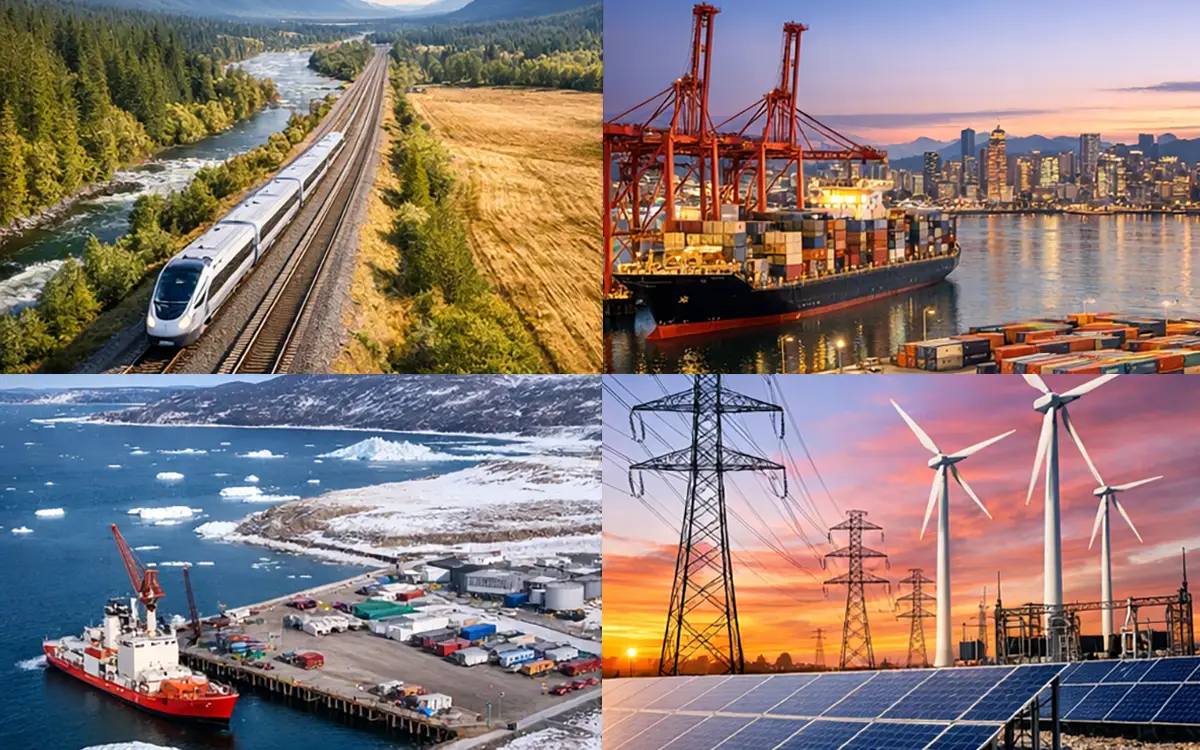
Imagine a high-speed rail corridor from Quebec City through Montreal, Ottawa, and Toronto to Windsor, linking nearly half of Canada’s population and economic activity. Just as railways once connected a young country, high-speed rail could knit together Canada’s economic heartland in a way we have never seen.
The same nation-building mindset applies elsewhere: pipelines to move Canadian energy to both coasts; a fully modernized Trans-Canada Highway; major investment in critical minerals in Northern Ontario and Quebec; and Arctic infrastructure—ports, icebreakers, navigation systems—to secure sovereignty as the Northwest Passage becomes a strategic shipping route.
Just as the St. Lawrence Seaway opened the continent’s interior to global trade, the Arctic may become another corridor of the future. But corridors do not secure themselves. They must be built.
At the same time, Canadians are rightly focused on affordability. Housing costs and the broader cost of living are putting pressure on families. A country that wants to be strong abroad must deliver prosperity at home. That means tackling housing affordability, reducing the tax burden on housing, and investing in the infrastructure that allows communities to grow.
Former Quebec premier Jean Charest recently suggested that twenty years from now, Canadians may thank Donald Trump—not because they agree with him, but because he forced Canada to confront its own complacency. For too long, Canada relied on American markets, American security, and the assumption that the global system would always take care of itself.
History has a way of correcting complacency. Pressure reveals weakness. And weakness forces renewal.
Canada has faced moments like this before. Railways were built. Ports were built. Energy systems were built. Institutions were built.
Now the question facing this generation is simple: Are we ready to build again?
Canada’s place in the world will not be decided by what we say. It will be decided by what we build: the infrastructure that connects our country, the industries that power our future, and the partnerships that allow us to thrive in a far more competitive world.
The future will belong to the countries that build. If Canada chooses to build again, this moment of disruption may become something else entirely. It may become Canada’s moment.