The Future of Downtown Ottawa: What Council Candidates Are Proposing
By Andrés Martínez
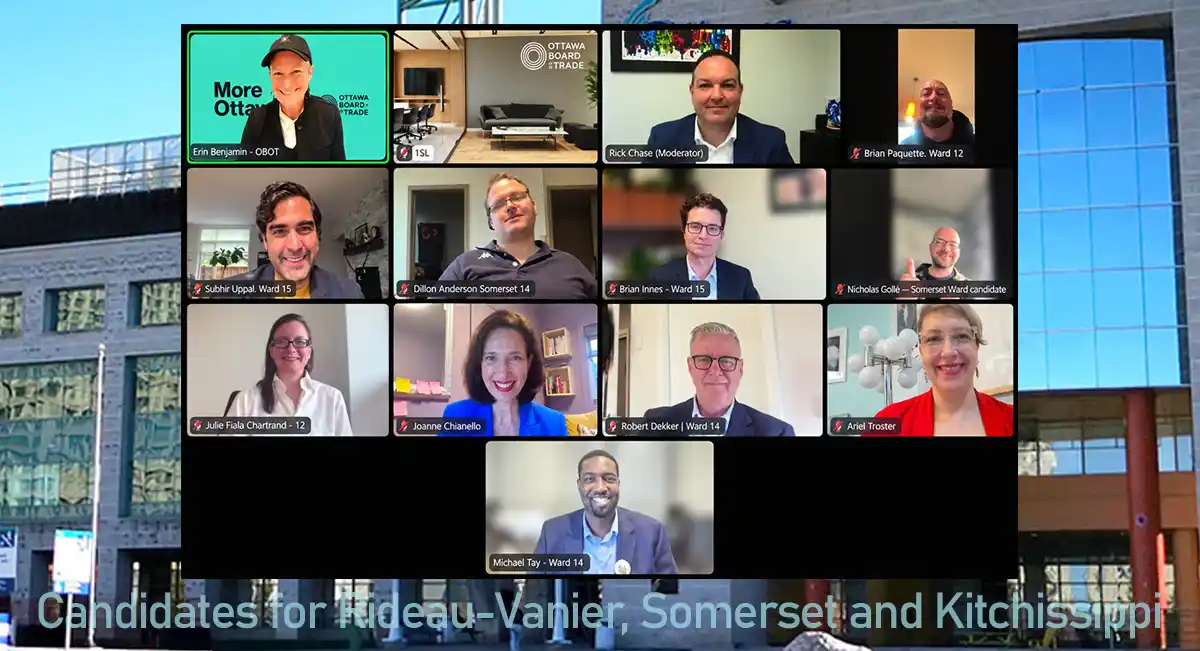
With Ottawa’s municipal election less than two weeks away, candidates from Rideau-Vanier, Somerset and Kitchissippi laid out competing visions for revitalizing the downtown core during a morning roundtable hosted by the Ottawa Board of Trade. From tackling homelessness and improving public transit to cutting bureaucratic delays at City Hall, candidates agreed on the need for change but differed on how to deliver it.
Downtown Renewal: Services, Safety and Street Life
SOMERSET WARD
For Somerset incumbent Ariel Troster, downtown revitalization begins with the people who already live there. “If you’re not taking care of your core, then you are not taking care of your city,” she said.
Troster linked the area’s economic prospects directly to chronic homelessness. “We can’t revitalize downtown unless we solve chronic homelessness,” she said, calling for social services to be more widely distributed and for provincial and federal governments to play larger roles.
Her Somerset challenger Robert Dekker approached the problem from the perspective of businesses and visitors. He said residents had told him they were choosing events outside Centretown because they no longer regarded downtown as an attractive destination. Concerns about crime and homelessness, he argued, are making it harder for local businesses to draw people back.
Dillon Anderson, another Somerset candidate, also called for safer streets but stressed that the response must include front-line support for people without housing. “That starts by helping people who are unhoused,” he said. Anderson argued that resources on the ground, rather than simply additional funding, are essential.
Michael Tay, meanwhile, framed his approach to public safety as one of compassion coupled with accountability.
RIDEAU-VANIER WARD
In Rideau-Vanier, Brian Paquette described a downtown that should be accessible and inviting seven days a week. “A rising tide raises all ships,” Paquette said. He made the case for encouraging private investment and new ventures, arguing that economic gains in the core can benefit other wards across the city.
Fellow Rideau-Vanier contender Julie Fiala Chartrand offered a different emphasis. She pointed to outdoor seating, colour, music and public art in neighbouring Somerset as ways to generate tourism and community life. She also raised concerns about public safety near bus shelters. Where Paquette focused on investment, Chartrand stressed the role of arts and culture in making public spaces worth visiting.
Better Transit, Better Access
Candidates also returned to a practical obstacle facing downtown businesses: getting customers and residents into the core and getting them home again.
SOMERSET WARD
“I’m hearing from people that they don’t come downtown at night because they don’t know if they can reliably get home,” Troster said.
Dekker suggested watching the city’s planned 2027 Glebe bus pilot program and assessing whether similar changes could extend into Centretown. He also argued that Bank Street is underused as a transit corridor and that more reliable, frequent service could improve access downtown.
RIDEAU-VANIER WARD
While Rideau-Vanier candidates focused less directly on transit during this portion of the discussion, both linked downtown vibrancy to creating welcoming and accessible public spaces.
City Hall’s Bottlenecks
KITCHISSIPPI WARD
In Kitchissippi, candidates focused on how Ottawa approves projects and delivers services.
Brian Innes said residents and builders need more predictable permitting decisions. He proposed clearer approval timelines and greater transparency in municipal processes, arguing that avoidable delays slow the delivery of new housing, including affordable homes.
Subhir Uppal emphasized the potential for artificial intelligence to improve city operations over the next council term. He also called for integrating more recreation and public amenities into high-rise developments, pointing to heavy demand at facilities such as Dovercourt.
Joanne Chianello advocated a city-wide service-delivery review to examine how programs perform, how long projects take and where accountability may be lacking.
She warned that funding an initiative does not guarantee it can proceed when the city lacks staff to deliver it.
“There is money in our ward to build a much-needed pedestrian crossing, but there is not the staff available to do that.”
The example illustrated the gap between funding a project and having the staff needed to deliver it, a problem Chianello argued exists across the city.
SOMERSET WARD
Nicholas Gollé echoed the case for clearer application requirements and suggested artificial intelligence could help reduce administrative delays.
RIDEAU-VANIER WARD
Chartrand emphasized collaboration among councillors and stronger cooperation between Ottawa and Gatineau.
From Campaign Pledges to Measurable Results
The Ottawa Board of Trade’s roundtable series was designed to ask candidates not only what they support but how they would deliver results and measure progress through 2030.
The competing approaches exposed a broader choice for voters. Downtown recovery could be pursued through stronger social support, confidence in public safety, cultural investment or better transit. Quicker city services could come from technology, improved staffing or clearer development rules. Those priorities sometimes overlap, but the routes to achieving them are not the same.
On October 26, voters will choose councillors who must turn those arguments into budgets, policies and services. The measure of success will not be felt in the roundtable itself, but in the streets of Ottawa and at City Hall.