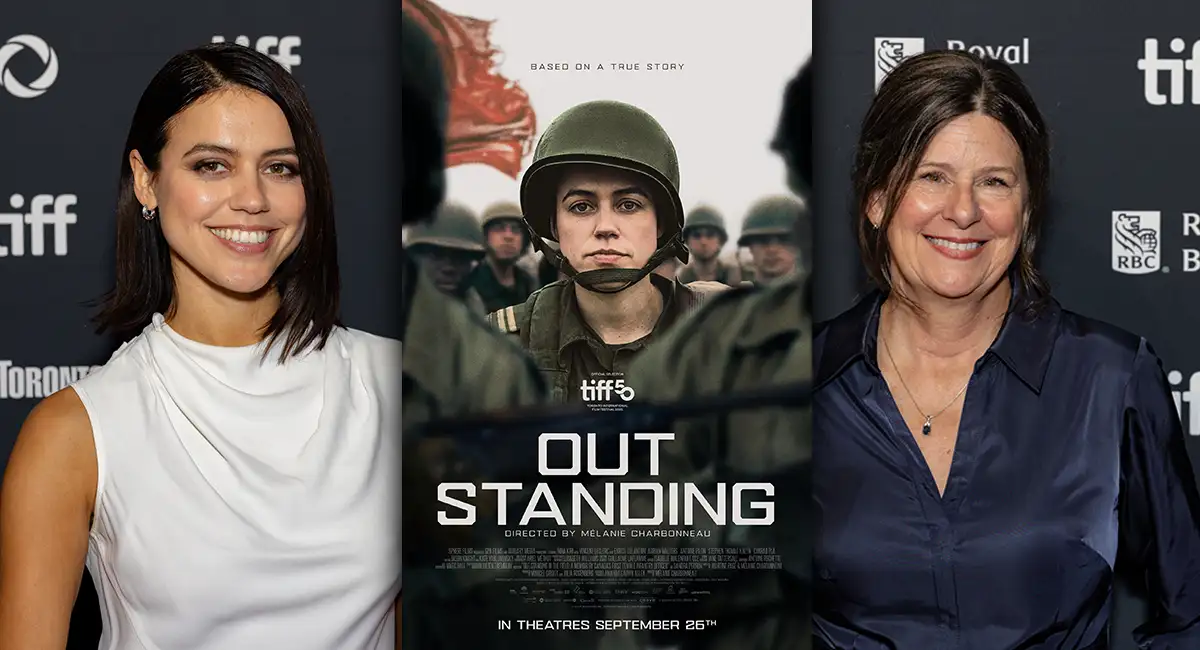
TIFF50 Review & Interview: ‘Out Standing’ Lives Up to Its Name With Power and Grace
Synopsis: Officer Sandra Perron resigns from the Canadian military after a controversial photo surfaces. Adapting to civilian life amidst an investigation, she denies abuse allegations despite evidence suggesting mistreatment within her unit.
Director: Melanie Charbonneau
Stars: Nina Kiri, Conrad Pla, Vincent Leclerc
Cinema has always had the power to shine a light on overlooked stories, and Out Standing is a powerful reminder of how vital that responsibility can be. Directed with quiet confidence and emotional clarity by Melanie Charbonneau, the film takes audiences deep into the intersecting worlds of personal identity, military service, and resilience. At its centre are two remarkable figures: Nina Kiri, who delivers one of the finest performances of her career, and Sandra Perron, whose presence and lived experience elevate the film into something both inspiring and deeply human.
Out Standing follows the journey of a young woman in the Canadian Armed Forces (brought to life by Kiri with stunning authenticity) as she navigates the challenges of duty, camaraderie, and self-discovery in an institution that has not always embraced inclusivity. The character’s path is informed and inspired by the extraordinary real-life experiences of Sandra Perron, Canada’s first female infantry officer, who not only serves as a guiding presence in the film but also as a testament to perseverance in the face of systemic adversity.
Kiri, best known for her breakout work on The Handmaid’s Tale, is mesmerizing here. She embodies her character with a mix of steely determination and raw vulnerability, allowing audiences to glimpse both the external pressures of military life and the internal struggles of identity. Kiri’s performance never feels forced; it is grounded, nuanced, and incredibly layered. In her hands, the role becomes a universal exploration of belonging—whether in the military, in society, or even within oneself. The way she conveys both toughness and fragility—sometimes within a single scene—cements herself as a compelling performer of her generation.
Equally moving is the presence of Sandra Perron herself. Although she is not the lead actor, her legacy and service are evident in every frame. Perron’s real-life career broke barriers in the Canadian military, where she fought for the right not just to serve, but to be recognized as an equal. Out Standing pays tribute to her achievements without turning her into an untouchable icon. Instead, it presents Perron as she truly is: a trailblazer whose story continues to inspire younger generations. The film takes care to highlight her humanity, her courage, and her resilience—not in spite of her struggles, but through them. In doing so, it honours her service while acknowledging the sacrifices and battles, both literal and institutional, that marked her career.
The film is most powerful when it allows these two narratives—that of Kiri’s character and that of Perron’s real history—to echo against each other. The result is a meditation on endurance, mentorship, and the quiet but revolutionary act of standing tall when others expect you to shrink. The director and screenwriter deserve credit for resisting the temptation to dramatise for effect; the storytelling here is refreshingly restrained, letting the strength of its subjects carry the film.
Visually, Out Standing opts for a grounded, almost documentary-like style. The cinematography emphasizes stark training grounds, muted barracks, and moments of quiet reflection that contrast sharply with the intensity of military life. This naturalistic approach keeps the focus firmly on the characters rather than spectacle, underscoring the film’s respect for the real stories it represents.
Thematically, the film is about more than gender, more than service; it is about the universality of persistence, the bravery it takes to claim space in environments that would prefer one’s silence, and the hope that comes from knowing you are not alone. Both Kiri and Perron embody these ideas with grace and honesty, turning Out Standing into a film that feels both deeply personal and broadly resonant.
In the end, Out Standing is a triumph of storytelling and representation. Nina Kiri gives a performance that should be remembered at awards season, while Sandra Perron’s career and service are honoured in a way that feels authentic and long overdue. Together, they anchor a film that is as much a call for recognition as it is a celebration of courage. For audiences seeking a story of perseverance and dignity, Out Standing is more than just a film—it’s an experience that lingers.
Grade: B+
Watch our interview with Sandra Perron and Nina Kiri.
Click here for more film reviews by Keith Whittier.