Abundance, Not Excuses: Canada Must Relearn How to Build
Canada’s biggest economic challenges are often discussed as if they exist in isolation.
Housing affordability. Infrastructure delays. Weak productivity. Energy constraints. A tax system that discourages investment.
But these are not separate problems. They are symptoms of a single, deeper issue:
👉 Canada has become a country that finds it too hard to build.
In their recent book Abundance, Ezra Klein and Derek Thompson argue that modern developed economies have become exceptionally good at process—rules, reviews, consultations, and approvals—while becoming increasingly poor at outcomes.
The goal is not to eliminate regulation or abandon oversight. It is something more fundamental:
👉 Advanced societies must retain the capacity to produce abundance.
More housing. More energy. Better infrastructure. Greater innovation. More opportunity.
When every worthwhile project becomes too slow, too expensive, and too difficult to execute, scarcity is no longer inevitable.
It is chosen.
This insight resonates powerfully in Canada.
We do not simply have a housing shortage—we have a system that makes housing too difficult to approve and build.
We do not just have expensive transit—we have a system that makes infrastructure projects excessively complex and inefficient.
We do not merely suffer from weak productivity—we have a system that taxes investment, delays execution, and undermines competitiveness.
This is not a debate about ideology. It is a debate about capacity.
Too much complexity, not enough execution. Too much proceduralism, not enough delivery.
The jurisdictions that succeed are not those with the most plans. They are the ones who can actually get things done.
Tax policy reinforces the problem.
As tax expert Harry Margulies notes, Canada’s system may see itself as fair, but it often works against productivity.
We heavily tax income. We heavily tax capital gains. We impose corporate tax structures that are not globally competitive.
Then we express surprise when business investment weakens, capital becomes cautious, and productivity stalls.
In effect, Canada does not just regulate building.
👉 We tax it.
We tax risk. We tax investment. We tax mobility.
And then we wonder why economic dynamism is lacking.
This is not an argument for trickle‑down economics or a race to the bottom. It is an argument for functional capitalism:
Competitive markets. Disciplined capital allocation. Reward for innovation and risk‑taking.
Not crony capitalism—where insiders are protected, competition is stifled, and government and incumbents reinforce each other’s power.
Unfortunately, Canada has drifted in that direction.
On one side, an overemphasis on process, veto points, and managed scarcity. On the other, a tolerance for concentrated power and weak competition.
The result is the same:
👉 Stagnation.
Nowhere is this more evident than in energy.
Canada should be an energy superpower.
We have the resources. We have the technical expertise. We operate under higher environmental and governance standards than many authoritarian regimes that supply global markets.
And yet we remain constrained—not by geology, but by policy.
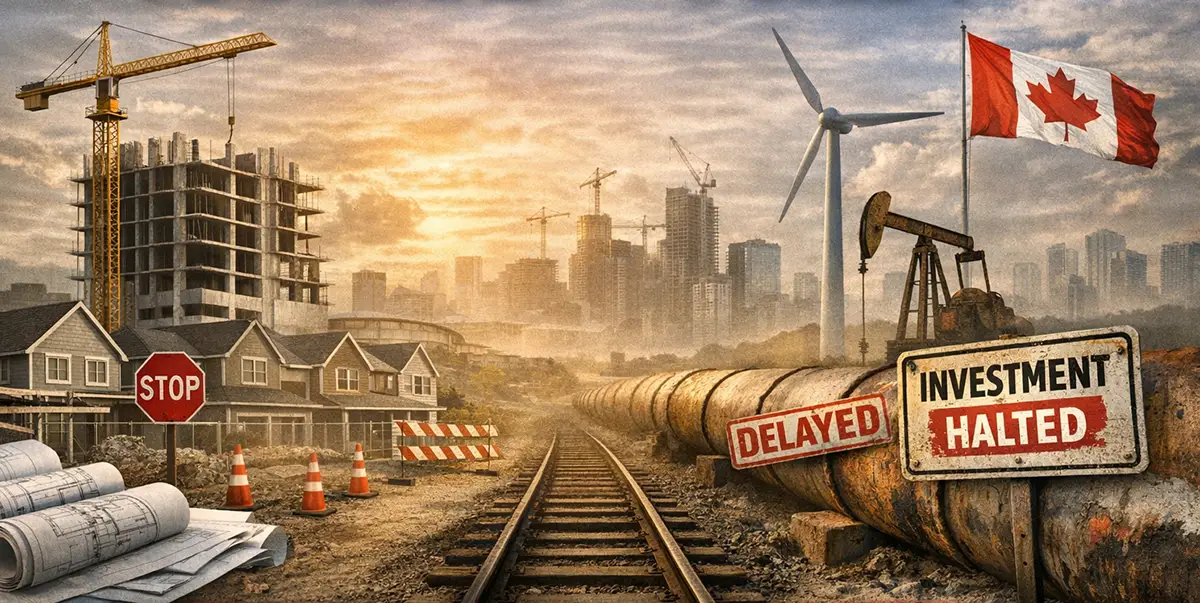
Pipelines are delayed. LNG capacity remains underdeveloped. Internal energy corridors are incomplete. Regulatory systems are slow and uncertain.
The issue is not potential. It is whether Canada can convert potential into capacity.
This is the real abundance question.
Can we build housing at scale? Can we deliver infrastructure efficiently? Can we develop energy systems that matter globally? Can we design a tax system that encourages investment instead of discouraging it?
Abundance is not an abstract ideal. It is the practical ability to solve real problems.
When housing supply increases, affordability improves. When infrastructure expands, productivity rises. When energy capacity grows, sovereignty and economic strength follow. When investment is rewarded, opportunity expands.
When these things do not happen, scarcity hardens—and politics becomes zero‑sum.
Young against old. Renters against owners. Climate against growth. Fairness against prosperity.
These are false choices.
You cannot redistribute what you do not create. You cannot regulate your way to abundance. You cannot tax your way to growth. And you cannot build a future if you have forgotten how to build.
So what would a different approach look like?
It would be unapologetically pro‑growth, pro‑investment, and pro‑competition—while firmly rejecting cronyism. It would prioritize outcomes over process. And it would focus on building national capacity.
That means:
• A true high‑speed rail corridor from Quebec City through Montreal, Ottawa, Toronto, and Windsor.
• Energy infrastructure—pipelines and LNG—connecting Canadian resources to global markets on both coasts.
• Critical minerals development in regions like the Ring of Fire and Northern Quebec.
• Arctic infrastructure to secure sovereignty in the North.
• And the foundational systems—transit, water, power—that enable housing to be built at scale.
These are not isolated projects. They are the building blocks of a productive, sovereign, and competitive country.
Canada did not become a nation through regulation.
It became a nation through construction.
Railways. The St. Lawrence Seaway. National energy systems.
These were not just infrastructure projects—they were acts of nation‑building. They expanded capacity, and in doing so, expanded opportunity.
Today, we face a different kind of moment.
Global supply chains are shifting. Energy security is once again a central geopolitical issue. Technology is redefining economic power.
In this environment, capacity is not theoretical.
👉 Capacity is built.
Canadians are right to demand affordability and opportunity at home. But those outcomes cannot be delivered through rhetoric alone.
They require supply. They require investment. They require execution.
This is the choice in front of us.
More process. More delay. More complexity. More excuses.
Or something else:
👉 A country that builds again.
Because abundance is not a slogan. It is a decision.
And the future will not belong to the countries that talk about their potential. It will belong to the countries that build it.
Photo: Copilot