Recommended Articles

Educational Exchanges as a Catalyst for Stronger China-Canada Relations
Woe Is Ottawa
The Mirage of Carney’s ‘New Direction’: Same Players, Same Problems



Canada is facing one of the most consequential economic and political moments in a generation. Prime Minister Mark Carney’s decision to walk away from trade negotiations with the United States rather than accept an agreement he believed was not in Canada’s interests has forced us to confront a question we have largely avoided for almost forty years: How economically dependent can one country become on another before that dependence begins to constrain its political sovereignty?
For me, this is not a new question. In 1986, 1987 and 1988, while completing my MBA at Harvard Business School, I became fascinated by the proposed Canada-U.S. Free Trade Agreement. I completed what amounted to a mini-thesis on the issue, read all 26 volumes of the Royal Commission on the Economic Union and the Development Prospects for Canada (the Macdonald Commission) and interviewed people involved in studying the agreement. I also had the benefit of two advisers who could hardly have represented more different perspectives. One was a former NDP premier of British Columbia, then a visiting professor at Harvard’s Kennedy School of Government, who worried deeply about the political and social consequences of economic integration with the United States. The other was a conservative Republican strategy professor at Harvard Business School who approached the question primarily through economics, competition and business strategy.
After studying the evidence and debating both sides, I came down in favour of free trade. I believed then, and still believe today, that the economic logic was compelling. Canada was a relatively small economy sitting beside the largest and wealthiest market in the world. Greater access to that market allowed Canadian companies to specialize, expand, attract investment and participate in continental supply chains. Free trade generated enormous benefits, but it also carried risks. The Macdonald Commission understood that economic restructuring would produce winners and losers, and I argued at the time for substantial transitional adjustment assistance, including consideration of a guaranteed annual income, because if government deliberately restructures an economy for the broader national good, it has some responsibility to those who bear the greatest costs.
We implemented free trade but did far less to implement those transitional protections. Instead, one of Canada’s most important adjustment mechanisms became the Canadian dollar. As our currency weakened against the U.S. dollar, Canadian goods and labour became more competitive in U.S. dollar terms. In effect, part of our adjustment came through making Canadian production and Canadian wages cheaper to Americans. The model nevertheless worked remarkably well for decades. What we failed to address adequately was a different risk: dependency.
At Harvard Business School, we studied the strategic dangers that arise when a small company becomes increasingly dependent on a single enormous customer. Imagine a manufacturer winning a transformative contract with Walmart or Costco. Sales soar, the company expands its plant, hires employees and redesigns its operations around serving that customer. It initially appears to be an extraordinary success. But then the customer grows from 20 per cent of sales to 40, then 60, perhaps eventually 80. At that point, the nature of the relationship changes. The customer can dictate price, specifications, delivery schedules, payment terms and even investment decisions. The supplier remains legally independent, but practically its options have narrowed dramatically.
Every competent executive, lender and board of directors understands customer-concentration risk. The solution is not to fire your largest customer. It is to find more customers. And that, I believe, is where Canada made its strategic mistake. Free trade was not the mistake. Allowing integration to become dependence was.
For nearly four decades, Canada became extraordinarily good at selling south. We built automotive, manufacturing, agricultural, energy and resource supply chains around privileged access to the United States. Because the relationship worked so well, we did too little to build alternatives. We did not build enough pipelines to tidewater or LNG capacity. We did not expand our ports, rail and trade infrastructure quickly enough. We did not process enough of our critical minerals at home, scale enough Canadian technology companies, eliminate enough barriers between our own provinces or diversify our international markets aggressively enough. For almost forty years, Canada brilliantly executed the integration strategy. We largely forgot the diversification strategy.
During the 1988 election, Liberal leader John Turner famously warned Canadians about the connection between economic and political sovereignty. I disagreed with his conclusion that free trade should therefore be rejected, but nearly four decades later I understand his concern better. Economic integration between sovereign countries can create enormous prosperity; excessive economic dependence can create political vulnerability. Those are not the same thing.
Canada agreed to open its economy to the United States. We agreed to competition, investment and increasingly integrated markets. We did not agree that Washington could determine Canadian foreign policy, tax policy, energy policy, defence policy, cultural policy or our relationships with other countries. Economic integration was supposed to expand our choices, not eliminate them. That is why Carney’s decision to walk away matters. Walking away from negotiations should never be celebrated for its own sake. Trade wars impose real costs, and Canada has proportionately far more at stake than the United States. But there comes a point in any negotiation when no agreement is preferable to a bad agreement.
I learned that lesson early in my career working for Jim Pattison. Jimmy understood that you often do not know how good a deal is available until you are genuinely prepared to walk away. Not as theatre, not in anger and not to humiliate the other side, but because the other party needs to understand that there is a point beyond which you will not go. He also understood that walking away does not mean the negotiation is over. Eventually, as he often reminded us, people do business with people. Canada should return to the negotiating table whenever there is a reasonable basis for an agreement. We should negotiate seriously, firmly and professionally, but compromise cannot mean surrendering Canada’s ability to make sovereign choices.
It would also be a serious mistake to see the current crisis simply as something Canada needs to endure until Donald Trump leaves office. The global economy itself is changing. Futurist Jo Caudron, whom I recently interviewed about his concept of “Worldshock,” argues that geopolitics, artificial intelligence, demographic change, energy insecurity and technological disruption are transforming the world simultaneously. Countries are no longer making economic decisions purely on the basis of lowest cost. Increasingly, they ask who controls the technology, where the energy is produced, who owns the data, whether critical supply chains can be trusted and whether essential goods will remain available during a crisis.
That world will remain long after any particular president leaves office. Canada therefore needs a strategy for the next generation, not simply the next American election. Former Canadian diplomat Colin Robertson has repeatedly emphasized in my conversations with him that Canada must understand the United States as it actually is. America is not simply the White House. It is 50 states, governors, senators, members of Congress, mayors, companies, unions, universities, chambers of commerce and civic organizations. Michigan, New York, Ohio, Pennsylvania, Texas and many other states benefit enormously from Canadian trade. American manufacturers depend upon Canadian inputs, refineries depend upon Canadian oil and electricity grids depend upon Canadian power. Our American strategy should therefore involve thousands of points of contact, not merely one relationship between a prime minister and a president.
Robertson’s broader point is even more important: Canada should remain deeply engaged with the United States, but not dependent at any price. That strikes me as precisely the balance we need—engagement without submission, integration without dependency, partnership without surrendering sovereignty.
Investor John Ruffolo has extended the same argument into the digital economy. Modern sovereignty is no longer simply about borders, pipelines, factories and natural resources. It is also about who owns our data, where it is stored, whose cloud infrastructure Canadian businesses and governments depend upon, who owns the artificial-intelligence platforms and who finances and ultimately owns our most promising companies. Canada produces world-class researchers, engineers and entrepreneurs, but too often someone else finances the company, scales it and ultimately owns it. If Canada wants greater economic sovereignty, we need to finance more Canadian companies, retain more intellectual property and build more of the digital infrastructure upon which a modern economy depends. Artificial intelligence, data centres, cloud computing, cybersecurity, semiconductors and quantum technology are no longer merely commercial sectors. They are strategic infrastructure.
Energy expert Heather Exner-Pirot makes much the same argument in the physical economy. Canada possesses extraordinary reserves of oil, natural gas, uranium, potash and critical minerals, along with hydroelectricity, agricultural capacity and sophisticated engineering expertise. At a time when Europe and Asia are increasingly concerned about energy security and geopolitical instability, Canada should be one of the world’s preferred democratic suppliers. But resources sitting underground are not geopolitical power. They become power when we can responsibly develop them, process them and move them to customers. That requires pipelines, LNG terminals, ports, railways, transmission lines, mines and processing facilities. Increasingly, Canada’s problem is not geology. It is execution.
The strategic answer, therefore, is not less trade with America. It is more trade with everyone else. Rick Anderson and others I have interviewed have argued that Canada should deepen relationships with Europe, Japan, South Korea, India, Southeast Asia and other middle powers seeking reliable democratic partners. That is not anti-Americanism. It is prudent diversification. If Canadian exports to the United States continue to grow while our exports to Europe and Asia grow even faster, Canada becomes both richer and less vulnerable.
We should simultaneously create something much closer to a genuinely integrated Canadian economy. It is absurd that a country now talking urgently about reducing its economic vulnerability to the United States still maintains significant barriers to commerce between its own provinces. We need freer internal trade, easier labour mobility, common recognition of professional credentials and major east-west infrastructure. Pipelines, ports, rail, electricity transmission and digital infrastructure do more than move products and information; they give Canadians choices. In the emerging geopolitical environment, national unity itself has become an economic asset.
There is another dimension to sovereignty that is too easily overlooked. Economic sovereignty means very little to a 28-year-old Canadian who has concluded that they will never be able to afford a home or build the life their parents enjoyed. Housing has become not merely a social issue but a productivity, labour-market, demographic and immigration issue. If talented Canadians cannot afford to live where economic opportunities exist, some will leave. If nurses, teachers, engineers, construction workers and entrepreneurs cannot afford the communities in which they work, our economy suffers. And if newcomers arrive believing Canada offers opportunity only to discover that housing consumes an impossible proportion of their incomes, confidence in the Canadian promise erodes.
We also need to invest in Canadians during periods of economic disruption. I argued for adjustment assistance in 1988 because markets create change, and change inevitably creates casualties. The same principle applies today. Workers affected by trade disruption, automation or artificial intelligence need retraining, mobility assistance and credible paths toward new opportunities. A stronger Canada cannot simply tell people to absorb the costs of national economic transformation while others enjoy the benefits. National change needs to be accompanied by national solidarity.
There is also a question of character. On Canada Day, I reflected on an interview I had with filmmaker Peter Gentile about You Are Here, the documentary telling the true story behind Come From Away. When thousands of passengers were stranded in Gander after the September 11 attacks, Newfoundlanders opened their homes, schools, churches and community centres. They fed strangers, found medicine, provided clothing and comforted frightened people. Their response ultimately came down to a remarkably simple question: What do you need?
That story reminds me that countries need both capacity and character. Capacity without character can become power without purpose. Character without capacity can become good intentions without results. Canada needs to become more productive, technologically sophisticated, energy secure, militarily capable and economically competitive without losing the qualities that make the country worth defending in the first place: democracy, decency, openness, opportunity, community and the rule of law.
Nearly forty years after studying the original free trade agreement at Harvard, I still believe Canada made the right decision. I would make it again. Economic integration with the world’s largest economy generated enormous prosperity for this country. But I would now attach a warning that feels considerably more urgent than it did in 1988: integration is valuable; dependence is dangerous.
Canada should trade enthusiastically with the United States. We should fight to preserve the extraordinary economic relationship we have built, and we should negotiate seriously and pragmatically to protect it. But at the same time, we must build more markets, more infrastructure, more Canadian companies, more intellectual property, more energy capacity and more strategic independence. The objective is not separation from the United States. Geography makes that unrealistic and prosperity makes it undesirable. The objective is something more sophisticated: interdependence without subservience—a relationship between two sovereign countries that trade enormously because both benefit, not because one has no alternative.
We cannot control Donald Trump or the next American president. We cannot control China, wars in the Middle East, technological disruption or every geopolitical shock that is coming. But we can control what Canada builds. We can diversify our markets, invest in our people, develop our resources, innovate, strengthen our institutions and remain united. Most importantly, we can make sure that the next generation inherits a country with more choices rather than fewer.
That, ultimately, is the real meaning of sovereignty. It is not isolation; it is choice. It is not protectionism; it is capacity. It is not hostility toward our closest neighbour; it is having the confidence and economic strength to stand beside that neighbour as a sovereign partner.
Nearly forty years ago, Canada chose free trade. Today we face another defining choice. This time, we need to choose not merely integration, but strength; not dependence, but optionality; not complacency, but resilience.
We need to choose to build.
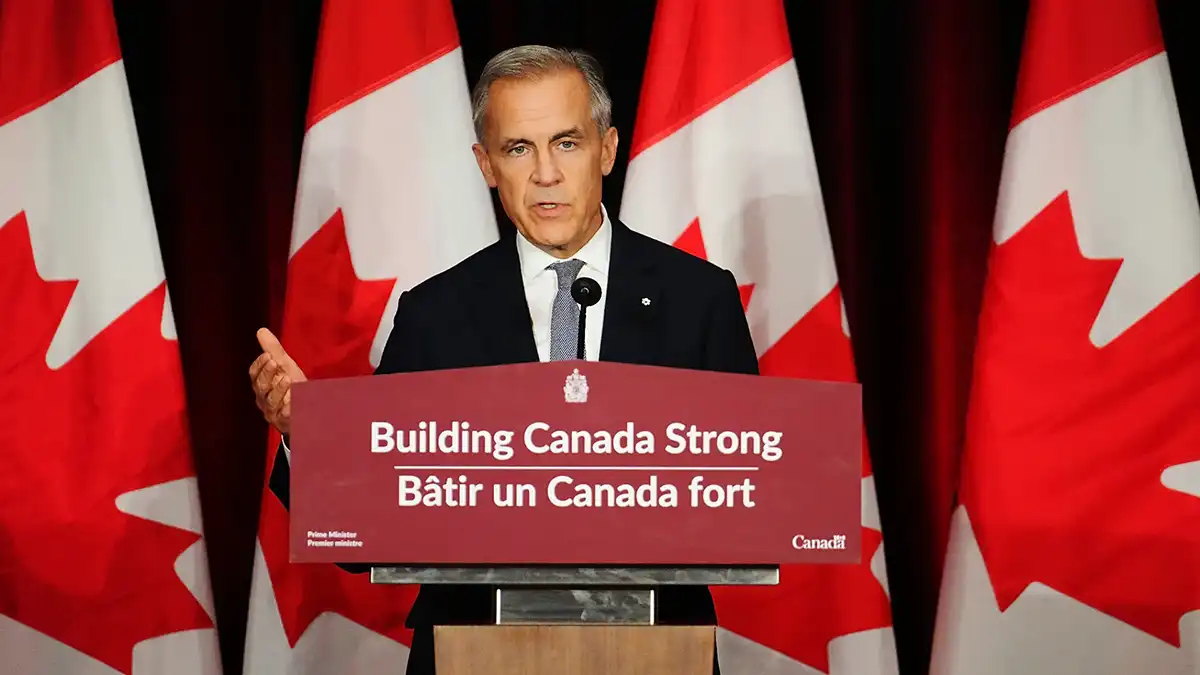
Header image: Prime Minister Carney. (Courtesy www.euronews.com)