Recommended Articles

Legislating Protection for Faith Spaces
Something is Really, Really Wrong in Ontario

Canada’s Middle Power Strategy: Why Leverage Matters More Than Speeches


As Quebecers go to the polls, there is a larger question Canadians should be asking: What holds a country together?
More than 30 years after the 1995 referendum brought Canada within a fraction of a percentage point of breaking apart, separatist sentiment remains significant in Quebec. In a recent interview, Steve Pinkus of Mainstreet Research described a Quebec electorate in which the Parti Québécois remains a major political force, even though a substantial majority of Quebecers do not support separation.
Quebec is not alone.
I recently returned from an extended business trip through Alberta and Saskatchewan. In conversations with businesspeople, community leaders and a Saskatchewan cabinet minister, I was surprised by how frequently Western separation came up. Nobody suggested it was a majority view. It isn’t. But there is a meaningful minority of Western Canadians who believe their provinces have been poorly served by Confederation.
We should take that seriously—not because Canada is about to break apart, but because we should ask why significant numbers of people in one of the wealthiest, freest and most fortunate countries in the world sometimes wonder whether they want to remain part of it.
Perhaps part of the answer is that we need to start building Canada again.
Canada wasn’t held together simply by a constitution. We built things that connected us.
The railway was fundamental to Confederation and Canada’s expansion westward. It moved goods, but it also moved people and ideas and created economic relationships between communities thousands of kilometres apart.
Then came the St. Lawrence Seaway, officially opened in 1959—an audacious project that allowed ocean-going vessels to travel deep into the industrial heartland of North America.
We followed that with the modern highway connection between Montreal and Toronto.
I remember that transformation personally. I was born in Montreal, and as a child we drove to Toronto to visit my grandparents. I remember portions of that journey before the highway connection became what we take for granted today. Highway 401 and Quebec’s Autoroute 20 dramatically reduced the practical distance between Canada’s two largest cities.
These projects weren’t just steel, concrete and asphalt.
They changed distance.
Montreal became closer to Toronto. Ontario became closer to Quebec. Western Canada became closer to Central Canada. Canadians became closer to one another.
What have we built in the past several decades that has transformed our relationship with one another in quite the same way?
Not enough.
Perhaps we became complacent.
The 1988 Canada-U.S. Free Trade Agreement and then NAFTA created enormous economic opportunities. But they may also have produced an unintended consequence: Canada’s economy became increasingly oriented north-south rather than east-west.
Ontario manufacturing became deeply integrated with Michigan and Ohio. Western Canadian energy became overwhelmingly dependent on American markets. Quebec became closely integrated with the northeastern United States.
We became comfortable assuming that our relationship with the United States would always be predictable.
Recent events should have taught us otherwise.
Sovereignty requires options.
That is why renewed discussion of a pipeline from Alberta to Canada’s Pacific coast matters. Another route to tidewater could give Canadian resources greater access to world markets and reduce our dependence on a single customer.
When I was recently in Alberta, people noticed Ottawa’s renewed interest in getting major projects built. It mattered economically, but I believe it mattered psychologically as well. It sent a message that Western Canadian resources matter to Canada’s future.
Heather Exner-Pirot of the Macdonald-Laurier Institute made an important qualification when I interviewed her recently. We shouldn’t build pipelines simply because lines across a Canadian map make us feel more united. Major projects need sound business cases.
That should be the test for modern nation-building: Does a project make Canada more productive, prosperous, resilient and connected?
Energy should be near the top of that agenda, but the conversation needs to extend far beyond oil.
Quebec possesses one of the world’s great hydroelectric systems. Ontario has extraordinary nuclear expertise. Saskatchewan has some of the world’s richest uranium deposits. Alberta possesses enormous oil and natural-gas resources.
Why aren’t we thinking much more ambitiously about how those strengths fit together?
Quebec receives western Canadian oil, but it also imports crude from the United States. Much of the energy infrastructure serving Central Canada reflects a continental system constructed during decades when dependence on the United States seemed economically logical and strategically benign.
Today we should at least ask whether Canada’s energy infrastructure is sufficiently Canadian.
That includes electricity.
The next great economic competition may be as much about electrons as barrels of oil. Artificial intelligence, data centres, advanced manufacturing and electrification will require enormous quantities of reliable power.
Imagine the competitive advantage of an Ontario-Quebec corridor capable of offering some of the cleanest and most reliable electricity anywhere: Quebec hydro combined with Ontario nuclear, supported by stronger interprovincial transmission.
That isn’t merely energy policy.
It’s industrial policy.
We should be able to say to the world’s technology companies: come here, build here, compute here and hire here.
Nuclear should be part of that ambition. Canada created a remarkable domestic capability through Atomic Energy of Canada and CANDU technology. Saskatchewan provides uranium; Ontario provides nuclear engineering, operating expertise and an established industry.
Canada should again aspire to be a world leader in nuclear technology.
The larger point is that our regions don’t need to possess identical resources. Their differences can make Confederation stronger.
Quebec has hydro. Saskatchewan has uranium and potash. Alberta has oil and natural gas. Ontario has nuclear expertise and advanced manufacturing. British Columbia gives us Pacific access. Atlantic Canada faces Europe. The North provides enormous resources and strategic geography.
Canada’s strength isn’t that every region has the same things. It’s that together we have almost everything.
Transportation is another opportunity.
When I interviewed transportation expert Michael Schabas about high-speed rail, one of the most interesting arguments wasn’t economic. It was social.
Imagine Toronto and Montreal connected by genuinely fast rail. Montreal becomes somewhere a Torontonian might visit for dinner or a weekend rather than an expedition requiring a five-hour drive. Businesses can operate more easily across Toronto, Ottawa, Montreal and Quebec City. People meet more frequently. Relationships form.
Infrastructure changes our perception of distance—and distance has always been one of Canada’s greatest challenges.
But 21st-century infrastructure isn’t only physical.
I recently interviewed Jo Kodron about Europe’s growing concern with digital sovereignty. His argument is that Europe and other middle powers have become dangerously dependent on American AI systems, cloud platforms, payment networks and technology companies.
Canada should be thinking about the same issue.
Sovereignty once meant controlling territory, ports, railways and energy. Today it also means asking where our data reside, who controls our cloud infrastructure and whose artificial-intelligence systems our economy depends upon.
Canada shouldn’t retreat from American technology. But diversification isn’t hostility. It’s resilience.
We should deepen technological relationships with Europe, Japan, Australia and other middle powers while building more Canadian capacity in AI, computing, cybersecurity and digital infrastructure.
Perhaps the next Canadian Pacific Railway isn’t entirely a railway.
Part of it may be digital.
Canada’s dramatic increase in defence spending creates another generational opportunity.
We obviously need to rebuild the Canadian Armed Forces. But some defence expenditures can simultaneously become nation-building investments—particularly in Canada’s North.
We are an Arctic country, yet for too long we have treated the North as somewhere at the top of the map rather than an integral part of Canada.
We need ports, airfields, communications networks, all-season transportation corridors, housing and community infrastructure, surveillance capabilities, icebreakers, Arctic-capable vessels, aircraft and drones capable of operating across an enormous territory.
Done intelligently, those investments can strengthen sovereignty while supporting economic and social development for northern and Indigenous communities.
Defending Canada and developing Canada don’t always have to be separate objectives.
The same principle applies to Canada’s automotive industry.
Southwestern Ontario faces profound uncertainty as the Canada-U.S. trading relationship changes. Our response shouldn’t simply be to protect yesterday’s industry. We need to build tomorrow’s.
Wayne Gretzky is famously associated with the advice to skate to where the puck is going, not where it has been.
Canada should do the same.
The transition to electric vehicles will not occur in a perfectly straight line. Technologies, consumer preferences and public policies will change. But batteries, electrification, critical minerals, advanced manufacturing and software will play enormous roles in transportation’s future.
Canada has critical minerals, abundant electricity, an established automotive cluster, world-class universities and advanced manufacturing expertise.
We should use them.
Yet countries aren’t ultimately held together by pipelines, railways or transmission lines.
They’re held together by people.
My day job with a national real-estate investment and development company gives me the unusual privilege of travelling Canada frequently. Recently I’ve been in British Columbia, Alberta and Saskatchewan. Earlier I was in Quebec and Ottawa, and I’ll be travelling to Atlantic Canada.
Every time I travel this country, I return with the same thought: What an extraordinary country this is.
I was born in Montreal. I’ve lived in Toronto and Vancouver. I’ve done business across Canada and had the privilege of working for both the Montreal Canadiens and Ottawa Senators.
Sports, culture, business and travel create relationships that politics often cannot.
Maybe Canadians need to make a more conscious effort to know our own country.
Before automatically spending another weekend in New York or Florida, spend one in Montreal. Visit Quebec City. Go to Halifax. Calgary. Saskatchewan. Vancouver Island. The North.
Meet Canadians whose politics differ from yours. Hear their frustrations. Understand their economies. Eat in their restaurants. Watch their hockey teams.
It becomes much harder to dismiss another part of Canada once you know the people who live there.
So our response to separatist sentiment shouldn’t simply be to ask how we defeat separatism.
The more important question is:
How do we build a Canada in which people everywhere feel they have a stake?
Imagine a country where Alberta energy contributes to Quebec prosperity, Quebec hydro supports Ontario growth, Saskatchewan uranium powers Ontario reactors, Ontario manufacturing supplies the country and the world, British Columbia connects us to Asia, Atlantic Canada connects us to Europe, and northern infrastructure establishes our sovereignty in the Arctic.
Connect that country with high-speed rail, stronger electricity grids, economically viable energy corridors, digital infrastructure and modern transportation networks.
Then reinforce those physical connections with business relationships, friendships, culture, sports and travel.
The railway didn’t just move freight.
The Seaway didn’t just move ships.
Highway 401 didn’t just move cars.
They reduced the distance between Canadians.
Perhaps we spent generations building the connections necessary to transform an enormous geography into a country—and then assumed the job was finished.
It isn’t.
Canada isn’t inevitable. No country is.
Every generation has to renew it.
The answer to separatism therefore may not simply be another constitutional argument. Part of the answer may be much more tangible:
Give Canadians more reasons to need one another. More reasons to trade with one another. More reasons to invest in one another. More reasons to visit one another. More reasons to understand one another. And more things we can build together.
We’ve done it before.
It’s time to build Canada again.
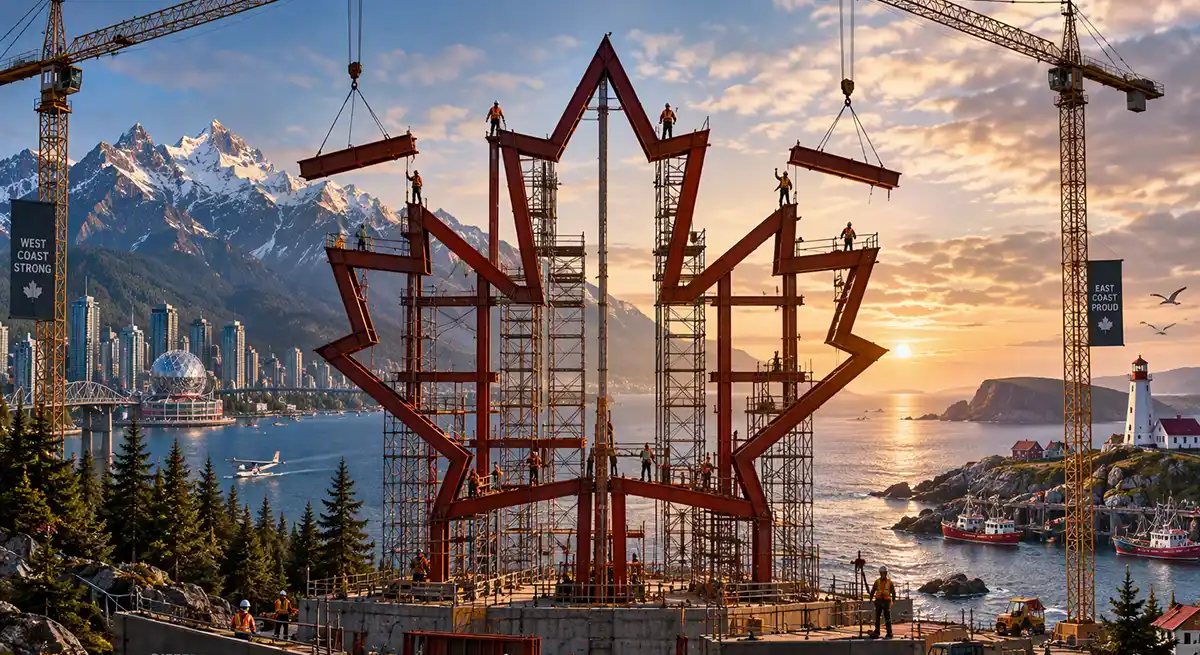
Photo: CoPilot